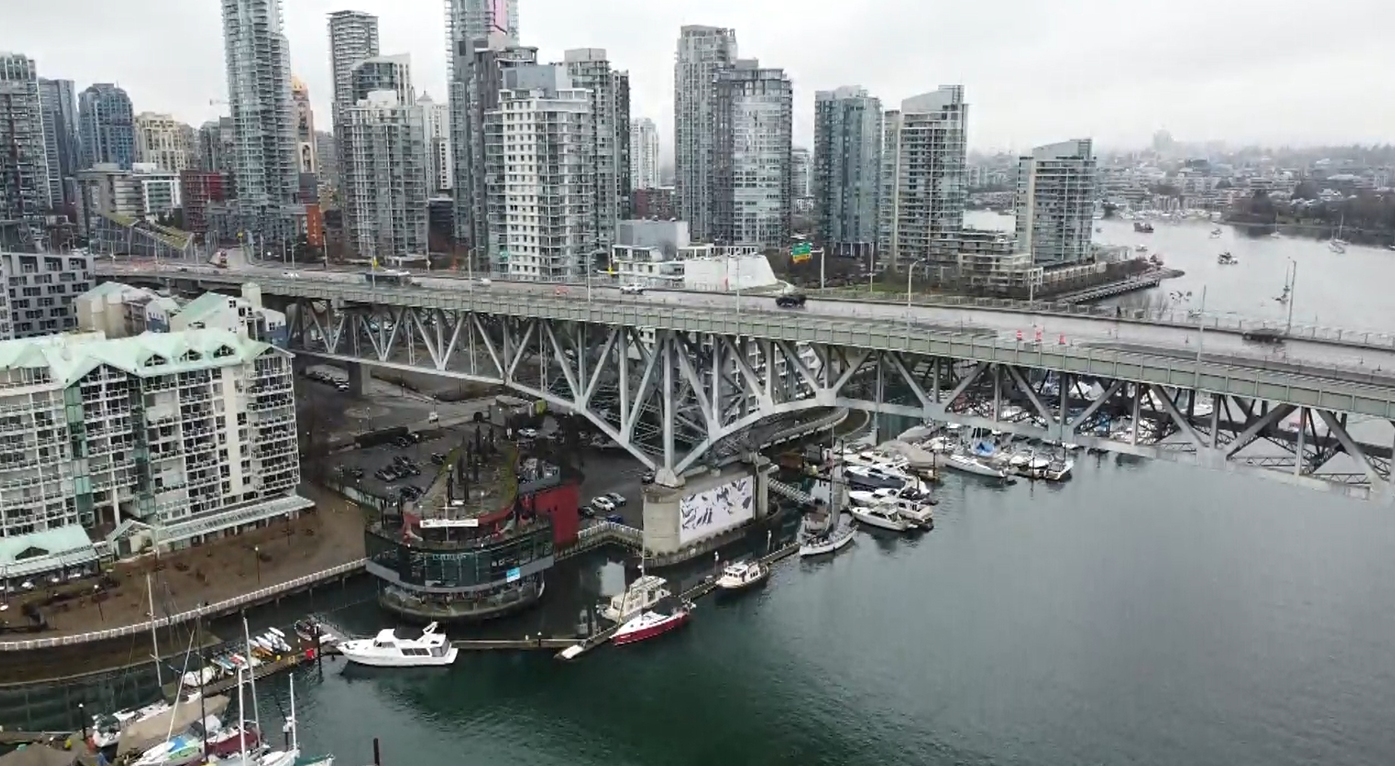
Vancouver is often called one of the most beautiful cities on earth, but for many, that beauty is shadowed by a long-standing failure in public safety. While the city spends millions on bike lanes and aesthetic upgrades, the Granville Street Bridge remains a glaring gap in our mental health infrastructure. It’s not just an engineering oversight. It’s a choice. Advocates have spent years shouting into the wind about the need for suicide barriers on this specific span, and the city’s slow response is costing lives.
If you’re struggling right now, please know there's support available. You can call or text 9-8-8 anytime in Canada to reach the Suicide Crisis Helpline. It’s free, confidential, and available 24/7. You don't have to carry this alone.
The lethal gap in Vancouver bridge safety
Vancouver has three major bridges connecting the downtown core to the rest of the city: the Burrard, the Cambie, and the Granville. If you walk across the Burrard Street Bridge, you'll see high, curved fencing. Those barriers weren't there by accident. They were installed because the data showed that when you restrict access to lethal means, people don't just "go somewhere else." They often don't attempt at all.
The Granville Street Bridge is the outlier. It’s a massive, multi-lane concrete structure with low railings that offer almost no protection. It’s accessible, it’s high, and it’s dangerous. For decades, the BC Coroners Service and various health authorities have pointed to bridge barriers as one of the most effective ways to prevent suicide. Yet, while the Burrard and Ironworkers Memorial bridges received upgrades, the Granville Street Bridge was left behind.
Why bridge barriers actually work
A common myth suggests that if someone is determined to end their life, a fence won't stop them. They'll just find another bridge, right?
Wrong.
Decades of global research prove that "means restriction" is the single most effective tool in the suicide prevention shed. Suicidal crises are often incredibly brief. They’re impulsive. If you can create a delay—even a few minutes of friction—that window of acute crisis can pass. The Harvard T.H. Chan School of Public Health has documented this extensively. Most people who are prevented from an attempt at a specific site do not go on to die by suicide later. They get help. They recover. They live.
By failing to install barriers on the Granville Street Bridge, the city is essentially leaving a door wide open during a house fire. We know the solution. We’ve seen it work on the Golden Gate Bridge in San Francisco and the Bloor Viaduct in Toronto. Toronto’s "Luminous Veil" barrier on the Bloor Viaduct virtually eliminated suicides at that location. The evidence isn't just strong; it’s undeniable.
The cost of delay is measured in lives
Critics often point to the cost of these installations. They talk about "heritage sightlines" or "architectural integrity." Honestly, it’s frustrating to hear those arguments when we’re talking about human life. The Granville Street Bridge is currently undergoing massive structural and functional upgrades. The city is spending $50 million on the "Granville Connector" project to make the bridge more friendly for pedestrians and cyclists.
This was the perfect time to integrate permanent, effective suicide barriers. While the project includes some improved fencing and "means restriction" elements, advocates argue it doesn't go far enough to match the gold standard seen on other spans. We’re already tearing up the concrete. We’re already moving the lanes. Not finishing the job with robust, full-height barriers is a massive missed opportunity.
What advocates are saying
Organizations like the BC Northern Lights and various local mental health experts haven't been quiet. They've been presenting data to City Council for years. They point out that bridge suicides aren't just tragedies for the individuals and their families. They’re also deeply traumatic for the first responders, the transit workers, and the witnesses who happen to be there.
The trauma ripples through the community. Every time a bridge is closed for a "police incident," it represents a failure of our urban design to protect its most vulnerable citizens. We wouldn't build a high-rise without balcony railings. We wouldn't build a highway without median dividers. Why do we treat bridge safety as an optional "add-on"?
A better path forward for Vancouver
Vancouver likes to think of itself as a world-class city. World-class cities prioritize the safety of their residents over aesthetic preferences. The Granville Street Bridge needs more than just a "pedestrian friendly" makeover. It needs to be a place where a moment of despair doesn't turn into a final act.
If you want to see change, it starts with pressure.
- Contact the City Council: Let them know that suicide barriers on the Granville Street Bridge should be a non-negotiable part of the current renovations.
- Support local mental health orgs: Groups like the Crisis Centre of BC provide the immediate support that bridges the gap when physical barriers aren't there.
- Talk about it: Breaking the silence around bridge safety helps strip away the stigma. It makes it harder for politicians to ignore the "uncomfortable" data.
The Granville Street Bridge doesn't have to be a place of tragedy. With the right engineering and a bit of political will, it can just be a way to get from one side of the city to the other. Let's make sure everyone makes it across.
If you or someone you know is in crisis, reach out. Help is a phone call away.
Resources:
- Canada Suicide Crisis Helpline: Call or text 9-8-8
- BC Crisis Line: 1-800-SUICIDE (1-800-784-2433)
- Hope for Wellness (Indigenous support): 1-855-242-3310