Western meteorological systems are failing the developing world. For decades, rich nations have built expensive, data-heavy weather models that work beautifully if you have supercomputers and fiber-optic internet. If you are running a weather office in Djibouti or a rural province in Pakistan, those systems are practically useless. You cannot download gigabytes of raw satellite data over a spotty connection, let alone process it before a flash flood hits.
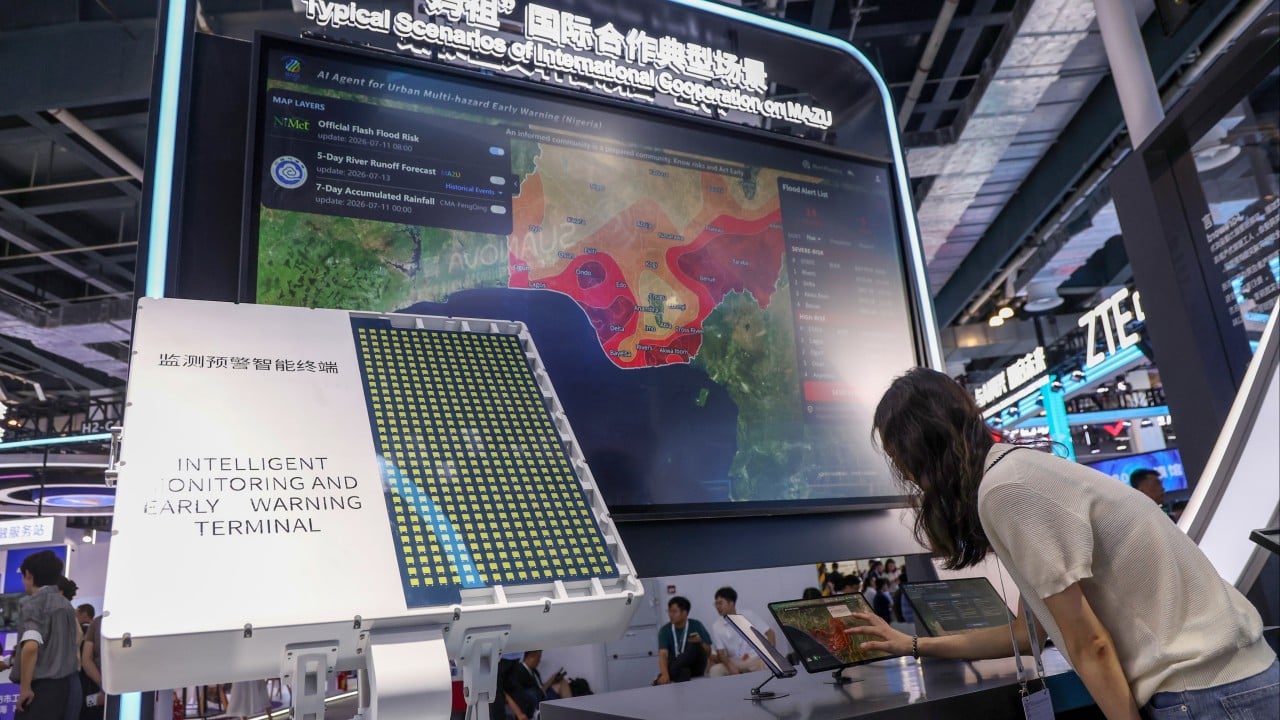
China noticed this massive gap and stepped in with a different strategy. At the World Artificial Intelligence Conference in Shanghai, the Chinese government turned its domestic weather tool, MAZU, into a major diplomatic export. They plan to roll out this system to 30 countries within five years.
This isn't just about sharing weather updates. China is exporting an entire tech stack that combines its Fengyun satellites, localized artificial intelligence models, and ground radar into a single package. For the Global South, this shifts the balance of power in climate survival.
The Broken System of Global Weather Forecasting
Traditional weather forecasting relies on massive computational power. European and American agencies run complex physics-based models that require millions of dollars in infrastructure to operate and interpret. They generate great forecasts for North America and Europe. But when it comes to predicting a sudden monsoon in South Asia or an intense heatwave in the Horn of Africa, the resolution drops significantly.
Developing nations often find themselves data-rich but processing-poor. They can access free global satellite feeds, but they lack the local servers needed to turn that raw data into an actual warning. By the time a local agency downloads and analyzes the data, the storm has already arrived.
MAZU changes that dynamic by shifting the heavy lifting to the edge. The acronym stands for Multi-hazard, Alert, Zero-gap, and Universal. It also pays homage to the ancient Chinese sea goddess who protects sailors. The name tells you exactly what China wants this to be: a reliable shield for vulnerable nations that the West has largely ignored.
How the Hardware and AI Integration Works
Most people think weather forecasting is just about looking at satellite images. It's actually a massive data integration problem. MAZU works by fusing three distinct layers of technology into a single interface that does not require massive local servers.
Space-Based Observation via Fengyun Satellites
China's Fengyun satellite network constantly tracks cloud bands, water vapor, and convective storms across the globe. Instead of forcing foreign meteorological offices to pull this data from distant cloud servers, China delivers it directly through dedicated broadcast systems like CMACast or localized satellite dishes.
Localized AI Inference
Instead of running heavy physics equations that simulate the entire atmosphere, MAZU uses deep learning models trained on decades of global weather data. These models recognize patterns instantly. An AI model can predict where a storm will intensify in seconds, using a fraction of the computing power required by traditional methods.
The Ground Radar Connection
The system doesn't just look down from space. It integrates with local ground-based radar and weather stations to patch up blind spots. This creates a tight loop between global satellite views and hyper-local ground truth.
To make this practical for countries with terrible internet infrastructure, China launched the MAZU-FengYun Satellite AI Box. This is a physical piece of hardware packed with integrated software. It uses edge computing to process satellite feeds right inside the local weather station. Forecasters don't need a stable internet connection to the outside world; the box receives the satellite signal and runs the AI models locally on its own chips.
Real World Testing From Djibouti to Pakistan
This isn't just a theoretical project. The system is already active on the ground, and the results show why developing nations are signing up.
Djibouti is one of the most climate-vulnerable places on Earth, facing intense heatwaves and sudden destructive flash floods. In 2025, China deployed the first version of the MAZU agent in the country to help manage urban hazards. During the Shanghai conference, they upgraded them to version 2.0.
The upgrade tells the real story of how fast this technology is moving. The forecast resolution sharpened from nine kilometers down to three kilometers. The local team can now see weather shifts up to three days in advance, with the system refreshing its predictions every six hours. It provides tailored alerts for the country's ports and airports, which are vital to its economy.
Pakistan offers another clear example of why localized AI matters. The Pakistan Meteorological Department worked with Chinese teams to tune the system specifically for the South Asian monsoon season. Traditional global models often miss the hyper-local cloudbursts that trigger devastating glacial lake outburst floods in northern Pakistan. By training the MAZU AI on the specific topography and historical patterns of the Indus River basin, local forecasters can now track flash flood risks in real time. Meteorologists can log into the cloud platform from anywhere in the country to check live risk maps, which keeps them operational even if their main office loses power.
In Mongolia, the system was customized to track freezing winter blizzards and intense dust storms. In Jordan, the focus shifted to drought monitoring and sudden cold spells. Every deployment looks different because the AI learns from the specific local hazards of the country operating it.
The Geopolitics of Humanitarian Tech
Let's be direct about the politics here. China is positioning MAZU as a global public good to meet the United Nations' Early Warnings for All initiative. The UN wants every person on Earth protected by early warning systems, and Western nations have been slow to fund the necessary infrastructure in poorer regions.
By donating hardware like the Satellite AI Box and setting up joint research facilities, such as the new bilateral AI forecasting laboratory launched with Thailand, Beijing is building deep institutional dependencies. When a country relies on Chinese satellites, Chinese edge-computing hardware, and Chinese trained AI models to keep its citizens safe from disasters, that country forms a long-term bond with Beijing.
Western critics often look at these initiatives through the lens of surveillance or soft power, but they miss the practical reality. If you're a government official in an underfunded tropical country, you don't care about geopolitical rivalry. You care that your citizens are dying in floods because you can't afford a multi-million-dollar supercomputer cluster to run Western weather models. China is offering a working solution that runs on a plug-and-play box.
Practical Steps for Meteorological Agencies Exploring AI
If you operate a regional weather office or work in disaster management within the Global South, relying purely on legacy global models is a massive risk. You need to transition toward hybrid systems that use machine learning to maximize your existing data.
First, audit your local data collection infrastructure. AI models are only as good as the local data used to tune them. Ensure your ground stations are recording clean, consistent temperature, pressure, and humidity metrics.
Second, look into edge computing solutions. Do not rely on cloud-heavy systems that require constant, high-bandwidth international internet connections. Look for platforms that allow you to download trained model weights once and run the inference locally on dedicated hardware chips.
Third, focus on multi-hazard integration. A weather forecast is useless if it doesn't translate into actionable alerts. Your systems must connect meteorological predictions directly to population density maps, emergency shelter routes, and automated SMS alert systems. This is where the old way of doing things falls short, and it's exactly where intelligent automated agents are proving their actual value.
Get your team trained on data science basics. The future of weather forecasting isn't just about reading charts; it's about managing localized data pipelines that feed into intelligent prediction engines. China has already trained nearly a thousand specialists from over a hundred countries since 2024. The shift toward AI-driven disaster prevention is happening right now, and the countries that adapt the fastest will save the most lives.

