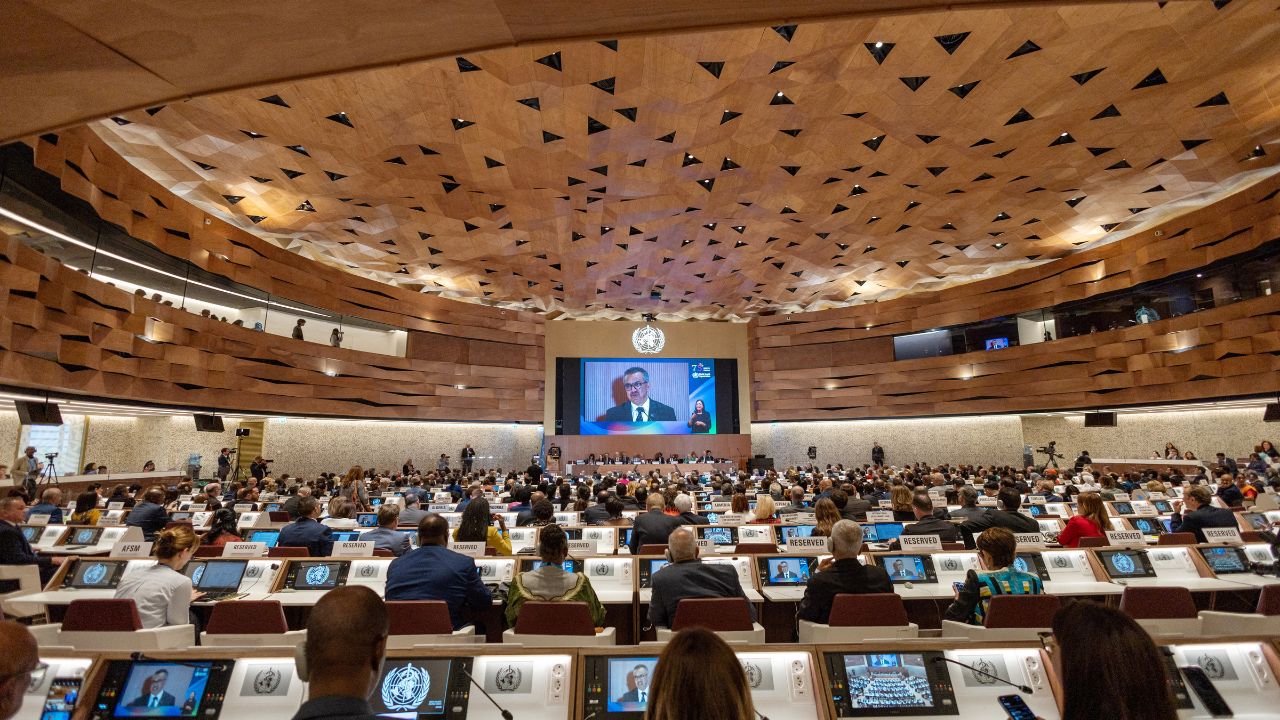
The World Health Assembly (WHA) convenes in Geneva this month under a familiar, darkening shadow. For the eighth consecutive year, Taiwan remains locked out of the world’s most important health summit because Beijing has effectively vetoed its invitation. This is not merely a diplomatic spat or a technicality of international law. It is a calculated removal of 23.5 million people from the global medical grid. When a virus mutates in a Taipei suburb or a breakthrough in oncology occurs at a laboratory in Hsinchu, the current system forces that information to travel through a political filter rather than a direct pipeline. This delay costs lives.
Beijing justifies this blockade by citing the "One China" principle, asserting that Taiwan is a province and therefore has no right to independent representation in UN-affiliated bodies. For observers in Washington, Tokyo, and Brussels, the argument rings hollow against the backdrop of a post-pandemic world that learned—at an unfathomable price—that pathogens do not check passports. The exclusion of Taiwan from the World Health Organization (WHO) creates a "blind spot" in global biosurveillance. If the goal of the WHO is "Health for All," the continued marginalization of a major regional transport hub and medical innovator reveals a massive structural failure.
The High Cost of the Taiwan Vacuum
Global health security is only as strong as its weakest link. Because Taiwan sits at a geographic crossroads in East Asia, it serves as a primary transit point for millions of travelers every year. By denying Taiwan direct, real-time access to the WHO’s Global Outbreak Alert and Response Network (GOARN), the international community is choosing to fly partially blind.
During the initial weeks of the COVID-19 pandemic, Taiwan was among the first to raise alarms regarding human-to-human transmission. Yet, because of its status, those warnings were not disseminated through official WHO channels with the urgency they deserved. Instead, the global body waited for data from sources that were, at the time, prioritizing political optics over clinical reality. This lag was not a mistake of science. It was a mistake of bureaucracy.
The fallout is not limited to pandemics. Taiwan is a global leader in universal healthcare and medical technology. Its National Health Insurance database is one of the most comprehensive in existence, providing a goldmine for longitudinal studies on disease and treatment efficacy. By barring Taiwanese experts from technical briefings and working groups, the WHO is essentially refusing to accept a massive donation of data and expertise. We are watching the world’s leading health organization reject a vital organ while the patient is still on the table.
The Mechanism of Exclusion
The technical barrier used to keep Taiwan out is the lack of an invitation from the WHO Director-General. From 2009 to 2016, Taiwan attended the WHA as an observer under the name "Chinese Taipei." This arrangement was possible only because the administration in Taipei at the time maintained a "1992 Consensus" with Beijing. When the political leadership in Taiwan changed, the invitation disappeared.
This proves that Taiwan's participation is being treated as a reward for political compliance rather than a necessity for public health. The WHO Secretariat often claims that it is bound by the decisions of its member states, specifically UN Resolution 2758. However, a closer reading of that 1971 resolution shows it addressed the representation of China, not the exclusion of the Taiwanese people from technical health cooperation. Legal scholars have argued for years that the WHO has the internal authority to grant observer status without a full vote of the assembly, yet the leadership remains paralyzed by the threat of losing funding or cooperation from its second-largest economy.
The Strategic Shift in Western Support
In recent years, the tone from G7 nations has shifted from quiet frustration to open defiance. The United States, the United Kingdom, Japan, and several EU nations now routinely issue joint statements calling for Taiwan’s "meaningful participation" in the WHA. They recognize that the status quo is no longer tenable in an era of rapid-fire zoonotic spillover.
These nations are not just being polite; they are acting out of self-interest. They want access to Taiwan’s early-warning systems. They want their scientists to sit across the table from Taiwanese epidemiologists who have successfully managed multiple avian flu threats. The current workaround—where Taiwanese experts are occasionally allowed to join meetings as individuals rather than representatives—is an insult to the professional caliber of their medical community. It creates a secondary class of membership that hinders the flow of information.
The Innovation Penalty
Beyond infectious disease, Taiwan’s exclusion impacts the development of international standards for medical devices and pharmaceuticals. As a major manufacturer of semiconductors and high-end medical equipment, Taiwan’s inability to contribute to the WHO’s regulatory harmonization efforts creates friction in the global supply chain. When standards are set without the input of a primary producer, the resulting inefficiencies drive up costs for healthcare providers everywhere.
A Fragmented Response Network
We are currently seeing a move toward "minilateralism," where countries bypass the UN system to form smaller, more functional health alliances. The U.S. and Taiwan have signed memorandums of understanding on health cooperation, effectively building a "shadow WHO" network to ensure that data continues to flow. While these bilateral agreements are useful, they are a poor substitute for a centralized, global system. They lead to a fragmented global health architecture where information is siloed and response times are inconsistent.
The Diplomacy of Health
Beijing’s strategy is clear: isolate Taiwan until it has no choice but to accept a political union on Beijing's terms. Using the WHO as a tool for this isolation is a violation of the spirit of the organization’s constitution. The "health of all peoples is fundamental to the attainment of peace and security," the document states. By allowing political sovereignty disputes to dictate who gets a seat at the table, the WHO is signaling that its founding principles are negotiable.
This sets a dangerous precedent. If one member state can veto the participation of a significant population center based on a territorial claim, what stops other nations from doing the same? The politicization of the WHA threatens to turn a technical body into another theater for the Cold War 2.0, where medical data is traded like currency and cooperation is a weapon of statecraft.
Reality on the Ground
Inside Taiwan’s hospitals, the work continues regardless of the vote in Geneva. Their doctors are treating patients, their researchers are sequencing genomes, and their public health officials are monitoring borders. They are doing everything a responsible member of the global community should do, while being treated as a pariah by the very institutions meant to protect them.
The 23.5 million people in Taiwan pay taxes, travel internationally, and contribute to the global economy. They are not a "problem" to be solved by diplomats; they are a vital part of the human collective. To pretend they do not exist for the sake of a smooth meeting in Switzerland is a form of collective delusion that makes the entire world less safe.
The international community needs to stop asking for permission to include Taiwan and start demanding it. This involves more than just signing a letter once a year before the WHA starts. It requires a sustained, coordinated effort to reform the WHO’s internal rules regarding observer status. It requires making it clear that health data is a global public good that should never be subject to a territorial veto.
The next pandemic will not wait for the UN to resolve the cross-strait dilemma. It will not care about the wording of Resolution 2758. It will move through the cracks in our fragmented system, thriving in the silence created by political exclusion. We have been warned, and the cost of ignoring that warning is written in the history of the last five years.
Directly confront the reality of the situation: the WHO cannot claim to lead global health while it deliberately leaves 23 million people in a data vacuum.