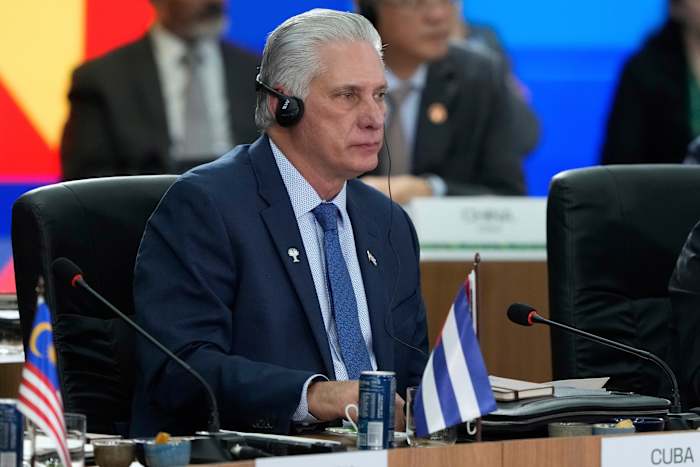
The air in a secure briefing room doesn't circulate like the air in a living room. It feels heavy, filtered, and stripped of scent, as if the very molecules are being monitored for dissent. When a high-ranking intelligence official stands before a row of microphones, they aren't just reading from a teleprompter. They are translating a thousand invisible whispers into a language the public can digest without panicking.
Tulsi Gabbard, now standing at the helm of the American intelligence apparatus, recently spoke a name that carries a specific, metallic weight: Pakistan.
To many, Pakistan is a spot on a map or a headline about cricket and mountain ranges. To those who sit in the windowless rooms of Langley or the Pentagon, it is something else entirely. It is a puzzle where the pieces are made of plutonium and the board is constantly shaking. Gabbard’s assessment wasn’t just a bureaucratic update. It was a recognition of a terrifying math.
Consider a hypothetical technician named Omar. He doesn't exist in the records, but his life represents the reality of thousands. Omar works in a facility where the silence is absolute. He wears a badge that monitors radiation exposure. Every day, he handles components that, if triggered, could erase a city from the face of the earth. He is a patriot. He loves his family. But Omar lives in a country where the ground is rarely still. Political shifts happen not in decades, but in afternoons.
The fear isn't that Pakistan is an "enemy" in the traditional, cinematic sense. The fear is about the custody of the spark.
The Architecture of Anxiety
Nuclear weapons are often discussed as if they are static objects, like trophies on a shelf. They are not. They are ecosystems. To maintain a nuclear arsenal, a nation needs a stable government, a loyal military, a secure power grid, and an unfailing chain of command. When any of those pillars crack, the "threat" shifts from intentional use to accidental loss.
The Intelligence Community tracks these cracks. They look at the influence of radical elements within a complex bureaucracy. They watch the borders. They calculate the distance between a storage site and a localized insurgency.
Gabbard’s warning centers on the intersection of capability and instability. Pakistan possesses a sophisticated, rapidly growing arsenal. At the same time, its internal politics are a hurricane of competing interests. Imagine a high-performance sports car being driven through a riot. The car is magnificent technology, but the environment makes it a liability.
The Invisible Physics
To understand why this keeps planners awake at 3:00 AM, we have to look at the physics of the region. This isn't just about the United States; it’s about the neighbors.
The relationship between Pakistan and India is often described as a "cold peace." In reality, it is a hair-trigger balance. In most nuclear doctrines, there are layers of "failsafes"—steps that must be taken before a launch is even considered. But when two nuclear powers share a border, the flight time of a missile is measured in minutes.
There is no time for a phone call. There is no time for a second opinion.
If a sensor glitches or a rogue commander makes a move, the entire world enters a countdown that cannot be paused. This is the "nuclear threat" Gabbard is referencing. It isn't just about a premeditated strike on Washington D.C. It’s about the chaos of a localized conflict cascading into a global catastrophe because someone, somewhere, lost control of the keys for sixty seconds.
The Human Cost of the Deterrent
We often talk about "deterrence" as a grand strategy, but for the people living in the shadow of these silos, it is a psychological tax.
Think about the children in Islamabad or New Delhi. They grow up in the glow of this reality. They know that their peace is predicated on the idea that both sides are too afraid to move. It is a peace built on terror. When the Director of National Intelligence labels a nation a "major threat," it ripples through the lives of these people. It affects investment, travel, and the way the world views their very identity.
The tragedy of the situation is that the weapons were built to ensure security. Yet, the more they build, the more insecure the world feels. It is a paradox of iron and fire.
The Shadow of the Black Market
There is another ghost in the room: proliferation.
History remembers A.Q. Khan, the man who turned nuclear secrets into a commodity. While that specific network was dismantled years ago, the blueprint remains. The intelligence concern today isn't just about the state of Pakistan, but about the "non-state actors."
What happens if the economic pressure becomes too much? What happens if a desperate official decides that a piece of technology is worth more than a secret?
These are the "invisible stakes." We aren't just tracking missiles; we are tracking human temptation and human desperation. Gabbard’s role is to look at the world not as it should be, but as it is—messy, fractured, and dangerous.
The Weight of the Badge
Speaking these truths out loud is a gamble. If the U.S. leans too hard, it risks alienating a necessary ally. If it stays silent, it risks being caught unprepared.
The intelligence chief isn't just an observer. They are a gatekeeper of reality. When she points to Pakistan, she is telling the American public that the era of focusing solely on "traditional" superpowers is over. The threats of the future are decentralized. They are found in the gaps between governance and weaponry.
The briefing room eventually clears. The microphones are turned off. The heavy, filtered air remains. Somewhere, thousands of miles away, a technician like Omar finishes his shift. He looks at the stars and wonders if the world knows how hard he works to keep the silence. He is the human element in a story written in radiation and steel.
The glimmer in the dark isn't always a light of hope. Sometimes, it is the reflection of a world holding its breath, waiting to see who will blink first in a staring contest that has lasted for generations. We live in the space between the warning and the event, hoping the watchers never have to say, "I told you so."
The sun sets over the Indus River, casting long, jagged shadows across the landscape. In the quiet of the evening, the machinery of the state continues its low, vibrating hum. It is a sound that most people ignore, until the day it stops.
Or until the day it grows too loud to ignore.