Some people build houses out of ambition. They stack brick upon heavy brick to impress the neighbors, to catch the afternoon light just right, to leave a monument that shouts into the future.
Hank Deverell did not build for the future. He built for a shelf.
In 1973, in the quiet expanse of Ontario, Hank looked at his wife, Mary, and the miniature inhabitants of her world. Mary Deverell was a collector of tiny things—porcelain dolls, delicate miniatures, figures so small they could easily be lost in the creases of a pocket or swept away by a careless breeze. They sat crammed inside standard display cabinets, hidden behind heavy wooden frames and dim glass, prisoners of a hobby that deserved better than shadows.
Hank was a high school teacher. He spent his days parsing grammar, correcting essays, and trying to make teenagers care about things that mattered. But with his hands, he understood geometry, patience, and the profound weight of small details.
He didn't buy a display case. He built a building.
The Architecture of Devotion
Imagine the yard in Ontario. The wind off the lakes has a bite to it, even in the gentler months, and winter there is a prolonged exercise in endurance. Yet Hank spent his spare hours constructing something entirely absurd, entirely beautiful, and entirely devoted to affection.
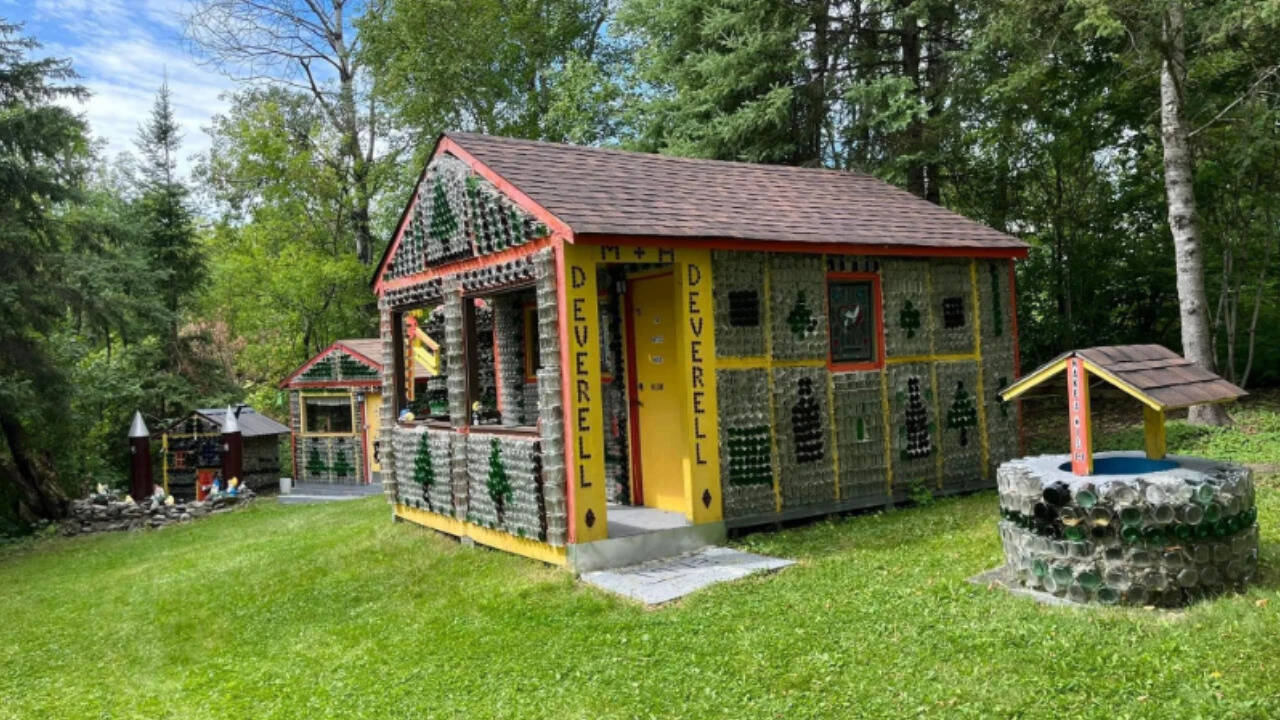
He began collecting bottles. Not just any bottles—thousands of glass containers, salvaged from local restaurants, bars, and neighbors who soon realized what the local schoolteacher was up to. Beer bottles, medicine bottles, old pop bottles. Green glass, amber glass, clear flint glass.
People watched him stack them. They probably shook their heads. In a small town, a man building a house out of trash is either eccentric or lost. But Hank knew what he was doing. He was mixing mortar—tons of it—and laying those bottles neck-to-bottom, row by row, creating thick, luminous walls that would catch the sun and turn it into stained glass.
It took thousands of bottles. It took months of labor, aching joints, mortar-stained fingers, and the quiet, rhythmic focus of a man who found peace in physical work.
When it was finished, it wasn't just a bottle house. It was a cathedral of light.
Why We Build Small Things in a Large World
We live in an era obsessed with scale. Bigger houses, faster processors, wider lenses, grander gestures broadcasted to millions of strangers who will forget us by tomorrow. We equate size with significance.
Hank Deverell understood the opposite truth. Significance lives in the micro.
Consider what Mary’s dolls represented. They were tiny people frozen in mid-gesture, wearing hand-sewn dresses, holding teacups the size of a ladybug. They were vulnerable. To leave them unprotected in a standard cabinet is to treat them as mere objects. To house them in a structure made of thousands of hand-laid glass bottles is an act of fierce preservation.
He was telling his wife: Your joy matters.
Not in a abstract, polite-dinner-party way, but in a three-ton, mortar-and-glass reality. He took the discarded refuse of daily consumption—beer bottles and medicine vials—and transformed them into a permanent sanctuary for porcelain miniatures.
The Physics of Translucence
When the sun hit the Ontario bottle house in the summer of 1973, the interior did not just illuminate; it transformed.
Light is a stubborn thing. It hits solid walls and stops, creating shadows and darkness. But when light passes through curved green and amber glass, it bends. It shatters into a million warm fragments. It pools on the wooden floors like liquid honey.
Inside that small structure, Mary’s dolls didn't just sit in the light; they lived in it. The ambient glow wrapped around their porcelain faces, giving the illusion of breath, of warmth, of a world quietly turning inside our own.
Hank didn't engineer this with a computer algorithm. He guessed, he experimented, he laid mortar thick enough to hold the weight, and he trusted the sun to do the rest. That is the essence of true craftsmanship. It is an honest dialogue between human sweat and natural law.
What Remains
Decades have passed since Hank mixed that final batch of mortar. Ontario has shifted, seasons have rolled over the Canadian shield, and the frantic pace of modern life has accelerated past anything Hank could have imagined from his classroom desk.
Yet the bottle house remains an enduring ghost of a quieter kind of love.
We search for hacks to make our relationships last. We read books on communication, schedule date nights, buy expensive gifts to bridge the distance carved out by work and screens. We look for grand strategies.
Hank Deverell’s strategy was simpler. He got his hands dirty. He collected trash and turned it into light. He looked at what his wife loved, and instead of nodding and smiling from the comfort of his armchair, he stood up, picked up a trowel, and built a world around it.
The dolls are quiet now. The bottles still catch the sun.
And somewhere in the quiet spaces of history, a teacher’s calloused hands remind us that the most profound thing a person can do with their time on earth is to make a safe, luminous space for someone else's joy.