The air inside MetLife Stadium smelled of stale beer, expensive cologne, and the sharp, metallic tang of hyper-vigilance. Outside the glass, eighty thousand people were screaming. A swirling vortex of human emotion, painted in the vivid jerseys of two nations, singing themselves hoarse under the New Jersey sky. They were cold, they were ecstatic, they were entirely alive.
But inside the luxury suite, the world was perfectly silent.
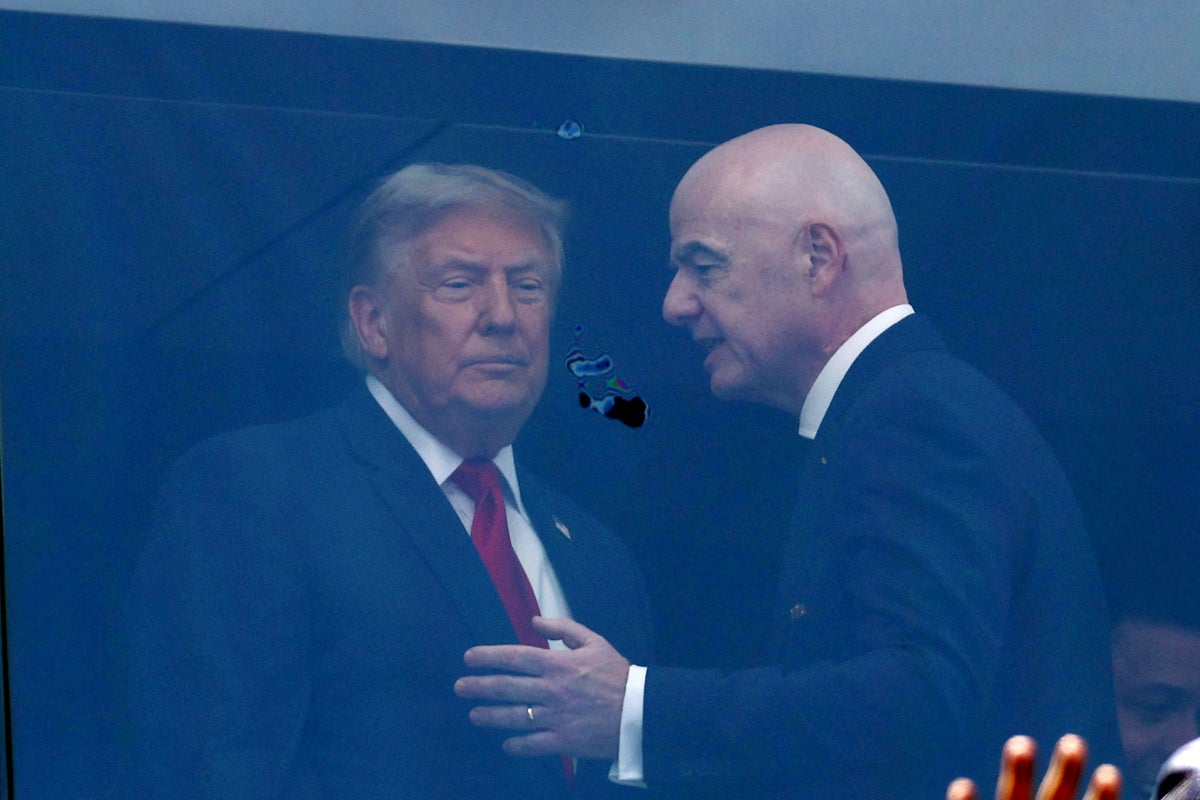
Soundproofing at this level doesn’t just block noise; it suffocates it. The roar of the World Cup final—the culmination of years of global anticipation, heartbreak, and triumph—was reduced to a muted, rhythmic vibration beneath the soles of expensive shoes. Behind a reinforced sheet of protective glass sat Donald Trump, his wife Melania, and Gianni Infantino, the president of FIFA.
Between them rested the trophy.
It is a solid gold weight of five kilograms, depicting two human figures holding up the Earth. It is arguably the most recognized symbol of meritocracy on the planet. To touch it, you are supposed to have bled for it. You are supposed to have run until your lungs burned, wept on the pitch, and survived the brutal, beautiful lottery of international football.
Donald Trump looked at the gold. He reached out a hand and patted it. Twice. A brief, casual gesture, like a man wishing a lucky dog well at a racetrack.
In that singular moment, the entire drama of modern power, spectacle, and human isolation was laid bare.
The Architecture of Separation
To understand what happened in that suite, you have to understand the glass.
Security in the modern era is no longer just about men with earpieces and serious expressions. It is architectural. The suite was a literal cage of safety, designed to ensure that the unpredictability of eighty thousand ordinary citizens could never breach the perimeter of the powerful.
Consider the contrast. On the pitch below, twenty-two men were exposing themselves to total vulnerability. They were risking public failure, physical injury, and the crushing weight of a nation’s expectations. Their sweat was real. Their agony was real. They were entirely exposed to the elements and the judgment of the world.
A few hundred feet above them, the spectators in the glass box lived in a different reality.
The glass creates a strange psychological distortion. It allows you to watch humanity without having to breathe the same air. It turns a visceral, thumping human ritual into a television broadcast, even when you are physically in the stadium. For a politician whose entire brand is built on the adoration of the crowd, the glass box is both a sanctuary and a prison. You can see the people cheering, but you can’t feel the wind of their voices.
Melania Trump sat beside him, an elegant study in calculated detachment. Her posture, as always, was a shield. While the stadium vibrated with the chaotic energy of a world united by a ball, the occupants of the suite maintained the rigid decorum of a corporate boardroom.
The Currency of Luck
Why pat the trophy?
It wasn't his to win. He hadn’t spent his youth running drills in the rain or enduring the agonizing politics of a national team selection. Yet, the impulse to touch it, to claim a piece of its mystique, is deeply human. We all seek proximity to greatness. We buy the jerseys of men half our age; we collect autographs; we stand in line for hours just to glimpse a passing motorcade.
But when a billionaire politician pats the World Cup trophy, the symbolism shifts.
It becomes an interaction between two different kinds of power. On one hand, you have FIFA, an organization that governs a sport with more member states than the United Nations. Infantino sat there as the gatekeeper of this secular religion, smiling the practiced smile of a diplomat who thrives in the company of titans. On the other hand, you have the political heavyweight, a man who views the world through the lens of deals, leverage, and optics.
The pat was not a gesture of reverence. It was a gesture of ownership. It was the way a landlord taps a brick wall to check its solidity.
It was a striking display of behavioral irony. The World Cup is a tournament where luck is despised. Teams spend decades engineering the luck out of the game through rigorous sports science, psychological conditioning, and tactical perfection. To the players on the field, relying on luck is an admission of failure. But to the man behind the glass, luck is a fickle deity to be courted, flattered, and patted on the head before the next big gamble.
The Quiet Crisis of the Spectacle
There is something profoundly isolating about watching the world from behind bulletproof glass.
The human brain evolved to synchronize with the tribe. When thousands of people scream in unison, our cortisol drops, our oxytocin spikes, and we experience a rare, ego-dissolving connection to something larger than ourselves. It is the closest thing modern secular society has to a transcendent experience.
The people in the cheap seats had that. They were freezing, their feet hurt, and they had paid entirely too much for domestic beer, but they were bound together in a collective, electric consciousness.
The occupants of the suite were denied that connection by the very mechanism that kept them safe.
They sat in a climate-controlled vacuum, watching the spectacle unfold like a silent movie. Infantino would occasionally lean over, offering a piece of whispered commentary, pointing toward the pitch like a museum curator explaining a canvas to a prestigious patron. Trump would nod, his eyes tracking the movement below, a man accustomed to being the center of attention suddenly reduced to a passive observer of someone else's triumph.
This is the hidden tax of extreme prominence. The higher you ascend, the thicker the glass becomes. Eventually, you find yourself in a room where even the most explosive human joy feels like a distant hum.
The Final Whistle
As the match reached its fever pitch, the tension in the stadium became almost unbearable. Voices cracked. Strangers gripped each other’s shoulders. The collective anxiety of millions of people hung over the field like a physical weight.
Inside the suite, the golden statue remained still, reflecting the soft, ambient lighting of the luxury box.
When the final whistle blew and the stadium erupted into a chaotic symphony of fireworks and tears, the man behind the glass watched the celebration begin. He had touched the gold. He had patted the luck. But as the players fell to their knees on the grass below, lost in a joy that cannot be bought, negotiated, or inherited, the absolute silence inside the glass box felt less like security, and more like an exile from the world.