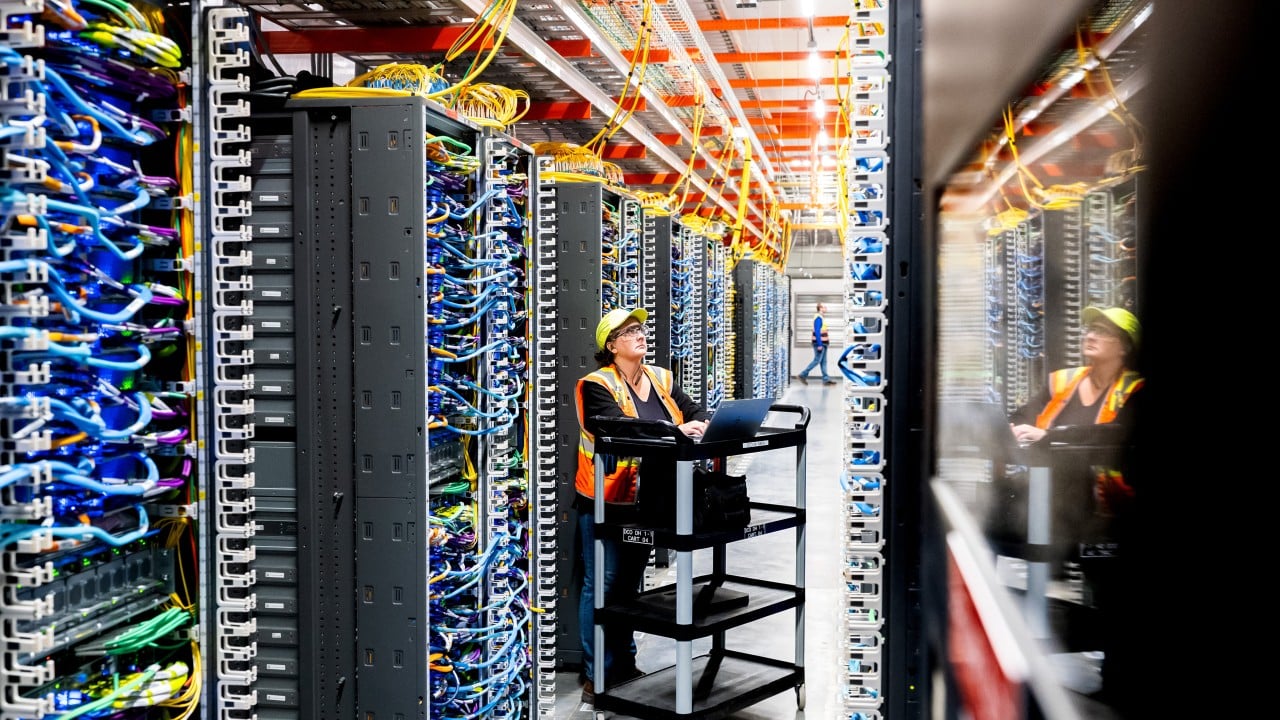
The servers do not hum. They scream.
Walk into a modern high-density data center at midnight, and you will hear a wall of sound so violent it requires heavy-duty hearing protection. It is the roar of millions of tiny fans fighting desperately against thermal death, cooling racks of silicon chips that consume more electricity than a small town. For years, the story of artificial intelligence has been told through the lens of these behemoths. We looked at the trillion-dollar companies hoarding proprietary models behind locked doors, guarded by API keys and subscription paywalls, and we assumed that was the only way forward. For a different view, consider: this related article.
We were wrong.
Far from the neon glow of Silicon Valley, a quiet counter-revolution is taking shape. A Hong Kong-based firm is placing a staggering bet—not on building another closed, proprietary fortress, but on Chinese open-weight models. Their ambition? To build a titan capable of looking CoreWeave in the eye and saying, We are here. Further insight on this trend has been published by TechCrunch.
To understand why this matters, you have to look past the stock tickers and the venture capital memos. You have to look at the metal.
The Architecture of Scarcity
Imagine standing in a warehouse floor filled with empty metal racks. You have the capital, you have the ambition, but you do not have the silicon.
For the past three years, the global artificial intelligence boom has been choked by a single, terrifying bottleneck: the graphics processing unit. Specifically, the high-end chips manufactured by a single company in Taiwan. If you wanted to train frontier models, you had to genuflect at the altar of proprietary infrastructure. Companies like CoreWeave built multi-billion-dollar empires by buying up these scarce resources early, renting out computational horsepower at astronomical rates to startups desperate for a seat at the table.
It was a classic gold rush. But instead of shovels, the currency was floating-point operations per second.
Then came the hardware restrictions. Geopolitical friction threw iron curtains across supply chains. The chips that power the Western AI miracle suddenly became contraband in other parts of the world. For many, this looked like an extinction event. If you cannot buy the Western gold, how do you mine?
The answer came not from surrender, but from an entirely different philosophy of creation: open weight.
The Weight of Openness
Closed-source artificial intelligence is like a high-end restaurant kitchen where the chef locks the doors, hides the recipes, and charges you fifty dollars for a single bite through a slot in the wall. You can taste the food, but you will never know how to cook it.
Open-weight models shatter that wall. They hand you the recipe, the ingredients, and the oven settings. They give you the raw neural network parameters—the weights—allowing engineers anywhere in the world to fine-tune, modify, deploy, and own their creations completely.
In mainland China and across Hong Kong, brilliant researchers faced with hardware embargoes did not stop building. Instead, they optimized. They squeezed greater efficiency out of fewer transistors. They trained models that rival Western flagships while running on domestic or alternative hardware architectures.
(Note: When I speak of domestic hardware here, I am referring to the rapidly evolving domestic semiconductor ecosystem in Asia that has adapted to export controls with remarkable ingenuity.)
This is where the Hong Kong firm enters our story. They are not simply buying servers and renting them out. They are orchestrating a massive arbitrage of philosophy. They are betting that the future belongs to decentralized, customizable, open-weight intelligence rather than locked-down subscription ecosystems.
Consider the sheer audacity of the move. While Western cloud providers lock developers into proprietary software stacks with rising egress fees and usage caps, this new wave offers an alternative: sovereign, adaptable compute paired with models that belong to the user, not a distant corporate landlord.
The Human Cost of Closed Systems
Why does any of this matter to someone who does not code?
Because the software running our hospitals, our financial markets, our legal systems, and our creative industries cannot belong to three or four corporations in California.
I spoke with an engineer last year who spent three months trying to migrate a healthcare startup's diagnostic tool from one proprietary API to another after a sudden pricing change. Her face was hollowed out by exhaustion.
"We built our entire life’s work on rented land," she told me, her voice dropping to a whisper over a lukewarm cup of coffee. "One morning, the landlord raised the rent by four hundred percent. We couldn't leave, and we couldn't pay. We just watched our margins evaporate."
That is the hidden tax of closed infrastructure. It creates an invisible cage.
When a company builds an alternative infrastructure stack powered by open-weight models, they are doing something far more profound than competing with CoreWeave. They are offering an escape hatch. They are saying to the world: You can build your own intelligence. You can inspect it, you can modify it, and no one can pull the plug because their quarterly earnings missed expectations.
The Clash of Titans
Let us look closely at the opponent in this match. CoreWeave did not become a giant by accident. They saw the cloud crunch coming before anyone else, bought thousands of enterprise-grade GPUs, and turned specialized data centers into cash-generating engines. They became the picks-and-shovels provider for the modern AI gold rush.
Can a firm rooted in Hong Kong really rival that kind of entrenched Western dominance?
Skeptics point to the hardware gap. They argue that without uninterrupted access to top-tier Western silicon, any competitor is fighting with one hand tied behind its back. They see the effort as a regional workaround, a localized phenomenon destined to stay within a specific geographic bubble.
They are missing the plot.
The bottleneck of the next decade will not be raw compute power alone; it will be efficiency and autonomy. As open-weight models from research teams in Beijing, Shanghai, and international open-source communities continue to narrow the performance gap against proprietary flagships, the value proposition shifts. Why pay a premium for a locked box when you can run a hyper-efficient, open-weight model on alternative infrastructure for a fraction of the cost?
The Hong Kong firm’s bet is predicated on this exact pivot point. They are building the specialized high-performance clusters required to train, fine-tune, and deploy these massive open models at scale. They are creating the pipes for a different kind of data flow—one that bypasses traditional Western cloud monopolies entirely.
The Shift We Did Not See Coming
History teaches us that monopolies rarely fall from a frontal assault by an identical competitor. They fall when the rules of the game change underneath them.
Think of how mainframe computers gave way to minicomputers, how minicomputers gave way to PCs, and how proprietary software eventually bled out in the face of Linux and open-source infrastructure. The open-weight movement is the Linux moment of artificial intelligence. It is messy, it is decentralized, and it is entirely unstoppable.
When you combine this philosophical shift with aggressive infrastructure investment coming out of financial hubs like Hong Kong, you get a tectonic realignment. It is no longer just about who has the biggest cluster of chips. It is about who can deliver usable, sovereign intelligence to the enterprises that need it most, without holding them hostage.
The servers in the data center still scream. The fans still fight the heat. But out on the edge of the network, the code is beginning to breathe on its own.
The giants are looking over their shoulder. And the quiet rise has already begun.
A single red indicator light blinks on a server rack in Kowloon, reflecting faintly in the rain-streaked glass of a twentieth-floor window, watching the harbor lights fade into the dawn.