The water off the coast of Vancouver Island does not merely splash. It bites. On a Tuesday morning wrapped in thick, low-hanging fog, the Pacific Ocean feels less like a body of water and more like a breathing, slate-grey slate waiting for something to be written upon it.
You sit on the damp vinyl seat of a rigid inflatable boat, the twin outboards idling with a low, vibrating growl that rattles your teeth. Your fingers are numb inside neoprene gloves. The air tastes of salt and decaying kelp, a sharp, clean scent that fills your lungs and makes your eyes water. For hours, there has been nothing but the swell. Up and down. A monotonous, hypnotic rhythm that tricks the mind into believing the ocean is empty.
Then, the surface shatters.
It is not a splash. It is an explosion of compressed air and vaporized water, shooting thirty feet into the sky with a sound like a freight train blasting through a tunnel. The sheer volume of the exhale makes the hull of your small boat thrum.
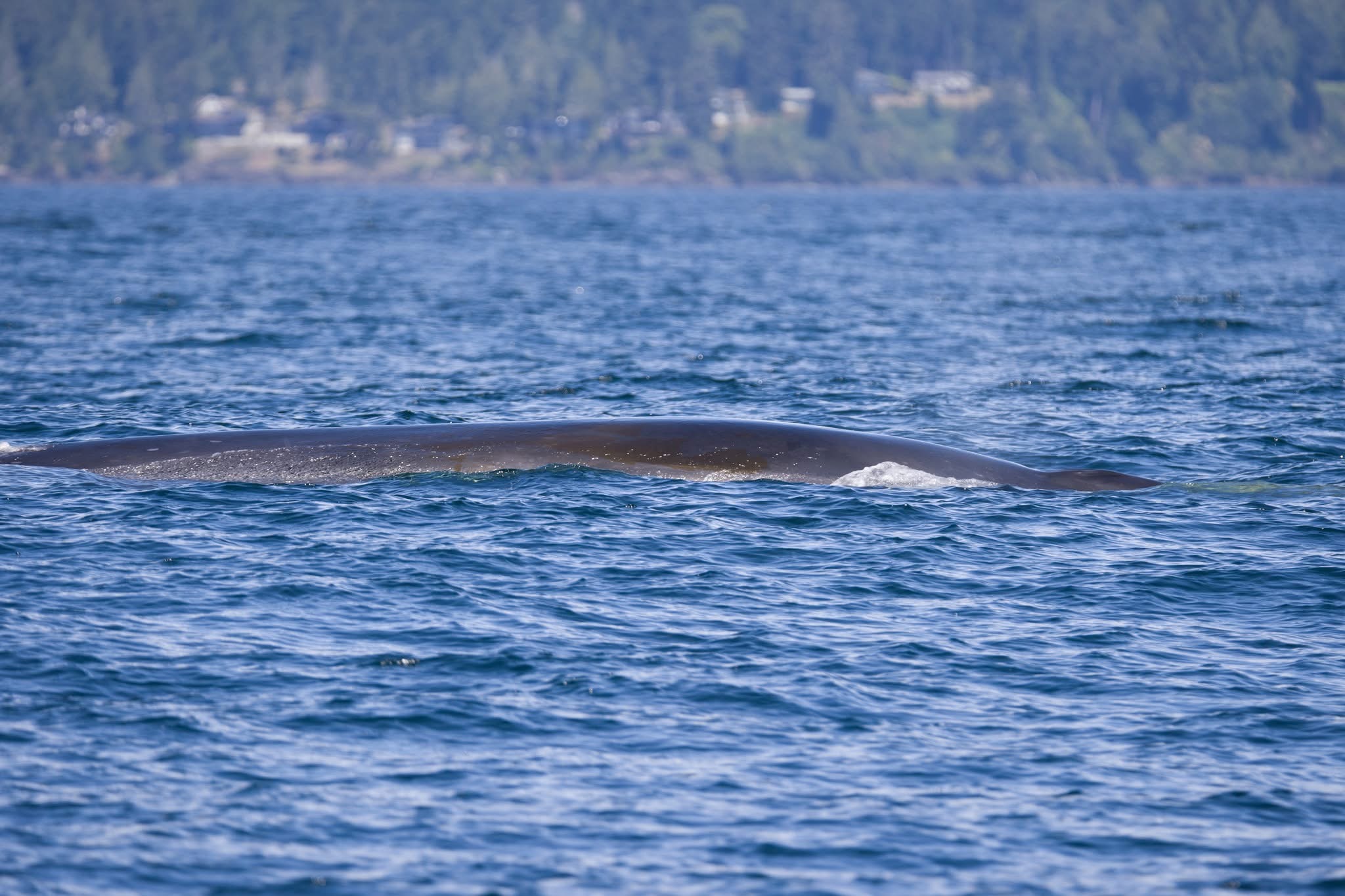
Through the thinning mist, a dark back begins to roll. And roll. And roll.
It keeps coming, a slick, charcoal-colored island of muscle that seems to defy the laws of geometry. Just when you think the creature must surely end, the dorsal fin finally appears, curved and sharp against the grey sky. It is a fin whale. Seventy feet of living, breathing history, gliding past a mere stone's throw from the rocky shoreline.
To see something that large is to understand your own insignificance in an instant. It is a humbling, almost terrifying realization that we share this planet with leviathans that operate on a scale of time and space we can barely comprehend.
The Shadows of the Past
For more than a century, the waters around Vancouver Island were silent. If you had taken a boat out into these same channels fifty years ago, you would have found an empty highway. The great whales were gone, turned into oil to light city streets and margarine to fill grocery shelves.
Consider the sheer scale of the slaughter. During the height of industrial whaling in the twentieth century, tens of thousands of fin whales were hunted across the North Pacific. They were targeted for their speed and their size. Second only to the blue whale, a mature fin whale can weigh up to eighty tons. They are the greyhounds of the sea, capable of swimming at speeds that left early wooden whaling ships far behind. But steam engines and exploding harpoons changed the balance of power. The ocean was hollowed out.
By the time the international bans took effect, the fin whales of the coastal waters had become ghosts. They retreated to the deep, open ocean, far away from the continental shelves, far away from the memory of the iron harpoons.
For generations of coastal residents, the idea of seeing a seventy-foot whale in the inside passages was fantasy. It was something written in old logbooks, a myth passed down by grandfathers who remembered a different ocean. The waters felt smaller, tamer, and infinitely lonelier without them.
But the ocean has a long memory, and sometimes, it forgives.
The Mechanics of a Giant
To understand the sheer wonder of a seventy-foot fin whale appearing off Vancouver Island, you have to understand what it takes to keep a creature of that size alive.
Imagine a mouth large enough to swallow a minivan. Inside that mouth are hundreds of plates of baleen, a fingernail-like material that acts as a massive sieve. The whale does not hunt individual fish; it hunts communities. It lunges through schools of krill and small schooling fish with its mouth agape, its throat grooves expanding like an accordion to take in tons of water in a single gulp.
Then comes the squeeze. Using a tongue that weighs as much as an elephant, the whale pushes the water out through the baleen, trapping millions of tiny organisms inside.
This process requires immense energy. A fin whale must consume up to two tons of food every single day just to survive. When a giant like this enters the shallow, coastal waters of Vancouver Island, it is not wandering aimlessly. It is a sign that something fundamental is shifting beneath the waves.
The presence of a top predator indicates a rich, thriving food web underneath. It means the currents are moving correctly, bringing nutrient-rich deep water to the surface. It means the herring and the krill are there in numbers vast enough to support a creature that burns calories like a furnace. The whale is a massive, living thermometer, measuring the health of the entire ecosystem.
The Human Eyewitness
On the boat, nobody speaks. The silence is absolute, broken only by the lap of water against the hull and the distant, fading echo of the whale’s breath.
A hypothetical observer—let's call her Sarah, a marine biologist who has spent twenty years studying the coast—stares through her binoculars, her hands trembling slightly against the cold. She has spent decades looking at data points on a screen, tracking population estimates, and reading dry reports about whale migratory patterns.
But data cannot prepare you for the reality of seventy feet of whale.
Sarah knows the mathematics of this encounter. She knows that finding a fin whale this close to the island is an anomaly, an event that would have been laughed out of a research symposium a few decades ago. She watches the asymmetrical coloring of the whale’s jaw—bright white on the right side, dark charcoal on the left—a classic identifying feature of the species used to stun schools of fish during a hunt.
This asymmetry is one of nature’s great design quirks. As the whale circles a school of fish, it turns on its side, showing the white belly and jaw to the prey, herd-driving them into a tight, panicked ball before the final lunge. Watching this ancient dance unfold in real-time, just miles from a bustling ferry route, bridges the gap between cold science and raw wonder.
The raw emotion on the boat is palpable. It is a mixture of awe and an underlying, unspoken anxiety. We are looking at a survivor of an extinction-level event. Every scar on its back tells a story of a species that refused to vanish from the earth.
The Invisible Hazards
The return of the giants brings a complicated reality. The modern Pacific is not the ocean their ancestors left behind. It is louder, crowded, and crisscrossed by invisible dangers.
Consider what happens next as the whale moves deeper into the coastal shipping lanes.
The waters around Vancouver Island are a bustling maritime highway. Cargo ships, container vessels, and commercial ferries churn through these channels day and night. To a seventy-foot whale swimming just beneath the surface, a container ship traveling at twenty knots is an unstoppable force. Vessel strikes are now one of the leading causes of death for these recovering giants.
The tragedy lies in the physics. A ship captain sitting high on the bridge of a vessel three football fields long cannot see a whale swimming ahead. Even if they could, a ship of that size takes miles to slow down or turn. The collision is often silent to those on board, noticed only when the ship reaches port and a body is found draped over the bow.
Then there is the noise. Undersea acoustic pollution from large engines and propellers creates a constant, deafening roar beneath the surface. Fin whales communicate using ultra-low-frequency pulses that can travel across entire ocean basins. It is a deep, booming song that allows them to find mates and stay connected across hundreds of miles.
Modern shipping noise cuts through those songs like static on a radio. It shrinks their acoustic world, leaving them isolated in a cloud of human-made din.
A Long Road Home
The sight of a fin whale off the island is a victory, but it is a fragile one. It reminds us that conservation is not a project with a clear end date; it is an ongoing negotiation between our world and theirs.
The whale takes one final, deep breath. The blowhole closes with a sharp, wet snap. The massive back arches higher this time, exposing the long, smooth slope of its spine.
The small dorsal fin slices through the water, followed by the broad flat of the tail stock. Unlike humpback whales, fin whales rarely lift their massive flukes high into the air before a deep dive. Instead, they simply sink, slipping beneath the dark water with a quiet elegance that seems impossible for an animal of seventy tons.
The slick of smooth water left behind—the whale footprint—gradually dissolves into the chop of the incoming tide.
The fog begins to roll back in, swallowing the horizon and hiding the distant mountains of the mainland. The ocean looks empty again. The cold seeps back into your boots, and the engines hum as the boat turns back toward the harbor.
But everything has changed. The water is no longer just a blank space on a map. It is a home, occupied once more by its rightful owners, moving silently through the deep.