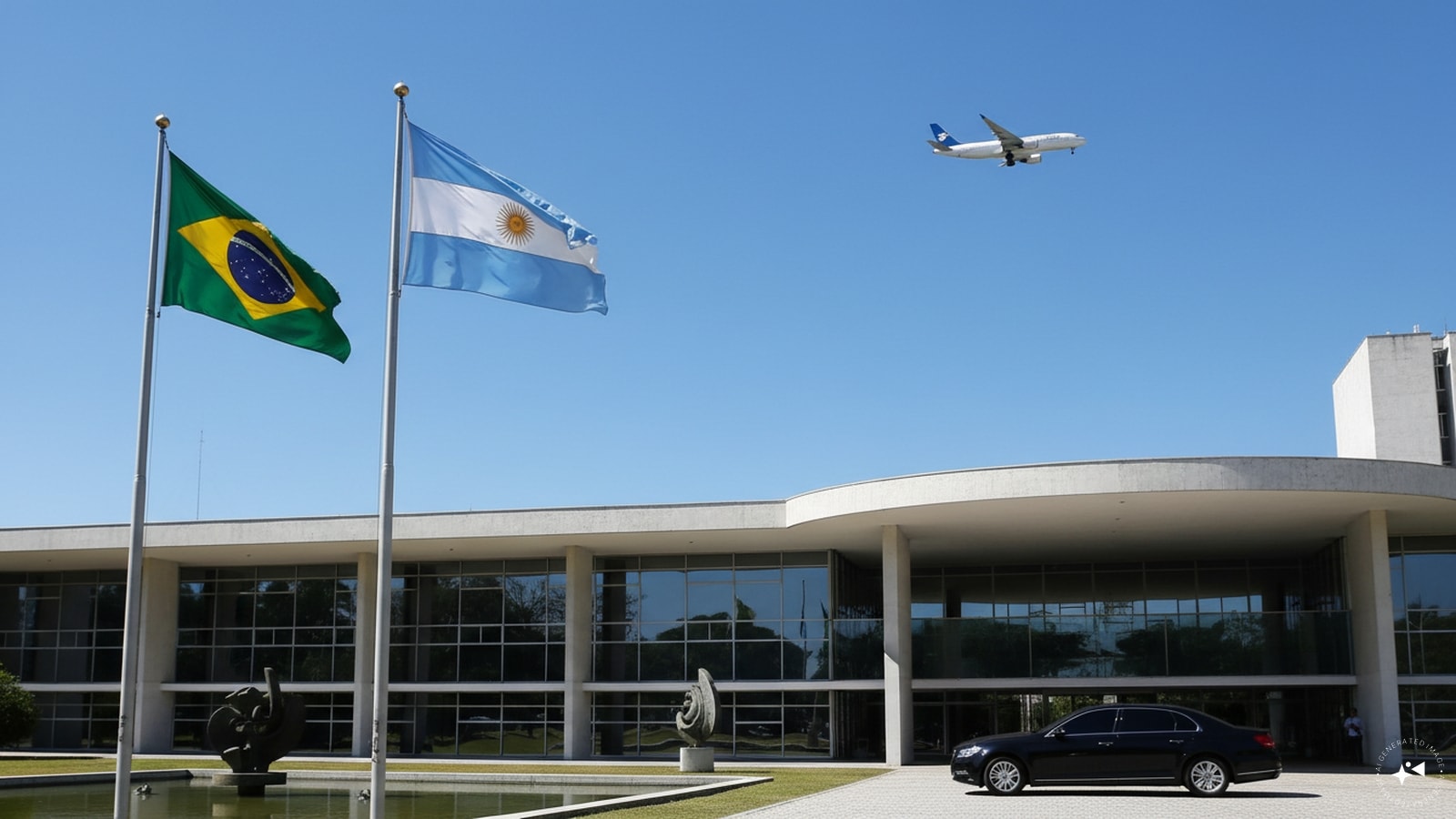
The air in Brasília’s Itamaraty Palace rarely feels heavy, even in the height of the tropical summer. Designed by Oscar Niemeyer, the Ministry of Foreign Affairs is a monument to weightlessness—concrete arches floating over dark, still reflecting pools, a deliberate architectural promise that Brazilian diplomacy would always be fluid, transparent, and serene.
Yet on a humid afternoon in mid-2026, the silence inside those marble corridors felt less like serenity and more like a held breath.
Across the polished floor walked an Argentinian diplomat, summoned to answer a question that sounded like the opening line of a Cold War thriller, yet carried the unmistakable, messy fingerprint of modern South American politics. How did Jair Bolsonaro—a former president stripped of his passport, encircled by federal investigations, and barred from leaving the country—slip past the radar, cross an international border, and board a flight bound for the United States?
To read the standard wire reports is to encounter a dry sequence of bureaucratic verbs. Summoned. Clarified. Investigated. Denied. The headlines treat the incident like a routine border irregularity, a minor friction between two neighboring giants who have spent decades alternating between warm embraces and icy stares.
They miss the point entirely.
When a man at the center of a nation’s deepest constitutional crisis vanishes into the clouds, the story isn't about aviation logs or diplomatic protocol. It is about the fragility of borders when ideology speaks louder than law. It is about the quiet terror of watching institutional guardrails bend until you can hear the metal groan.
The Border That Breathes
To understand how a high-profile political figure disappears from a country of over two hundred million people, you first have to abandon the map in your head. On paper, the border between southern Brazil and northern Argentina is a crisp, definitive line—a series of rivers, bridges, and customs checkpoints manned by uniformed officers with rubber stamps.
In reality, it is a sieve.
Picture a hypothetical afternoon in Paso de los Libres, the Argentinian town sitting just across the Uruguay River from the Brazilian city of Uruguaiana. Here, the air smells of diesel exhaust, river mud, and grilled beef. Thousands of trucks, commuters, and families cross the Getúlio Vargas International Bridge every single day. For locals, the river isn't a wall; it is a hallway. People live on one side, work on the other, and buy groceries wherever the exchange rate happens to favor them that Tuesday.
If you want to disappear in South America, you do not buy a ticket at Guarulhos International Airport in São Paulo, where biometric scanners and federal police cameras watch every blink. You drive south. You blend into the rhythm of a border town where waving a familiar hand at a tired guard is often enough to keep the traffic moving.
Consider the mechanics of a vanishing act like this. In February 2024, Brazil’s Supreme Federal Court ordered the seizure of Jair Bolsonaro’s passport as part of an expansive investigation into an alleged plot to overturn the 2022 presidential election. For more than two years, that missing blue booklet was supposed to be an invisible tether, keeping the former president anchored to Brazilian soil while prosecutors untangled the wreckage of the January 8, 2023 riots in Brasília—the day thousands of his supporters stormed and trashed the seat of government.
A revoked passport works on a simple premise: it assumes you will play by the rules of international travel. It assumes you will walk up to a counter, hand over your credentials, and wait for a computer screen to flash green.
It does not account for a friendly neighbor.
A Tale of Two Capitals
Diplomacy, at its core, is just neighborhood politics scaled up to the size of continents. Imagine living in a quiet suburban cul-de-sac where you and your next-door neighbor share a driveway. For years, you’ve had your disagreements, sure, but you both agree on basic rules: nobody blocks the exit, and if someone’s teenager sneaks out at midnight, you tell the parents.
Now imagine a new neighbor moves in—someone loud, ideological, and openly contemptuous of the homeowners' association. Suddenly, the shared driveway isn't a shared responsibility anymore. It’s an escape route.
That is the emotional subtext of the diplomatic tremor between Brasília and Buenos Aires. Since Javier Milei took office in Argentina in late 2023, the ideological axis of South America has tilted violently. Milei, a self-described anarcho-capitalist with a penchant for chainsaws and theatrical populism, never hid his admiration for Bolsonaro. When Bolsonaro attended Milei’s inauguration in Buenos Aires, the two men embraced like brothers-in-arms fighting a common, shadowy globalist enemy.
For Brazilian President Luiz Inácio Lula da Silva, watching Buenos Aires turn into a sympathetic sanctuary right next door was always a quiet nightmare. Lula and Milei occupy opposite ends of the political universe; they barely speak, communicating instead through icy press releases and pointed absences at regional summits.
When reports surfaced that Bolsonaro had bypassed Brazilian exit controls, entered Argentina, and boarded a flight to the United States—a country where he had previously spent three months in self-imposed exile in Orlando following his 2022 election loss—the reaction in Brasília was instantaneous.
Summoning an ambassador or chargé d'affaires is diplomacy’s equivalent of slamming a hand on the kitchen table. It is a formal, deliberate escalation. It strips away the polite fiction that everything is fine and forces the other side to look you in the eye and explain themselves.
Did Argentinian border agents look the other way? Did someone in Buenos Aires quietly facilitate transit documents for a man who legally had none? Or was it simply bureaucratic incompetence—the kind of human error that happens when a famous face walks through a VIP lounge and nobody dares to ask for paperwork?
The Anatomy of a Diplomatic Headache
I have spent years watching how Latin American institutions handle pressure, and there is a distinct physical sensation that accompanies moments like this. You feel it in the stomach—a sudden drop, like an elevator cable slipping an inch before catching. It is the realization that the rules you thought were carved in stone are actually written in pencil.
To grasp the stakes, you have to understand what happens when a legal system loses its physical grip on a defendant.
Think of a court summons as a promise between a state and its citizens: No matter how powerful you are, the law can still reach your shoulder. Throughout 2024 and 2025, Brazil’s institutions worked overtime to prove that their democracy could survive an attempted rupture. Police raided homes, arrested former ministers, and scrutinized encrypted messages. The message to the world—and to Brazil’s own fractured populace—was clear. Accountability was coming.
Then, suddenly, the chair is empty.
For ordinary Brazilians watching the news unfold on their phones during their evening commute, the details of bilateral treaties mean very little. What they see is simpler, and far more corrosive. They see a system where a working-class citizen who misses a court date over a traffic fine has their bank account frozen before lunch, while a former head of state can allegedly slip across an international river and catch a flight to North America.
That disparity is poison to a democracy. It breeds a cynicism so thick you can taste it.
And what about the United States? Every time Bolsonaro boards a plane heading north, Washington inherits a geopolitical migraine. Under any administration, the U.S. State Department walks a razor’s edge when foreign political figures arrive on American soil under murky legal circumstances. Granting entry—or discovering someone has already entered on an existing visa issued years earlier—places Washington squarely in the middle of someone else’s domestic firestorm.
If Brasília eventually issues an international arrest warrant or an extradition request, American diplomats will find themselves trapped between legal treaties and intense domestic political pressure from Bolsonaro’s American allies. Nobody in Foggy Bottom wants to be the referee in a Brazilian constitutional crisis.
The Shadows Behind the Official Denials
Inside the diplomat’s meeting at Itamaraty, the script is predictable. The Argentinian representative offers assurances. Buenos Aires, they insist, respects Brazilian sovereignty. An internal review will be conducted. Border logs will be checked. There was no official conspiracy, no state-sponsored smuggling operation.
Maybe that is entirely true.
The uncomfortable reality of modern governance is that you rarely need a grand conspiracy when simple negligence or localized sympathy will do the trick. A border guard who happens to admire a former president doesn't need a secret phone call from a presidential palace to wave a car through. A customs official intimidated by an entourage of bodyguards doesn't need a bribe to avoid asking uncomfortable questions.
Power has an inertia of its own. Even out of office, even stripped of titles and passports, men like Bolsonaro carry an aura that makes lower-level bureaucrats hesitate. And in the gap created by that hesitation, a car crosses a bridge. A boarding pass is scanned. Wheels lift off tarmac.
By the time the digital trail catches up—a passenger manifest flagged by an airline system, a rumor leaked to a columnist in Brasília, a grainy photo snapped in an airport terminal—the airspace is already international. The jurisdiction has evaporated.
What Happens When Lines Blur
We like to pretend that nations are solid things, defined by flags, anthems, and crisp lines on classroom globes. We tell ourselves that laws stop cleanly at the edge of a river and pick up neatly on the other bank.
Incidents like this strip away that comfort. They reveal how much of international order relies on the honor system—on the quiet, unglamorous daily agreement between neighbors that neither will help the other’s fugitives, outcasts, or political ghosts slip through the back door.
When ideological kinship begins to outweigh institutional loyalty, those invisible agreements rot from the inside out. Today it is a former president crossing a southern river to catch a flight north. Tomorrow it is a precedent—a blueprint for anyone with enough money, fame, or sympathetic friends across the border to treat national justice as an optional inconvenience.
In Brasília, the reflecting pools outside Itamaraty Palace remain dark and mirror-smooth, catching the late afternoon light just as Niemeyer intended. Inside, clerks file away the minutes of the diplomatic summons, adding another folder to a cabinet already overflowing with crises.
Thousands of miles away, high above the Atlantic, contrails dissolve into thin, pale threads against the darkening sky, leaving no trace of who was aboard, or which river they crossed to get there.