The Sound of a Switch Closing
I remember the hum of the transformer behind my childhood fence. It was a low, ferrous vibration that you only noticed when it stopped. That sudden silence usually meant a summer storm had ripped through the county, dropping a branch across a live line and plunging three hundred homes into the dark. You waited in the kitchen, listening to the hum of the refrigerator die down, watching the analog clock on the wall freeze at 4:14.
We take that hum for granted. We flip a switch, and light spills from a bulb. We plug in a phone, and invisible electrons race through silicon to give us the weather in Tokyo. But beneath the hum lies a quiet, paranoid architecture.
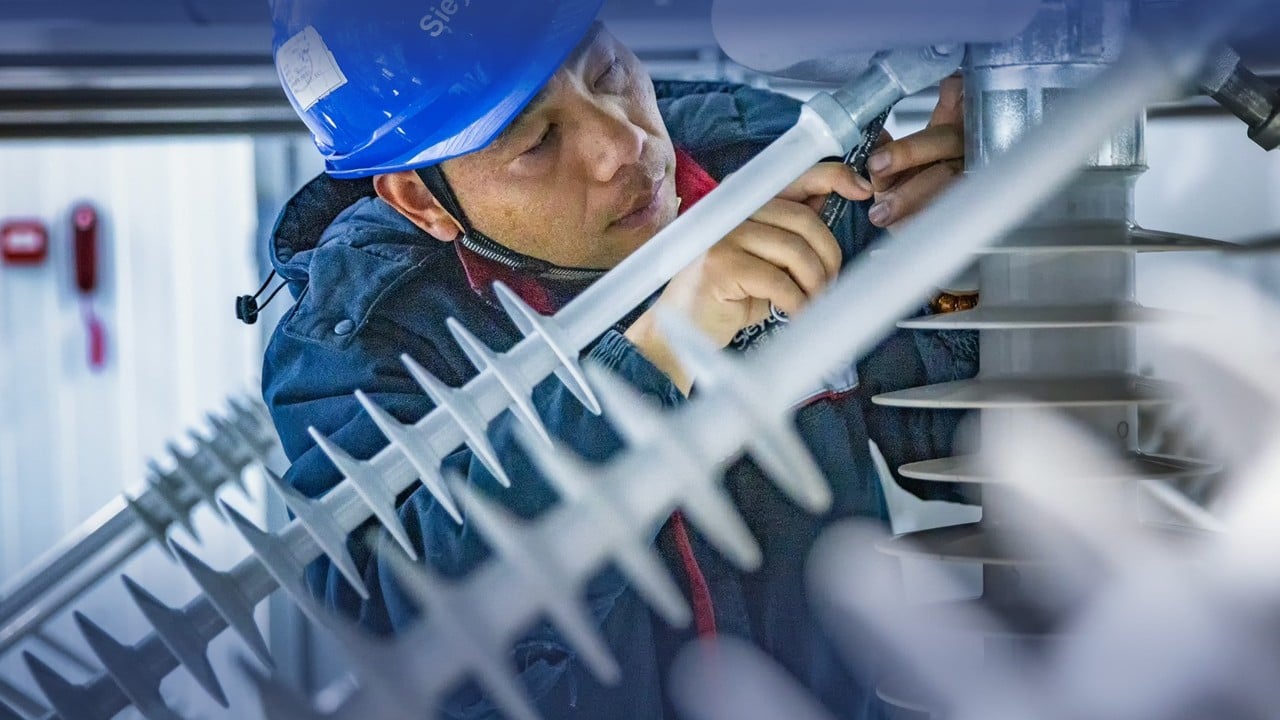
Picture Chen Wei sitting in a high-rise office in Shenzhen, staring at a bank of monitors that flash with emerald code. Chen is an engineer whose life is measured in hertz and voltage drop tolerances. His company builds the heavy iron lungs of the modern electrical grid—massive transformers, smart relays, and high-voltage direct current converters that carry power across thousands of miles without choking on resistance. He spent twenty years perfecting the art of keeping the lights on for millions of people he will never meet.
Then, a piece of paper drops in Washington.
A bureaucratic stroke of a pen. A ban on foreign hardware within critical grid infrastructure.
Across the ocean, the market reacted with the subtlety of a falling safe. Chinese power stocks slumped, dragging down conglomerates that had spent decades wiring the developing world and nibbling at the edges of Western supply chains. Traders in Shanghai and Hong Kong watched their terminals bleed red, clutching their coffee cups and asking the oldest question in finance: Is the sell-off warranted?
To understand that panic, you have to look past the ticker tape and into the machinery of fear.
The Invisible Architecture of Trust
Electricity is the ultimate anonymous guest. When a kilowatt-hour enters your home, it doesn't carry a passport. It doesn't wear a flag. It is just raw, vibrating energy, indifferent to geopolitics.
Yet, the brain that guides it—the software, the microprocessors, the digital valves that decide whether to choke a surge or route a blackout—that brain has a nationality.
(Note: For the sake of illustration, consider a modern substation as a nervous system. The power lines are the veins, but the digital relays are the synapses. If someone else controls the synapses, they control the reflex.)
For years, globalization operated on a simple, comforting bargain. We buy the cheapest, most efficient hardware from wherever it is made, saving taxpayers millions and keeping inflation at bay. If a Chinese firm can manufacture a transformer station ten percent cheaper and six months faster than an American or European counterpart, economic logic dictates we buy it. Efficiency was our secular religion.
Until the realization set in that efficiency without sovereignty is a vulnerability.
When the news of the US grid ban broke, the market panicked not because Chinese manufacturers suddenly forgot how to wind copper wire, but because the rules of the game changed overnight. The market priced in a wall. A physical and digital wall dividing the world’s two largest economies into hermetic technological spheres.
Chen Wei didn't lose his job that morning. The copper didn't melt in his factories. But the horizon shrank. The markets saw the slump and screamed disaster. But reality, as it usually does, lives in the gray shadows between panic and triumph.
The Weight of the Balance Sheet
Let us look at the numbers without the hysteria.
When shares of companies like Nari Technology or other major grid infrastructure players take a beating, investors are trying to price in the total loss of Western markets. It is a catastrophic pricing model. It assumes that because the front door is bolted, the entire house is worthless.
(Note: In this financial context, we are observing the knee-jerk correction of equity valuations where sentiment routinely outruns fundamental revenue exposure.)
The domestic market inside China is staggering in scale. As the country races to integrate massive desert solar arrays and wind corridors in its western provinces to power the coastal megacities, the demand for high-voltage transmission equipment is at an all-time high. Chen’s factories are still running three shifts a day. The domestic grid needs upgrades that dwarf the export volume to Western nations.
So why the steep sell-off? Because global capital hates uncertainty more than it hates bad news. Uncertainty is a blank check written in the dark.
When Washington signals that foreign hardware is a national security risk, other regions notice. Europe watches. Southeast Asia watches. Allies take notes. They begin to ask themselves whether they want their own power grids tethered to a supply chain that could become radioactive overnight. That psychological contagion is what pulled the stock prices down. It is the fear of fragmentation.
The Cost of Living Apart
We are building a fractured world.
I think back to that transformer behind my childhood fence. It didn’t care where the copper was mined or where the assembly drawings were drafted. It just took the load and did its silent, brutal work.
Today, we are entering an era where every bolt, every line of firmware, and every microchip must pass an ideological purity test. This is not inherently wrong; national security is a legitimate master. But we must be honest about the invoice.
Decoupling electrical grids is expensive. It means redundancy instead of optimization. It means reinventing wheels that were already turning smoothly. It means higher costs for ratepayers and slower rollouts for green energy transitions.
When the dust settles on the power stock slump, we will find that the sell-off was partially justified by the permanent loss of international growth vectors, but wildly overdone regarding the core business health of these industrial giants. They will adapt. They will sell inward, they will sell to aligned markets, and they will continue to build the heavy machinery of civilization.
The hum outside your window will not stop tomorrow. But the sound of the world changing is getting louder. It is a different kind of vibration—one of iron, suspicion, and steel walls rising in the dark.