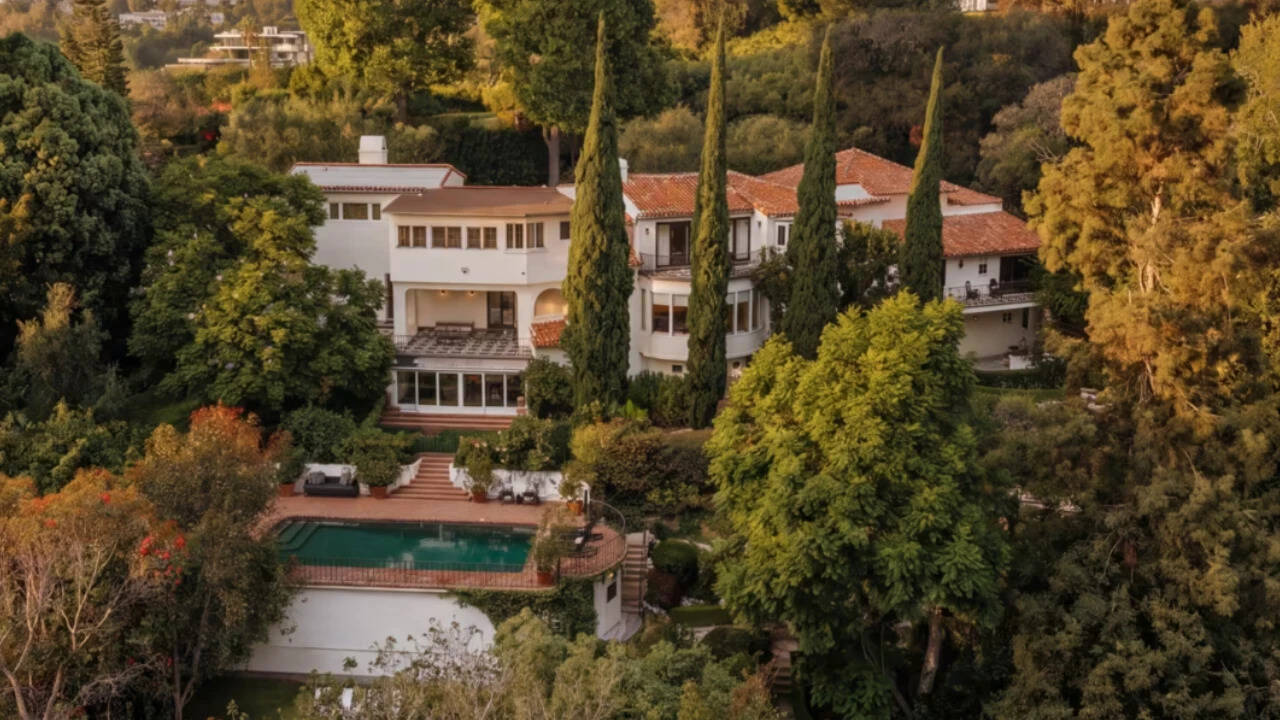
The stucco does not crack of its own accord. It settles because the ground remembers every winter rain since Calvin Coolidge sat in the White House.
In 1928, Alphonzo E. Bell looked at the dry, stubborn chaparral of the Santa Monica foothills and saw an empire. He did not see brush or heat. He saw a sanctuary. A refuge for a class of people who had more money than time, and more ambition than peace. He poured his wealth into the dust, hired masons who worked with wet lime and heavy hands, and raised a house. Not just a house—a statement. A sprawling, terracotta-tiled anchor in what would become the most exclusive zip code on the western seaboard.
Step inside those high-ceilinged rooms today, and you can still smell the old plaster. It is a scent like library dust mixed with sun-baked cedar.
For nearly a century, these walls have listened. They heard the clink of crystal highballs during the twilight of the Jazz Age. They absorbed the hushed whispers of studio heads plotting the fate of starlets during the golden era of cinema. The house itself has no voice, but it holds a memory. Every archway bears the geometry of an era when things were built to outlast their builders.
Then came 2010.
The world outside was licking its wounds from a financial collapse. The air smelled of panic and bad debt. Yet, luxury real estate operates on a different clock. It is a universe divorced from the mundane worries of grocery prices or mortgage rates. Someone with fifty-five hundred thousand dollars—five point five million, in the cold parlance of the ledger—walked through those wrought-iron gates and bought a piece of history.
It felt like a steep sum at the time. The floors groaned in the damp morning air. The electrical wiring was a museum of fire hazards. The plumbing gurgled like an angry stomach. But real estate speculators are gamblers who buy antique clocks not to tell time, but for the beauty of the brass gears ticking inside.
What happens when you take a historical landmark and hand it over to modern capital?
Consider what followed. Over the next decade and a half, the property underwent a quiet, violent transformation. Millions vanished into imported Italian marble, invisible smart-home wiring, and infinity pools that mirror the smog-softened Los Angeles sky. The bones remained—Bell would have recognized the courtyard—but the skin was stripped away and replaced with billionaire armor.
By the time the listing agent hammered the new sign into the manicured parkway, the price tag had ballooned to thirty-two million five hundred thousand dollars.
Thirty-two and a half million. Let that number sit on your tongue for a second. It tastes like copper and champagne.
How does a building appreciate by nearly six hundred percent in fourteen years while the rest of us worry about the cost of eggs? Is it the wood? Is it the tile?
No. It is the scarcity of ghosts.
In a city as ephemeral as Los Angeles, where bulldozers rewrite the map every Tuesday morning, history is the ultimate luxury. People do not buy thirty-two-million-dollar mansions for the square footage. They buy the invisible pedigree. They buy the right to say, Alphonzo Bell walked these flagstones before the world went mad. They buy an alibi against their own transience.
Walk the perimeter of the estate at dusk, just as the marine layer rolls over the ridge, swallowing the palm fronds one by one. The lights inside the grand salon flick on automatically, casting a warm, amber glow through leaded glass windows that survived the Great Depression, World War II, and every earthquake that ever rattled the coast.
The current owner is likely someone whose face graces the Forbes list or the credits of a streaming giant. They will host parties where deals are struck over canapés and white wine. They will sleep soundly beneath hand-painted timber beams, shielded from the noise of the boulevard below by thick stone and double-gated paranoia.
Yet, Alphonzo Bell’s ghost is the one who truly owns the deed.
He built it to conquer the wilderness. He built it to leave a mark deeper than a footprint in the dust. And as the price climbs higher, fueled by the relentless inflation of American ambition, the house simply watches. It has seen owners come and go like tenants in a grand hotel. It knows that roofs leak, paint fades, and bank accounts empty.
But the view from the ridge? That remains priceless.