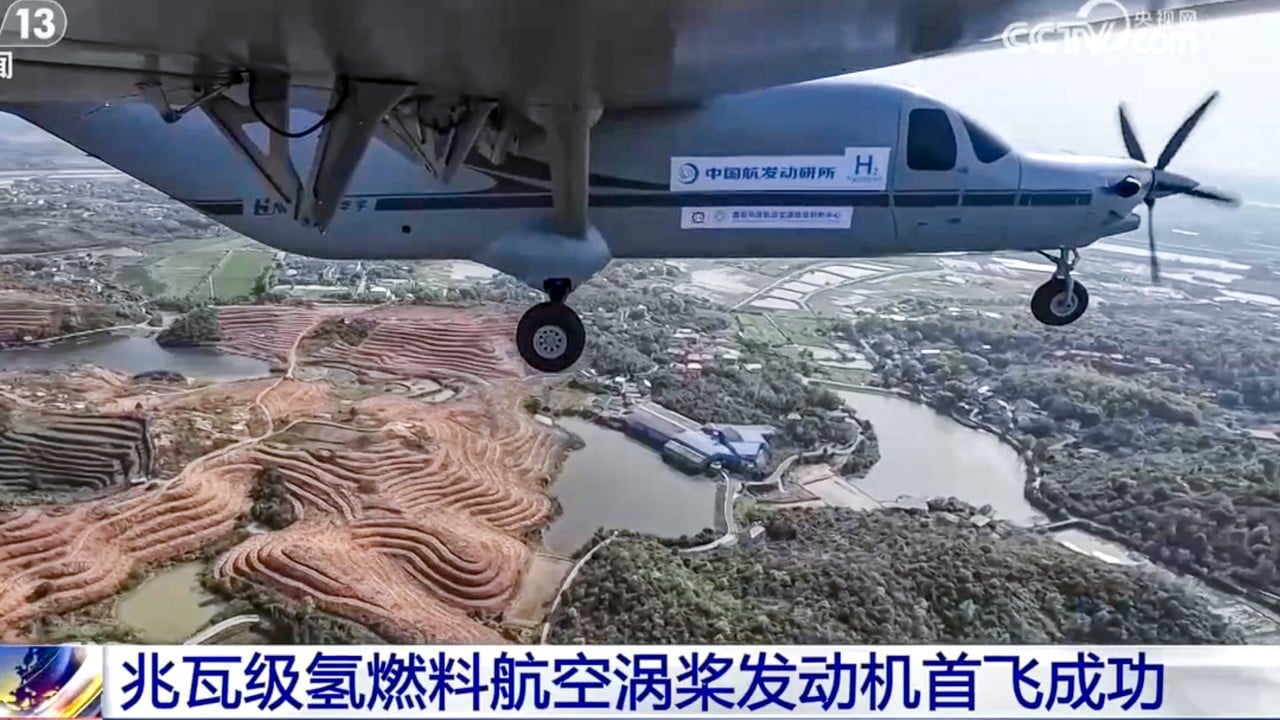
China’s pursuit of hydrogen-powered aviation is not a singular pursuit of "green" technology; it is a strategic response to the volatility of global liquid fuel supply chains. By accelerating the development of the COMAC ARJ21-equivalent hydrogen prototypes and regional fuel-cell aircraft, Beijing is attempting to decouple its domestic transport sector from the Malacca Strait’s energy bottleneck. The intersection of this technological push with the Iranian energy crisis reveals a broader structural shift: the transition from an energy economy based on extracted molecules to one based on manufactured electrons.
The Triad of Hydrogen Aviation Constraints
The viability of hydrogen as an aviation fuel is governed by a rigid set of physical and logistical constraints that current media narratives often ignore. To assess the progress of China’s recent testing cycles, one must analyze the three specific pillars of flight-grade hydrogen:
- Gravimetric Density vs. Volumetric Inefficiency: While hydrogen possesses an energy density by mass roughly three times that of Jet A-1 ($120 \text{ MJ/kg}$ vs. $43 \text{ MJ/kg}$), its volumetric density is abysmal. Even when liquefied at $-253^\circ\text{C}$, it requires four to five times the storage volume of traditional kerosene for the same energy output. This necessitates a fundamental redesign of airframes, moving away from wing-stored fuel toward "plug" fuselages or blended-wing bodies.
- The Cryogenic Tax: Maintaining hydrogen in a liquid state (LH2) requires vacuum-insulated, double-walled tanks. This adds significant "dead weight" to the aircraft, often neutralizing the mass advantages of the fuel itself. China’s recent patents in lightweight carbon-fiber cryogenic tanks suggest a focus on minimizing this specific weight penalty.
- The Infrastructure Lock-in: Aviation is a hub-and-spoke system. A hydrogen aircraft is useless without a "liquefaction-at-gate" infrastructure. China’s State Grid and Sinopec are currently building integrated hydrogen corridors, treating the aircraft not as a standalone vehicle, but as a mobile node within a national electricity-to-gas grid.
The Iran Variable: Energy Security as a Catalyst
The ongoing energy crisis in Iran serves as a real-time stress test for the Chinese energy strategy. Despite possessing massive natural gas reserves, Iran’s inability to maintain its power grid due to sanctions and infrastructure decay has led to rolling blackouts and heating shortages. For China, this is a cautionary tale of "Resource Abundance vs. Systemic Fragility."
Beijing’s investment in hydrogen aviation is a hedge against two specific Iranian-related risks:
The Crude Oil Displacement Theory
China remains the largest buyer of Iranian oil. However, the logistical chain for this oil is subject to geopolitical interference. By shifting the "fuel" of domestic aviation from imported crude to domestically produced green hydrogen (via Inner Mongolian wind and solar), China reduces its exposure to the Persian Gulf's instability. The goal is to transform the aviation sector from a liability in times of conflict into an extension of the domestic industrial complex.
Technology-for-Energy Arbitrage
The relationship is reciprocal. As Iran struggles with its power sector, China is positioning itself as the primary provider of electrolyzer technology and hydrogen storage solutions. This creates a dependency loop where Iran provides raw thermal energy or solar land-rights, while China provides the high-value technical stack required to convert those resources into usable industrial fuel.
Deconstructing the Hydrogen Propulsion Stack
To outpace Western competitors like Airbus (via the ZEROe program), China is focusing on two distinct propulsion architectures. Each carries a different risk profile and timeline.
Hydrogen Fuel Cell (HFC) Hybridization
This involves using hydrogen to generate electricity through a chemical reaction, powering electric motors.
- The Advantage: Zero $NO_x$ emissions and high efficiency at low altitudes.
- The Bottleneck: Power density. Current fuel cells are heavy and struggle to provide the high-power output required for takeoff in narrow-body aircraft. China’s strategy here is focused on regional turboprops and short-haul logistics drones, where the power requirements are manageable.
Hydrogen Direct Combustion (HDC)
This modifies existing gas turbine engines to burn LH2 directly.
- The Advantage: Near-parity with existing engine thrust profiles. It allows for larger aircraft and faster development cycles using modified versions of the WS-20 or CJ-1000A engines.
- The Challenge: $NO_x$ production remains an issue due to high-temperature combustion in the atmosphere. Furthermore, hydrogen’s flame speed is significantly higher than kerosene’s, leading to "flashback" risks where the flame enters the fuel injector.
Chinese research papers from the Harbin Institute of Technology indicate a prioritization of HDC for larger transport frames, viewing HFC as a secondary technology for the general aviation market.
The Cost Function of the Hydrogen Transition
The economic barrier to hydrogen aviation is often cited as "too high," but this assumes a static cost for carbon-based fuels. The "Cost Function of Aviation Fuel" ($C_f$) can be modeled as:
$$C_f = (P_{base} + T_{carbon}) \times L_{geo}$$
Where:
- $P_{base}$ is the production cost.
- $T_{carbon}$ is the regulatory or environmental tax.
- $L_{geo}$ is the geopolitical risk multiplier (the cost of securing supply lines).
For China, $L_{geo}$ is the dominant variable. While the $P_{base}$ for green hydrogen is currently 3–4 times that of Jet A-1, the geopolitical risk of being cut off from oil imports makes the "effective cost" of hydrogen competitive in a strategic context. By subsidizing the initial $P_{base}$ through state-owned enterprises, China is artificially accelerating the point of "Strategic Parity."
Operational Reality: The Mid-Tier Bottleneck
Despite the headlines, a significant gap remains between a "test flight" and "commercial viability." The second limitation that most analysts overlook is the turnaround time ($T_{TAT}$).
Refueling a commercial jet with kerosene is a standardized, high-speed process. Refueling with LH2 involves:
- Pre-cooling the fuel lines to prevent vaporization.
- Managing "boil-off" gas, which is highly explosive.
- Vacuum-sealing connectors.
If a hydrogen aircraft requires a 90-minute turnaround compared to 30 minutes for a Boeing 737, the airline’s utilization rate drops by 30%. This makes the aircraft economically unviable regardless of the fuel cost. China’s push for "automated cryogenic refueling" at airports like Daxing International is an attempt to solve this logistical friction before the aircraft even leave the hangar.
Strategic Direction: The Decentralized Energy Hub
The final move in China’s aviation masterclass is the integration of airports into the "Hydrogen Economy." In this model, the airport is not just a transport terminal; it is a chemical processing plant. Excess renewable energy from the regional grid is sent to the airport, converted to hydrogen via on-site electrolysis, and stored for flight.
This eliminates the need for expensive hydrogen pipelines or trucking, which are the most significant "hidden costs" in the hydrogen value chain. This localized production model is particularly attractive for the Iranian market, where the national grid is unreliable. If an airport can function as an energy island, it can maintain flight operations even during a national power collapse.
The move toward hydrogen aviation is a calculated play to redefine the physics of sovereignty. China is betting that the mastery of the liquid hydrogen cycle will yield the same geopolitical dividends that mastery of the steam engine and internal combustion once did for the West. The Iranian crisis only serves to validate their hypothesis: in the 21st century, energy security is found in the laboratory, not the wellhead.
Establish a standardized "Cryogenic Ground Support" (CGS) protocol within the next 24 months to ensure that hardware development does not outpace terminal capability. Failure to do so will result in a fleet of advanced aircraft that are functionally grounded by the lack of a specialized labor force and refueling throughput.