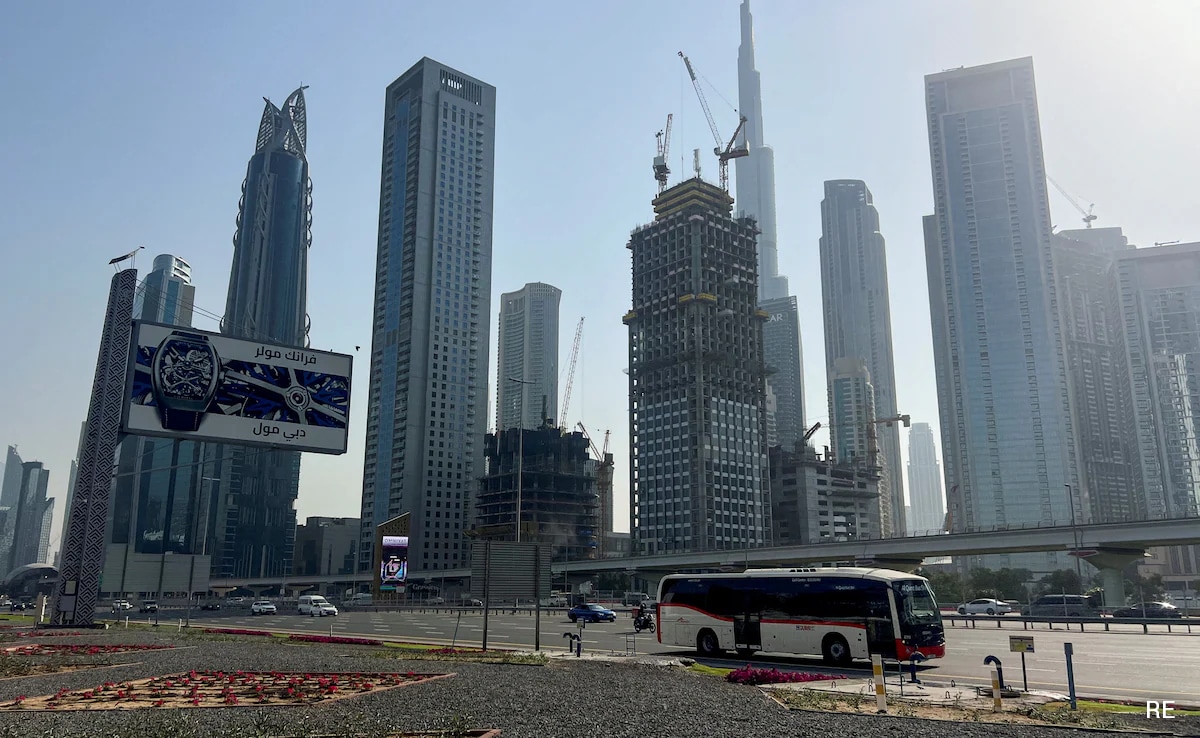
The survival of Dubai as a global Tier-1 hub depends on the deliberate decoupling of "geographical proximity" from "systemic risk." While the city resides within the immediate strike radius of a potential Iran-Israel escalation, its economic architecture is designed to function as a neutral, high-liquidity isolation chamber. The current push to contain fallout is not merely a public relations campaign; it is an aggressive deployment of three specific strategic buffers: Sovereign Neutrality, Infrastructural Redundancy, and Capital Flight Capture.
The Illusion of Proximity: Why Geography is a Lagging Indicator
Traditional risk assessment models over-index on physical distance. In a kinetic conflict involving Iran, the Strait of Hormuz becomes a primary choke point. However, Dubai’s economic engine has transitioned from a trade-reliant port to a service and finance-driven "Safe Haven 2.0." The city-state operates on a Bifurcated Risk Model.
- The Internal Stability Variable: This is the domestic environment, which remains under total state control with zero tolerance for internal dissent or spillover protests.
- The External Exposure Variable: This involves the flow of goods and people.
The strategy currently being executed involves widening the gap between these two variables. By ensuring that internal stability is perceived as a fixed constant, Dubai shifts the conversation from "Will the war reach us?" to "Where else would you put your money?" This creates a counter-cyclical flow where regional instability actually drives high-net-worth individuals (HNWIs) and corporate entities into the Dubai International Financial Centre (DIFC) as they flee more volatile neighboring jurisdictions.
The Three Pillars of Risk Containment
To understand the mechanics of Dubai’s resilience, one must look past the "It's Safe" rhetoric and analyze the structural pillars supporting that claim.
I. Institutional Neutrality as an Economic Asset
Dubai, and by extension the UAE, has refined a "Multi-Vector Foreign Policy" that serves as a protective shield. By maintaining functional relationships with Tehran, Tel Aviv, Washington, and Moscow simultaneously, the UAE reduces the probability of becoming a primary target. In game theory terms, Dubai positions itself as the Indispensable Intermediary.
If Dubai remains a vital conduit for regional back-channel diplomacy and non-sanctioned trade, its destruction yields a net loss for all belligerents. This "Utility-Based Defense" is more effective than any missile battery because it integrates the city into the survival strategies of its enemies.
II. The Logistics Diversification Mandate
The primary threat to Dubai’s physical economy is the closure of the Strait of Hormuz. To mitigate this, the Emirates have invested heavily in land-based and bypass logistics. The Etihad Rail project and the expansion of the Fujairah port (located outside the Persian Gulf on the Gulf of Oman) function as a Logistics Insurance Policy.
- The Fujairah Bypass: By piping oil and moving critical dry cargo to the eastern coast, the UAE ensures that even a total naval blockade of the Gulf does not result in total economic strangulation.
- Air Bridge Resilience: Emirates Airline operates as a strategic asset. In the event of maritime disruption, the air cargo capacity of DWC (Al Maktoum International) is scaled to prioritize high-value, low-volume goods that sustain the city’s luxury and tech sectors.
III. The Migration of Intellectual and Financial Capital
The "Fallout" the government seeks to contain is not physical debris, but the "Fear-Driven Exodus." To counter this, Dubai has transitioned from short-term residency to long-term "Golden Visas." This structural shift changes the psychology of the resident population.
When residents are "transients," they flee at the first sign of smoke. When they are "stakeholders" with 10-year visas and property ownership, they stay to protect their assets. This creates a Social Inertia that stabilizes the real estate market during periods of high geopolitical tension.
The Cost Function of Security
Maintaining the "Safe Haven" status during a regional war is an expensive operation with diminishing returns. The fiscal burden manifests in three primary areas:
- Increased Insurance Premiums: Even if a single missile is never fired at Dubai, the "War Risk" surcharges on shipping and aviation increase the cost of living and doing business.
- Defense Spending Opportunity Cost: Redirecting billions into advanced missile defense systems like THAAD and Patriot PAC-3 draws capital away from social infrastructure and innovation hubs.
- Reputational Maintenance: The marketing spend required to convince global tourists that a city 100 miles from a conflict zone is "business as usual" grows exponentially as the conflict persists.
The current strategy relies on the Liquidity Premium. Dubai bets that the world’s elite will pay a premium—in the form of higher costs and luxury taxes—to reside in a place where the rule of law is predictable and physical safety is guaranteed, even if the neighborhood is on fire.
The Friction of Narrative: Facts vs. Perception
The government’s messaging focuses on the "Safe Haven" narrative, but a data-driven analysis reveals specific vulnerabilities that no amount of PR can fully mask.
Energy Dependency
Dubai is heavily reliant on desalinated water and natural gas for power. Both are centralized systems. A localized kinetic event, even if unintentional (a "stray" drone), could cause systemic failure. The mitigation strategy here is the Barakah Nuclear Power Plant and the Mohammed bin Rashid Al Maktoum Solar Park. By diversifying the energy mix, Dubai reduces its "Single Point of Failure" risk.
The Tourism Sensitivity Index
The hospitality sector is the most volatile component of the GDP. In Q4 of previous regional escalations, hotel occupancy rates showed a direct inverse correlation with "Conflict Intensity" headlines. To counter this, Dubai has shifted its target demographic toward the "Resilient Traveler"—individuals from Russia, China, and India who have a higher tolerance for regional geopolitical noise compared to Western European or North American tourists.
Structural Bottlenecks in the Containment Strategy
While the push to contain fallout is robust, it faces a significant bottleneck: Global Banking Compliance.
Even if Dubai remains physically safe, the global financial system is sensitive to regional instability. If international banks perceive the Middle East as a "High-Risk Zone," they may restrict credit lines or increase KYC/AML (Know Your Customer/Anti-Money Laundering) scrutiny on all regional transactions. Dubai’s recent removal from the FATF Grey List was a critical defensive move, but a full-scale Iran-Israel war would test the limits of this institutional trust.
The second bottleneck is The Human Capital Flight Risk. The Western "expat" workforce, which manages much of the high-level financial and legal infrastructure, is traditionally risk-averse. A sustained conflict could lead to a "Brain Drain" toward Singapore or London. Dubai’s response has been the rapid "Localisation" of high-skill roles and the aggressive recruitment of talent from emerging markets who see Dubai as an upgrade in safety, regardless of regional tensions.
Measuring the Effectiveness of the "Safe Haven" Claim
To quantify whether the containment strategy is working, analysts must track three specific metrics:
- DIFC Incorporation Rates: A steady or increasing number of new firm registrations in the financial center indicates that corporate entities still view the legal framework as decoupled from regional risk.
- Credit Default Swap (CDS) Spreads: Monitoring the cost of insuring Dubai’s sovereign debt provides a real-time market sentiment analysis of the actual risk of default or catastrophic failure.
- Real Estate Transaction Volume (Secondary Market): High volume in the secondary market suggests that investors believe in the long-term liquidity of their assets, whereas a spike in "Fire Sales" would indicate the strategy is failing.
The Strategic Play: Operationalizing Resilience
The objective is no longer to avoid the war—which is outside of Dubai's control—but to Capture the Displacement.
Every conflict in the Middle East over the last 30 years (the Gulf War, the Iraq War, the Arab Spring) has resulted in a net inflow of capital and talent to Dubai. The city doesn't just survive the fallout; it harvests it. The current "Push to Contain" is actually a "Pull to Attract." By aggressively signaling safety while the rest of the region signals danger, Dubai maximizes its relative value.
For investors and global firms, the logical move is to treat Dubai as a Macro-Hedge.
- Increase exposure to "Hard Assets" (Real Estate, Infrastructure) that the state is incentivized to protect at all costs.
- Utilize the DIFC’s common law jurisdiction to ring-fence assets from regional civil law volatility.
- Monitor the Fujairah-Dubai logistics corridor as the primary indicator of the city's physical survival capacity.
The city-state is betting that in a world of increasing chaos, a "Fortress of Certainty" is the most valuable product on the market. As long as the UAE can maintain its role as the region's "Neutral Ground," the fallout from an Iran-Israel conflict will not be an end-state for Dubai, but another catalyst for its expansion as the world’s premier risk-arbitrage hub.