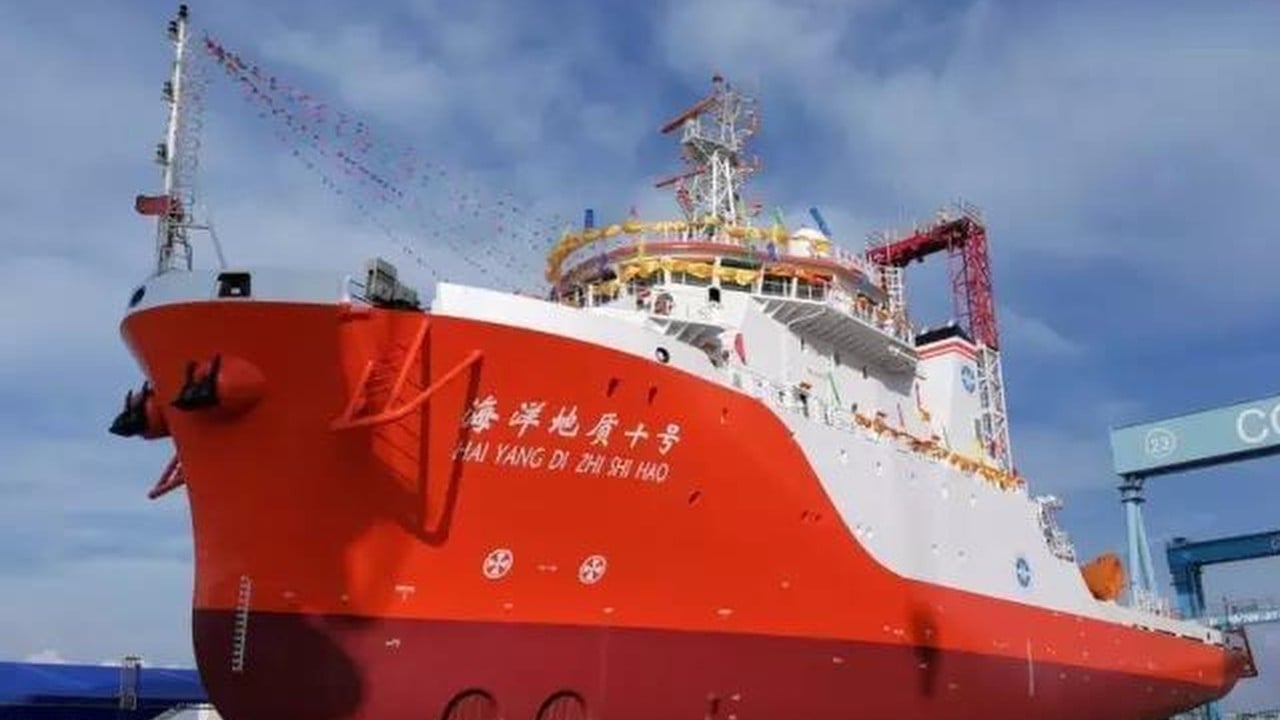
Maritime sovereignty enforcement in contested zones relies less on kinetic clashes and more on the sustained expenditure of operational assets. When a state maintains continuous vessel presence near disputed geographical features like Scarborough Shoal, it imposes a structural cost model upon regional competitors. Evaluating these missions requires discarding vague media narratives about "tensions" and instead analyzing the underlying logistics, resource allocation, and strategic signaling mechanisms that govern modern maritime competition.
The Operational Mechanics of Continuous Stationing
Maintaining a research or enforcement vessel in a localized maritime sector for extended intervals—such as a month-long deployment—demands a tightly managed logistics chain. Unlike transit operations, stationary or loitering operations introduce specific engineering and operational variables:
- Station-Keeping Fuel Burn: Dynamic positioning or continuous low-speed maneuvering against prevailing currents and seasonal monsoons incurs baseline fuel consumption that scales directly with hull displacement.
- Rotational Crew Fatigue Management: Extended missions require either onboard crew rotation via tender vessels or periodic port returns, creating a recurring vulnerability window during transit handoffs.
- Sensor Maintenance Cycles: Saltwater environments degrade radar arrays, sonar transducers, and optical equipment rapidly, necessitating continuous preventative maintenance by specialized technicians while underway.
These operational constraints mean that a month-long mission is not a static event; it is an exercise in resource optimization. The deploying state tests its capacity to project administrative presence without triggering an escalatory threshold that justifies a direct military response.
Strategic Signaling and the Cost Asymmetry
The fundamental utility of deploying research or paramilitary vessels to contested zones stems from the principle of cost asymmetry. Military warships carry high operating costs, severe opportunity costs regarding fleet readiness, and high political signaling value that can prematurely force an adversary's hand. Conversely, civilian-hulled research vessels or coast guard cutters alter this calculus.
[Deployment Vector]
       │
       ├──> High-End Naval Asset (High Escalation Risk, High Operating Cost)
       │
       └──> Multi-Role Research/Cutter Vessel (Ambiguous Status, Low Escalation Risk, High Persistence)
By utilizing non-military or auxiliary hulls for long-duration data collection, bathymetric mapping, and environmental sampling, a state achieves three distinct objectives:
- Legal and Administrative Precedent: Continuous presence builds a persistent record of operational oversight, which can later be cited in diplomatic or legal frameworks as de facto administrative control.
- Adversarial Attrition: Forcing a competitor to deploy counter-assets in response consumes their patrol vessel budget, strains their maintenance schedules, and diverts assets from other critical maritime zones.
- Information Dominance: Research vessels execute dual-use mapping. The collection of oceanographic, salinity, and acoustic data serves both civilian scientific interests and submarine warfare navigation modeling.
The Economic and Geopolitical Equilibrium
The strategic equilibrium around features like Scarborough Shoal is governed by endurance rather than tactical supremacy. Neither side seeks open kinetic conflict, as the economic fallout of disrupting regional trade lanes outweighs the immediate value of the shoal itself. Consequently, competition manifests as a war of endurance measured in cumulative days at sea, vessel availability rates, and the political will to absorb ongoing operational expenditures.
When analyzing reports of extended missions, observers must look past the superficial framing of diplomatic posturing. The true metric of success is the efficiency of the logistics train and the psychological pressure exerted on adversary command structures through predictable, unyielding persistence.
To forecast future shifts in these contested zones, monitor changes in vessel class rotations, the frequency of resupply rendezvous, and the deployment of specialized auxiliary craft designed for extended endurance rather than high-speed tactical engagement. The state that optimizes its logistics for permanent, low-cost persistence will ultimately dictate the operational baseline of the region.


