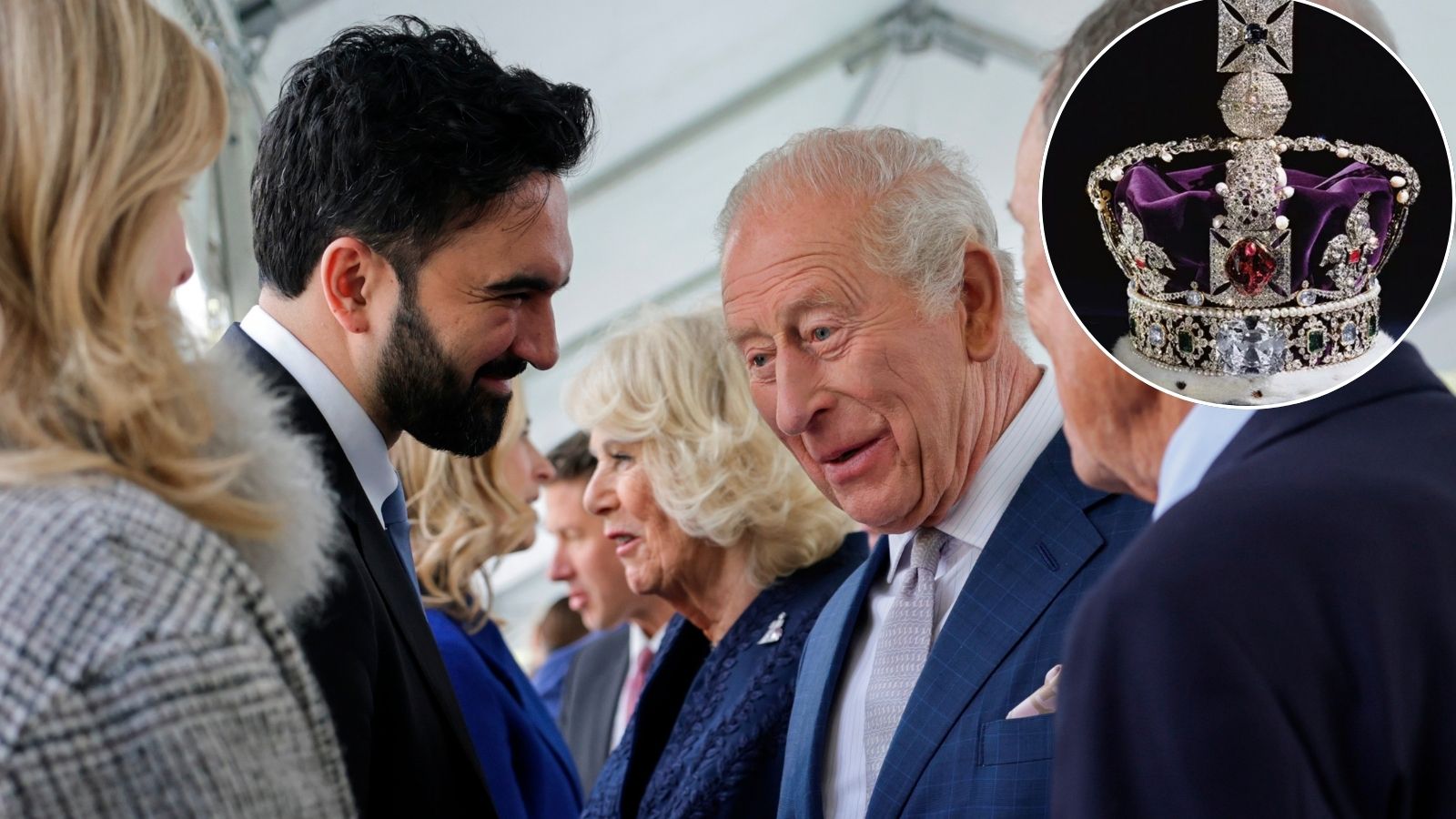
The endorsement of the Koh-i-Noor diamond’s return by New York Mayor Zohran Mamdani during the 2026 visit of King Charles III represents more than a localized political gesture; it functions as a calculated stress test for the contemporary "Special Relationship" between the United States and the United Kingdom. While populist discourse frames this as a simple matter of historical restorative justice, a rigorous analysis reveals a complex intersection of urban constituent management, international property law, and the shifting valuation of soft power assets in a post-colonial global economy.
The Tripartite Framework of Repatriation Logic
To understand why a municipal leader would intervene in a matter of international sovereign artifacts, one must deconstruct the motivations into three distinct drivers: Constituent Alignment, Symbolic Arbitrage, and Legal Precedent Pressure.
1. Constituent Alignment and Localized Foreign Policy
New York City serves as a microcosmic hub for the Global South diaspora. Mamdani’s stance is an exercise in "paradiplomacy," where subnational leaders bypass federal channels to speak directly to international issues that resonate with their local voting blocs. The South Asian diaspora in New York possesses significant economic and political density. By aligning with the repatriation movement, municipal leadership converts a distant historical grievance into immediate domestic political capital. This creates a feedback loop where local advocacy influences national platforms, eventually forcing the State Department to calculate the friction cost of remaining neutral.
2. Symbolic Arbitrage
The Koh-i-Noor is not merely a 105.6-carat diamond; it is a concentrated symbol of the British Empire’s extractive history. In the current geopolitical climate, the "cost of holding" such an asset is rising. For the British Monarchy, the diamond acts as a lightning rod for republican sentiment and Commonwealth instability. Conversely, for India, the diamond is a "sovereignty multiplier." Its return would signify a formal closing of the colonial chapter, providing a psychological and political victory that outweighs the stone’s intrinsic mineral value.
3. Legal Precedent Pressure
The return of the Koh-i-Noor would fundamentally alter the legal landscape for "contested cultural property." Currently, the British Museum Act of 1963 and the National Heritage Act of 1983 serve as statutory barriers to de-accessioning artifacts. However, executive-led returns—such as the recent return of the Benin Bronzes by various European institutions—create a "customary law" momentum. Mamdani’s public backing adds to the mounting global consensus that statutory protections for colonial-era acquisitions are becoming morally and diplomatically untenable.
The Economic and Diplomatic Friction of Restitution
The argument for repatriation often ignores the mechanical complexities of the transfer. We must evaluate the Friction Coefficients that prevent a simple hand-over.
- The Chain of Custody Paradox: The diamond has been claimed by India, Pakistan, Afghanistan, and Iran. A return to India alone triggers diplomatic volatility with other regional powers. The UK uses this "multi-claimant" reality as a defensive buffer to maintain the status quo.
- The Slippery Slope Financial Risk: If the Koh-i-Noor is returned, it sets a valuation benchmark for thousands of other artifacts. For institutions like the British Museum, the "Repatriation Liability" could represent a significant portion of their physical asset base, potentially leading to a "hollowing out" of Western cultural repositories.
- The Security and Insurance Overhead: Moving an asset of this magnitude requires a multi-million dollar security apparatus. The logistical execution involves sovereign-level risks that local politicians often underestimate when calling for "immediate return."
The Mechanics of Sovereign Legitimacy
King Charles III’s visit to the United States occurs at a moment of transition for the British Monarchy. The institution is attempting to pivot from "Imperial Continuity" to "Commonwealth Partnership." In this context, the Koh-i-Noor is a liability to the brand.
A data-driven view of soft power suggests that the UK's influence is increasingly tied to its ability to lead on moral and international norms rather than its historical hoard of wealth. Mamdani’s timing exploits this vulnerability. By raising the issue during a state-level engagement, he forces the King into a defensive rhetorical posture, which in turn diminishes the "diplomatic yield" of the visit.
The Institutional Response Matrix
The British government typically employs a "Retentionist Strategy" based on three pillars:
- Legality: The acquisition was formalized through the Treaty of Lahore (1849).
- Universality: The idea that artifacts are better served in "universal museums" where they are accessible to a global audience.
- Conservation: The claim that the UK provides a superior environment for the preservation of delicate historical items.
Mamdani’s intervention systematically attacks the "Universality" pillar by suggesting that the diamond’s presence in London is not an act of global service, but a persistent mark of historical "theft." When a leader of New York—the world’s other primary claimant to the title of "Global City"—challenges the universalist argument, the British position loses its primary intellectual defense.
Quantifying the Geopolitical Shift
If we treat international relations as a market, we are seeing a "Sell" signal on colonial heritage assets. The United States government, while officially neutral, monitors these local political movements to gauge shifts in the "Anti-Colonial Sentiment Index" among key demographics.
The "Mamdani Effect" illustrates a shift in how political pressure is applied. Instead of top-down diplomatic cables, we see a "bottom-up" erosion of legitimacy. This is a horizontal pressure model:
- Level 1: Grassroots activism and academic critique.
- Level 2: Municipal and regional political endorsements (The Mamdani Stage).
- Level 3: National legislative debates.
- Level 4: Formal diplomatic ultimatum.
The movement for the Koh-i-Noor is currently transitioning from Level 2 to Level 3. The presence of a high-profile US politician in this discourse accelerates the timeline for Level 4.
The Strategic Path Forward
The British Monarchy and Government cannot afford to ignore the rising cost of the Koh-i-Noor’s retention. A purely defensive posture is a decaying strategy. To manage the diplomatic fallout and preserve the long-term integrity of the Commonwealth, a "Staged Restitution Model" is the most logical outcome.
- The Collaborative Stewardship Phase: Establishing a joint UK-India commission to manage the diamond, potentially allowing it to travel between the two nations for public display. This lowers the immediate "sovereignty shock."
- The Legal Carve-Out: Amending the National Heritage Act to allow for the return of artifacts specifically listed as "Sovereign Regalia," which separates the Koh-i-Noor from the thousands of smaller artifacts in the British Museum, thus containing the "slippery slope" risk.
- The Digital Equity Initiative: Investing in high-fidelity digital repatriation and cultural investment in the source country to offset the physical loss of the artifact.
The return of the Koh-i-Noor is no longer a question of "if" but "under what conditions." Political actors like Mamdani are effectively raising the "holding tax" on the UK's colonial legacy. For the British state, the most efficient move is to negotiate the return on their own terms before the diplomatic cost becomes prohibitive. The ultimate objective is to convert a symbol of past extraction into a vehicle for future partnership, thereby preserving influence in the very regions where the diamond’s history began.