The shift in Northern Europe’s security architecture is driven by structural military integration rather than symbolic political gestures. The deployment of Swedish mechanized forces under direct NATO command along the eastern flank introduces an updated operational reality. This integration converts Sweden's historical doctrine of territorial defense into a forward-deployed, collective deterrence model. By examining the structural mechanics of this deployment, the integration of command structures, and the altered defense economics of the Baltic Sea basin, the strategic implications for the North Atlantic Treaty Organization and its regional adversaries become clear.
The Tri-Border Force Posture: Mechanics of Forward Land Forces
The deployment operates through two distinct operational nodes on the eastern flank: the Forward Land Forces (FLF) in Latvia and the newly established FLF Finland. This dual-axis posture creates an integrated defensive front that optimizes Sweden's specific military capabilities.
                  [ JFC Norfolk / SACEUR ]
                             |
         +-------------------+-------------------+
         |                                       |
[ MNB Latvia (Ādaži) ]                [ FLF Finland (Boden/Rovaniemi) ]
  - Framework: Canada                   - Framework: Sweden
  - Swedish Mechanized Battalion        - Swedish Core Battalion
  - Role: Baltic Littoral Defense       - Role: High North Arctic Warfare
The Southern Axis: FLF Latvia
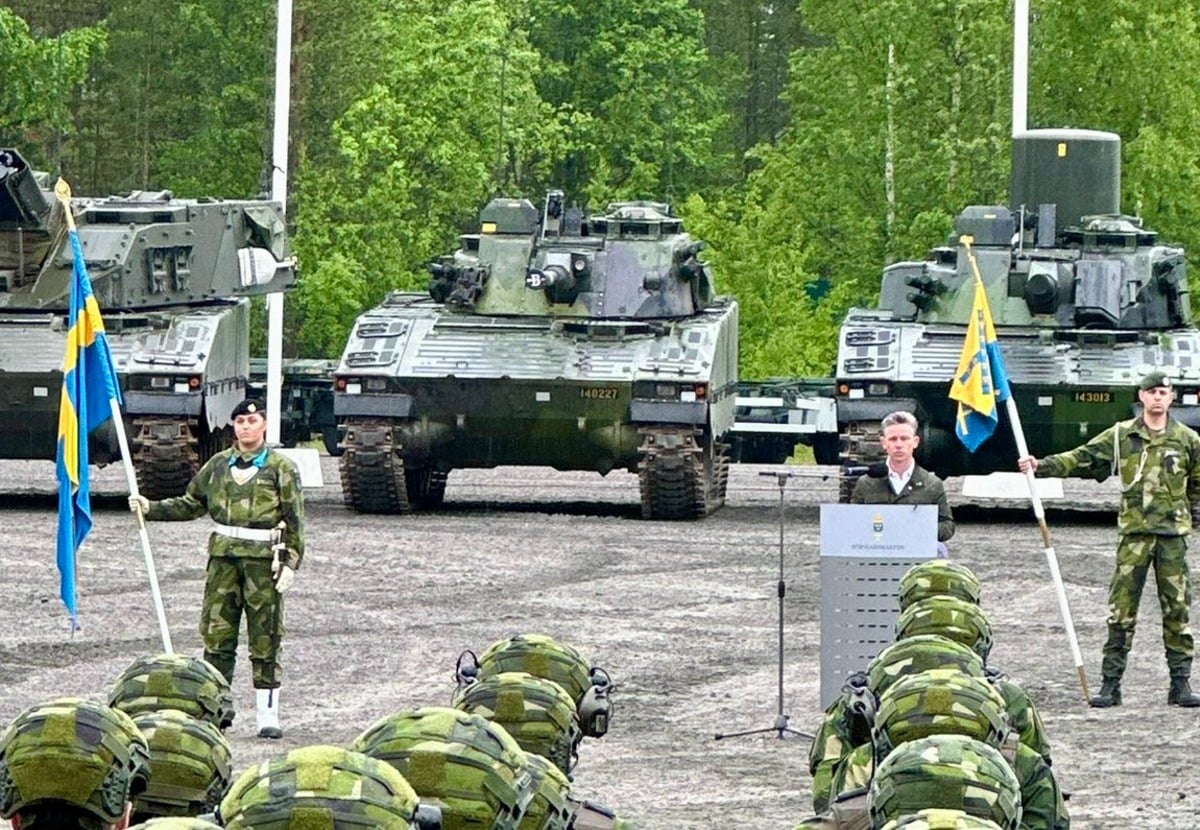
Based at the Ādaži military base outside Riga, the NATO Multinational Brigade Latvia (MNB-LVA) functions under Canadian leadership as the framework nation. Sweden contributes a mechanized battalion equipped with Stridsfordon 90 (CV90) infantry fighting vehicles and Stridsvagn 122 main battle tanks.
- Operational Objective: Establish tactical friction along vulnerable land corridors to delay any rapid peer-adversary advance.
- Logistical Pipeline: The force is sustained via sea lines of communication across the Baltic Sea from Gothenburg and Karlskrona to Riga, turning the Baltic Sea into an internal NATO logistical route.
The Northern Axis: FLF Finland
Headquartered with a Multinational Staff Element in Rovaniemi and drawing its core Swedish battalion from the Norrbotten Regiment (I 19) in Boden, FLF Finland operates directly under Joint Force Command (JFC) Norfolk.
- Operational Objective: Secure the North Calotte region, an Arctic zone stretching across northern Norway, Sweden, and Finland.
- Scalability Framework: The baseline deployment of approximately 600 personnel features an built-in surge capacity to scale up to 1,200 personnel within a 72-hour window. This structure uses pre-positioned equipment stockpiles to minimize transit lag.
Command Transfer Architecture and Interoperability Bottlenecks
The transition from national command to NATO’s Allied Command Operations introduces complex procedural shifts. The formal Transfer of Authority (ToA) relocates the tactical direction of Swedish forces from the Swedish Joint Forces Command to the Supreme Allied Commander Europe (SACEUR). This process highlights three main structural challenges.
1. The C4ISR Integration Function
Achieving true technical interoperability requires aligning sovereign command, control, communications, computers, intelligence, surveillance, and reconnaissance (C4ISR) systems. Swedish units must integrate into the NATO Secret Wide Area Network (NSWAN). This transition demands hardware compatibility for encrypted data links and tactical data networks like Link 16, ensuring real-time blue-force tracking across multinational formations.
2. Standardization of Rules of Engagement (ROE)
National legal constraints frequently conflict with alliance-level operational mandates. While NATO operates on pre-negotiated, matrixed ROE tailored for collective defense under Article 5, the Swedish government retains ultimate constitutional authority over its troops. This dual-key command risk can introduce hesitation during hybrid or ambiguous gray-zone incidents, where the threshold for open kinetic conflict is intentionally obscured by an adversary.
3. Logistical Interoperability and Ammunition Consumables
Despite decades of partnership, differences remain in the specific configurations of 155mm artillery ammunition, data buses on armored vehicles, and supply chain tracking systems. The operational utility of the Swedish battalion depends on its ability to utilize Canadian, Danish, or Latvian supply lines without degrading combat readiness.
Baltic Sea Geopolitics and the Anti-Access Dilemma
The inclusion of Swedish territory and military assets changes the strategic calculus within the Baltic Sea maritime theater. Historically, NATO’s primary vulnerability in the region was the Suwalki Gap—a narrow land corridor separating Belarus from the Russian exclave of Kaliningrad. This gap was the sole land route connecting Poland to the Baltic states.
OLD REGIONAL DYNAMICS:
[NATO Poland] <--- Vulnerable Suwalki Gap ---> [Baltic States] (Isolated)
                                                  ^
                                                  | (At Risk from Kaliningrad A2/AD)

NEW REGIONAL DYNAMICS:
[NATO Sweden] === Secure Maritime/Air Lines ===> [Baltic States] (Reinforced)
Swedish integration changes this geographic vulnerability by providing strategic depth. Gotland Island, situated in the center of the Baltic Sea, serves as an unsinkable platform for long-range air defense and anti-ship missile systems.
The deployment of Swedish forces to the eastern littoral counters Russia’s Anti-Access/Area Denial (A2/AD) bubble centered in Kaliningrad. The combination of Sweden’s Visby-class stealth corvettes, Gotland-class air-independent propulsion (AIP) submarines, and forward-deployed mechanized forces creates an overlapping defensive counter-bubble.
This network secures the airspace and maritime lanes across the Baltic, ensuring that the reinforcement of Estonia, Latvia, and Lithuania is no longer entirely dependent on the Suwalki Gap.
Resource Attrition and Force Sustainability
Evaluating the long-term viability of Sweden's forward-deployed posture requires assessing its military asset capacity. Maintaining a persistent rotation of 600 to 1,200 troops abroad places demands on a state’s military infrastructure.
A standard deployment matrix requires a 3:1 generation ratio:
$$\text{Total Force Required} = 3 \times N$$
In this equation, $N$ represents the forward-deployed force. For every battalion stationed in the Baltics or Finland, one battalion must be undergoing post-deployment reconstitution and maintenance at home, while a third undergoes pre-deployment mission-specific training. For the Swedish Army, which maintains a streamlined active-duty brigade structure, a permanent deployment of 600 personnel absorbs a significant share of its baseline readiness assets.
Furthermore, Arctic warfare capabilities are resource-intensive. Operating mechanized armor in the sub-zero environments of the High North accelerates equipment wear, requiring specialized maintenance footprints and higher parts-consumption rates than standard European deployments. Sweden must balance these forward alliance commitments against its core national requirement to maintain a credible domestic defense posture.
Strategic Playbook for the High North
The integration of Swedish forces under NATO command shifts the regional balance of power from ambiguous neutrality to structured collective defense. To maximize the deterrent value of this deployment while mitigating its inherent risks, alliance planners should focus on three operational priorities:
- Establish Permanent Pre-Positioned Weapon Stockpiles (POMCUS): Rather than continuously moving heavy armor across the Gulf of Bothnia, NATO should establish permanent equipment storage sites in northern Finland, maintained by Swedish framework elements. This cuts transport requirements to personnel allocation alone during a crisis.
- Unify the Arctic Command Structure: Resolve potential command friction between JFC Brunssum (which oversees the Baltic states) and JFC Norfolk (which manages the High North) by designating a unified sub-regional command for the Nordic-Baltic zone.
- Invest in Overlapping Active Air Defense: Deploy mixed air defense batteries combining Sweden's RBS 98 with long-range Patriot systems to safeguard the logistical hubs in Boden and Rovaniemi against potential pre-emptive missile strikes.