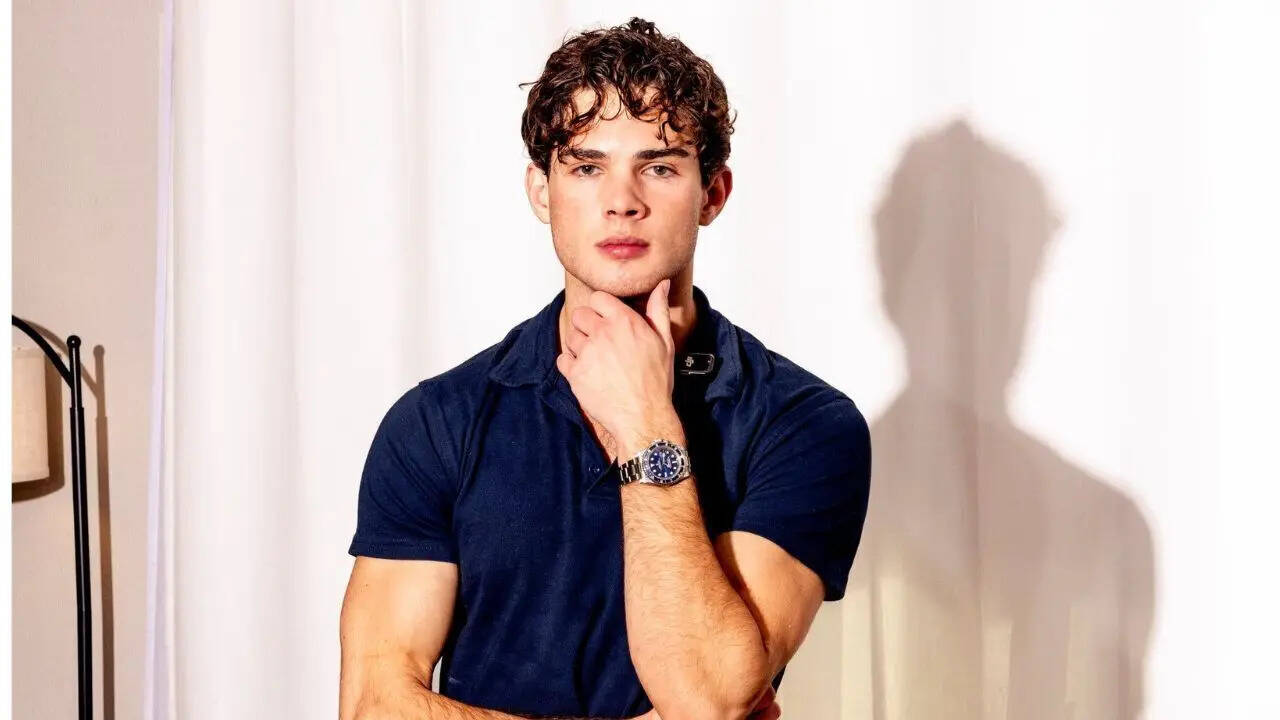
The glow of a smartphone screen at 2:00 AM doesn’t just illuminate a face; it acts as a window into the collective id of the internet. Most of us scroll through the digital ether looking for a distraction from the weight of our own lives. We look for a laugh, a recipe, or perhaps a reason to feel indignant. But every so often, the algorithm serves up something that doesn’t just annoy—it chills.
Recently, the influencer known as Clavicular didn’t just cross a line. He erased it. Meanwhile, you can read related events here: The Brutal Truth About Why British Insults Work.
By announcing an "impregnation competition," Clavicular managed to transform the most profound biological and emotional commitment a human can make into a viral gimmick. The premise was as simple as it was staggering: he would seek out women to compete for the chance to carry his child, framed with the same breathless energy one might use to give away a custom PC or a year’s supply of energy drinks.
It was a stunt designed for the era of the click. It worked. Millions watched, thousands commented, and a wave of visceral, white-hot outrage followed. But if we look past the immediate shock, we find a story that isn't really about one man’s vanity. It is a story about what happens when the logic of the creator economy finally consumes the human soul. To see the bigger picture, check out the recent report by Apartment Therapy.
The Architect of the Absurd
To understand the weight of this, you have to look at the man behind the camera. Clavicular thrives on the edge. His brand is built on a specific kind of modern bravado—one that treats life as a series of levels to be beaten and clout as the ultimate currency.
When he looked into the lens and uttered the words, "I’m gonna be a dad," he wasn't speaking with the hushed awe of a man who had just seen an ultrasound. He was speaking like a CEO announcing a merger.
The proposal involved a vetting process, a competition, and a public spectacle. In this hypothetical arena, the potential mothers weren't partners or even co-parents; they were contestants. They were variables in an equation designed to maximize engagement metrics.
Imagine a young woman, perhaps struggling with the loneliness that defines the digital age, seeing this. To her, it might look like a shortcut to a life of luxury or relevance. To the rest of us, it looks like the commodification of a heartbeat.
The Ghost in the Machine
Human biology is a stubborn thing. It doesn't care about your follower count.
For hundreds of thousands of years, the act of bringing a life into the world has been tethered to social bonds, whether they were rooted in love, survival, or community. It is a process that requires vulnerability. It demands that you put someone else’s needs above your own for at least two decades.
Contrast that with the influencer’s playbook. The playbook demands constant self-optimization. It requires you to be the protagonist of every story. It treats every interaction as a "content opportunity."
When you apply that logic to fatherhood, the math breaks. A child is not a trophy. A child is not a limited-edition drop. Yet, Clavicular’s proposal treated the very existence of a human being as a "reward" for a successful marketing campaign.
The outrage wasn't just about bad taste. It was a defensive reflex from a society that still, despite everything, believes some things should remain sacred. We felt that cold shiver because we recognized a terrifying truth: if we can gamify birth, there is nothing left that is off-limits.
The Invisible Victims of the Viral Loop
We often talk about "the audience" as a monolith. We treat them as a data point. But the audience is made up of individuals—many of whom are young, impressionable, and increasingly unable to distinguish between a performative stunt and a moral reality.
Consider the psychological fallout.
When a massive creator treats the creation of life as a game, it shifts the Overton Window. It suggests that children are accessories to a lifestyle rather than people with their own inherent rights. It reinforces a world where the only thing that matters is the "win."
If Clavicular’s competition were to actually manifest, what happens to the child? That child would enter the world not as a person, but as a legacy of a PR stunt. They would be born into a digital archive of their own conception-as-entertainment. Every milestone, from the first steps to the first day of school, would be filtered through the lens of a brand.
That isn't parenting. It’s a long-form reality show where the star never signed a contract.
The Mechanics of the Outrage Economy
Why do we keep seeing these escalations? Why does a creator feel the need to move from "prank videos" to "human breeding contests"?
The answer lies in the brutal physics of the attention economy.
Attention is a depreciating asset. What shocked people yesterday is the background noise of today. To stay relevant, to keep the sponsorship checks rolling in and the numbers climbing, creators must constantly raise the stakes. They have to find the next "unthinkable" thing and think it.
- Stage 1: Mild controversy (A rude comment, a bad take).
- Stage 2: Calculated offense (Staged fights, public disruptions).
- Stage 3: Existential boundary-pushing (Life, death, and now, birth).
Clavicular reached Stage 3. He tapped into the ultimate human taboo because it was the only thing left that could still pierce the veil of our collective boredom.
The Silence of the Stakeholders
In the wake of the viral video, the silence from platforms and sponsors was telling. We live in a time where a creator can be banned for a copyright strike on a song, yet the discussion of a "human competition" for pregnancy is treated as just another piece of "edgy content."
This is the failure of the digital landscape. We have built the most powerful communication tools in history, but we have failed to build a moral compass to go with them. We reward the loudest voice, the most shocking claim, and the most narcissistic display. Then, we wonder why the culture feels so hollow.
A Choice at the Crossroads
We are at a point where we have to decide what we value more: the freedom to pursue "clout" at any cost, or the dignity of the human experience.
Clavicular is a symptom, not the disease. The disease is a culture that equates visibility with worth. It is a mindset that sees other people as NPCs (non-player characters) in the story of our own greatness.
If we allow the most fundamental aspects of our humanity—love, grief, birth—to be converted into "content," we lose the very thing that makes life worth living. We become characters in a script written by an algorithm that doesn't know how to feel.
The "impregnation competition" failed to launch in the way Clavicular perhaps hoped, meeting a wall of resistance that even his ego couldn't ignore. But the fact that it was proposed at all remains a stain. It serves as a warning.
A child is a person. A mother is a person. They are not prizes in a digital raffle.
Somewhere, far away from the cameras and the comments sections, a father is holding his newborn for the first time. He isn't thinking about his reach. He isn't checking his engagement. He is looking into a pair of eyes that represent an infinite, terrifying responsibility. He knows that his life, as he knew it, is over, and something much more important has begun.
That quiet, heavy, beautiful reality is the one thing the internet can never truly capture. It is the one thing that cannot be won in a competition. It is the one thing that, for all his followers, Clavicular seems to have completely forgotten.
The cameras eventually turn off. The lights go dim. The followers move on to the next scandal. But a child is forever.