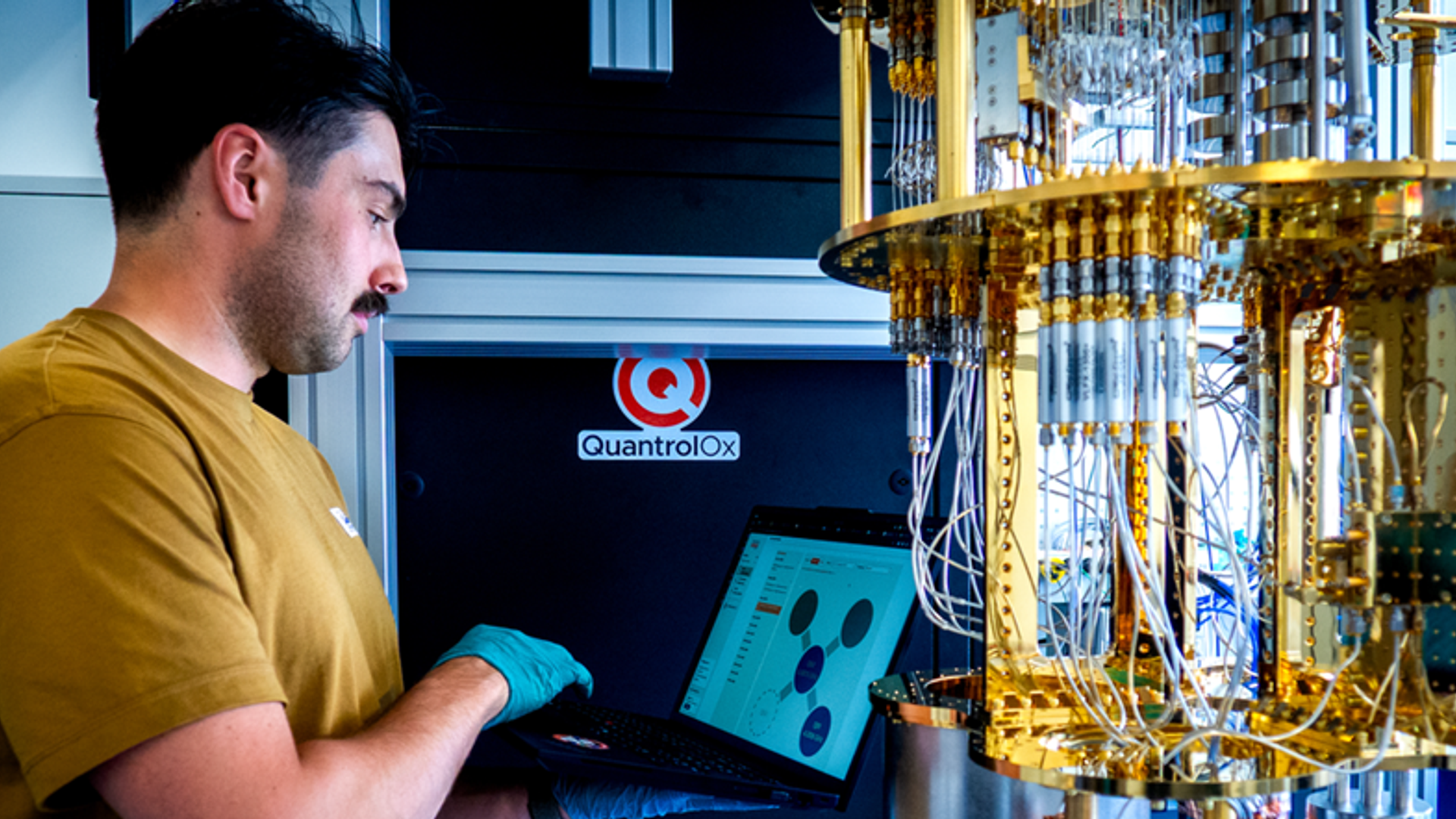
Ten million pounds in quantum computing sounds like a fortune. In hardware reality, it barely pays for a handful of dilution refrigerators, cryogenic cabling, and senior physicists whose salaries rival quantitative finance desks.
When a headline announces that an Oxford spinout like QuantrolOx has landed a £10m funding boost, the standard press release chorus begins on cue. Investors celebrate momentum. Pundits write about British deep tech climbing the global ladder. Founders talk about scaling control electronics and automating qubit calibration. Recently making headlines in this space: The Economics of Noncompliance: Deconstructing Meta’s Multibillion Privacy Penalties.
None of that is a crime. Raising money is hard, especially in a capital-intensive sector where commercial payoff still stretches out over years rather than quarters.
Yet the lazy consensus surrounding quantum funding announcements gets the core tension backwards. The market loves cheering for incremental tooling and control-layer breakthroughs as if solving calibration speed or pulse precision automatically unlocks fault-tolerant quantum advantage. It does not. Control automation is necessary plumbing. Confusing better plumbing with a finished house is how boards, founders, and taxpayers end up misallocating attention and capital. More information into this topic are explored by TechCrunch.
The Wrong Question Everyone Keeps Asking
Whenever a quantum control or characterization company raises fresh capital, the predictable questions follow immediately. Can their software tune qubits faster? Will their automated calibration shave hours off lab bring-up? Does this give domestic hardware teams an edge in the race toward commercial machines?
Those questions treat qubit tuning as the main event. It is not.
In quantum information processing, a qubit is not a clean binary switch waiting for a neat control waveform. It is a fragile quantum state coupled to an environment full of noise, drifting parameters, two-level system defects, crosstalk, and control electronics imperfections. You can apply the sharpest, most mathematically optimized microwave or laser pulses in the world, and you still run smack into decoherence, gate errors, and the brutal scaling math of quantum error correction.
Think of it like tuning the suspension on a rally car while the chassis is still cracking over rough terrain. Better damping helps you test the car faster between repairs. It does not magically turn brittle metal into titanium.
I have watched deep-tech teams pour millions into slick automation layers on top of noisy, poorly understood physical platforms. The dashboards looked impressive in investor demos. The underlying error rates stubbornly refused to cross fault-tolerant thresholds at scale. When physical qubits drift or suffer correlated errors, faster calibration simply lets you measure the pain at higher frame rates.
What Qubit Control Actually Does—And Where It Hits a Wall
To see where the nuance lies, we need precise definitions. Qubit control refers to the physical signals—microwave pulses, laser fields, magnetic biases, or baseband voltage sequences—used to initialize, manipulate, and read out quantum states. Characterization and calibration refer to measuring how those physical operations actually behave compared to their ideal unitary targets, then adjusting parameters to compensate for drift and distortion.
In real superconducting, trapped-ion, neutral-atom, or spin-qubit hardware, every pulse has flaws. Attenuators and mixers have nonlinearities. Cryogenic lines introduce frequency-dependent dispersion. Qubits shift in frequency over time. Neighbors talk to one another when you only want one to move.
Automated tuning and characterization tools attack this friction directly. Instead of a graduate student or postdoc spending weeks tweaking parameters by hand after every thermal cycle, automated routines map out Hamiltonian parameters, optimize gate shapes, and track drift systematically.
That matters for two concrete reasons:
- Lab throughput rises. Engineers spend less time babysitting individual devices and more time testing architectural changes across arrays.
- Reproducibility improves. Standardized calibration reduces human guesswork when moving from a single qubit or small coupler to multi-qubit lattices.
Yet even best-in-class control hits hard physical ceilings. No pulse-shaping algorithm can repeal thermodynamic noise or material defects inside a Josephson junction or semiconductor quantum dot. If a device suffers from charge noise or fluctuating two-level defects, pulse optimization can sometimes suppress specific coherent errors or mitigate certain drift modes, but it cannot conjure infinite coherence times out of thin air.
At larger qubit counts, control complexity itself becomes a scaling monster. Running bespoke, slow calibration loops on hundreds or thousands of physical qubits breaks down quickly if overhead scales poorly with system size. You do not just need clever tuning on one chip; you need scalable architectures where control, readout, and error correction work together without drowning the system in latency and wiring.
Why Capital Chases Control Layers
If control automation is supporting infrastructure rather than the whole miracle, why does capital keep flowing into companies focused on tuning, characterization, and control workflows?
Follow the incentives.
Building a full-stack quantum computer from scratch requires staggering capital expenditure, specialized fabrication, cryogenics talent, and years of patient R&D before revenue looks remotely meaningful. Early-stage and mid-stage investors frequently look for "picks-and-shovels" plays—companies selling software, instrumentation, or control tools to every hardware lab regardless of which qubit modality eventually wins.
In theory, that sounds prudent. If ten labs are building superconducting processors, spin qubits, or neutral atoms, a company that speeds up characterization or control can sell into multiple buyers without betting everything on one physical qubit design.
In practice, that strategy carries a trap. Tooling businesses only grow as fast as their customers' hardware scales and budgets hold. If a hardware customer stalls on error rates or runs out of runway, a vendor selling calibration or control tooling loses an expansion path. Worse, big hardware players often build internal control and automation stacks once a workflow becomes mission-critical, squeezing third-party specialists unless those specialists stay sharply differentiated.
Oxford sits inside one of Europe's densest quantum ecosystems, backed by strong academic pedigree and university spinout machinery. That environment produces serious physics talent and credible founders. Still, geographic proximity to world-class research does not exempt a company from harsh commercial math. Ten million pounds buys time to prove product fit, sharpen software and hardware integration, and win paying enterprise or research customers. It does not guarantee a monopoly on the quantum stack.
Imagine a Different Bottleneck
Imagine a scenario where a hardware team has already solved automated qubit calibration to near-perfection. Every single gate on a 256-qubit processor is tuned in minutes, drift is tracked continuously, and pulse distortions are compensated cleanly. Now imagine that the physical two-qubit gate error rate still hovers around 1 percent, and wiring density inside the cryostat is already maxed out.
What happens next?
Nothing transformative. The team has a brilliantly tuned machine that still cannot run large fault-tolerant algorithms because logical error suppression requires far lower error rates, massive physical-to-logical qubit overhead, and tight integration with fast classical decoders.
This is the reality check missing from most funding cheerleading. Faster tuning makes an existing experimental setup more productive. It does not solve quantum error correction, cryogenic I/O bottlenecks, or materials engineering on its own.
What Heavy Hitters Have Been Saying for Years
Anyone who has followed serious quantum engineering knows this argument is not fringe heresy—it lines up with what foundational figures in the field have stressed for years.
John Preskill coined "NISQ"—Noisy Intermediate-Scale Quantum—to capture an era of dozens to a few hundred noisy qubits where error rates and qubit counts limit what algorithms can achieve without full error correction. You do not exit the NISQ regime merely by making calibration scripts cleaner; you exit it through dramatic improvements in error rates, qubit counts, and fault-tolerant architectures.
Scott Aaronson has repeatedly pushed back against hype while defending the genuine scientific depth of quantum computing, reminding observers how steep the engineering climb remains from clever lab demonstrations to broadly useful quantum speedups.
And look at the roadmaps from major hardware builders like IBM, Google, and Quantinuum. Across superconducting and trapped-ion architectures, the center of gravity has shifted relentlessly toward quantum error correction, logical qubits, real-time decoding latency, and scalable system engineering. Calibration and control sit inside that pipeline, not above it.
Dismantling the "People Also Ask" Myths
When people search around a funding story like QuantrolOx's, their follow-up questions usually rest on shaky assumptions. Let's tear those down directly.
"Does £10m in funding mean commercial quantum computers are almost here?"
No. A £10m round for a specialized spinout is a growth and execution milestone, not a commercial finish line for universal quantum computing. Commercial utility on problems that genuinely beat classical supercomputers remains a multi-year engineering campaign across hardware, error correction, and algorithms. Treating a £10m spinout raise as proof of imminent commercial dominance confuses local company momentum with industry-wide maturity.
"Is automated qubit calibration more important than building better qubits?"
Not even close. Better physical qubits—longer coherence, higher gate fidelity, cleaner fabrication, lower crosstalk, and scalable interconnects—are the bedrock. Automated calibration is a force multiplier for engineers working with those qubits. A force multiplier on a weak foundation still produces a weak result.
"Will UK quantum spinouts beat US and Asian giants with targeted funding rounds?"
Not on raw capital scale alone. US tech giants, dedicated public-market quantum players, and state-backed programs in Asia deploy vastly larger sums over longer horizons. Where UK spinouts can compete is sharp technical specialization, tight links to academic breakthroughs, and capital discipline—provided they do not mistake modest funding rounds for parity with multi-billion-dollar hardware programs.
Unconventional Moves That Actually Work
If you run a quantum tooling or control company—or allocate capital into one—stop trying to sound like a full-stack quantum savior and do the unglamorous things that actually stick.
- Pick a concrete workflow pain and own it end-to-end. Vague claims about "accelerating quantum readiness" go nowhere with seasoned lab directors. Cut calibration overhead from days to minutes on a specific hardware stack, integrate cleanly with existing lab instruments, and prove measurable hours saved.
- Optimize for scale, not hero demos. Anyone can tune a handful of qubits on a good day. Build workflows that survive thermal cycles, hardware drift, and growing qubit counts without turning into brittle custom scripts that break every time the lab changes a component.
- Price for real budgets, not fantasy futures. Quantum research labs and early enterprise buyers scrutinize every pound. Offer clear, modular value tied to hardware utilization, engineering time saved, or integration speed rather than waiting for hypothetical trillion-dollar markets to materialize.
- Stay modality-aware without pretending every hardware path is equal. Having cross-platform capability sounds neat on a slide deck, but deep integration with specific control electronics and physical architectures often wins real contracts. Focus where your physics and engineering edge actually bite.
Where My Contrarian Stance Can Backfire
Being contrarian feels great until the market proves your nuance too cautious. There are real risks to downplaying control and characterization companies.
First, engineering bottlenecks sometimes flip in ways outsiders underestimate. If a hardware team already has promising qubits and strong error-correction architecture, slow or manual calibration and characterization can genuinely stall iteration speed for months. A sharp tooling partner that removes that drag can punch well above its funding size.
Second, control electronics and characterization sit right at the interface between quantum physics and classical engineering. As systems scale up, automated diagnostics, drift compensation, and hardware-aware control could become embedded staples across multiple platforms—creating durable, high-margin niches even if they never take the spotlight reserved for qubit processors themselves.
Third, dismissing modest funding rounds can blind you to disciplined operators. Capital-constrained teams sometimes build tighter, more practical products than flush giants burning cash on sprawling moonshots.
Even with those caveats, the core diagnosis stands. A £10m boost for a quantum spinout is worth noting, not worshipping. Calibration makes the lab sharper; error correction, scalable hardware, and real workloads build the machine. Stop mistaking the wrench for the engine.