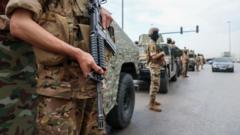
A temporary cessation of hostilities between nation-states and non-state actors is structurally unstable when the underlying enforcement mechanisms operate on asymmetrical rules of engagement. The 45-day extension of the Israel-Lebanon ceasefire, brokered in Washington on May 15, 2026, highlights this institutional design flaw. While diplomatically framed as a step toward regional stabilization, the operational reality on the ground—exemplified by an Israeli strike on a civil defense center in southern Lebanon that killed six personnel—reveals a system where military friction is actively incentivized rather than suppressed.
The core structural failure of the current truce is the concept of the porous ceasefire. Under the terms negotiated in Washington, a nominal cessation of offensive operations exists alongside an explicit carve-out: the United States has permitted Jerusalem to continue executing preemptive and responsive strikes against targeting assets deemed an imminent threat. This structural asymmetry transforms the ceasefire from a hard barrier into a managed conflict framework, where both sides utilize distinct calculus to justify ongoing kinetic actions.
The Asymmetrical Cost Function of Truce Violations
To understand why tactical violence persists despite high-level diplomatic agreements, the conflict must be analyzed through the asymmetric cost functions governing the Israel Defense Forces (IDF) and Hezbollah. A standard state-to-state truce relies on mutual deterrence, where the cost of violation ($C_v$) exceeds the perceived strategic benefit ($B_v$). In this theater, that equation is fundamentally broken.
For Israel, the strategic cost function incorporates an expansive definition of defense that values preventive neutralization over passive observation. The IDF operates under a doctrine where allowing Hezbollah to reconstitute its logistics, rearm its tactical positions, or reposition operatives in southern villages constitutes an unacceptable future risk. Consequently, the threshold for what constitutes an imminent threat is low. When Israeli drones or signals intelligence identify localized movements—such as weapons-bearing vehicles or personnel returning to frontline sectors—the perceived benefit of immediate kinetic elimination outweighs the diplomatic friction of a technical truce violation.
Conversely, Hezbollah’s cost function is driven by an imperative to maintain operational viability and territorial presence south of the Litani River. Having resumed major combat operations on March 2, 2026, following the escalation of the wider regional conflict, the group cannot accept total operational paralysis. For Hezbollah, a complete freeze on movement allows Israeli intelligence to map static assets with absolute precision. Therefore, the group accepts the tactical risk of attrition—such as losing localized operatives or infrastructure—to maintain a fluid, decentralized posture. This mismatch in operational definitions ensures that what Israel classifies as a necessary defensive interruption, Lebanon and Hezbollah classify as an overt breach of sovereign territory.
Tactical Friction Points and Lethal Escalation Mechanisms
The persistence of lethal strikes during an active diplomatic negotiation is driven by specific tactical triggers on the ground. These are not random breakdowns in discipline, but predictable outcomes of conflicting operational mandates.
- The Proximity Bottleneck: The physical overlap between non-state combatants, state defensive forces, and civilian infrastructure in southern Lebanon creates compressed reaction times. When IDF aerial reconnaissance detects movement in proximity to previously mapped launch sites or storage facilities, the decision loop favors immediate engagement.
- The Intelligence-Strike Loop: Israel’s persistent deployment of low-altitude unmanned aerial vehicles (UAVs) over Lebanese territory, including Beirut, maintains a continuous target-acquisition cycle. This permanent surveillance creates an operational bias toward action; when targets of opportunity emerge, the system is optimized to strike rather than defer to diplomatic channels.
- Retaliatory Equilibrium: Hezbollah operates under a doctrine of calibrated retaliation to prevent Israel from establishing a new baseline of uncontested access. When an Israeli strike occurs, Hezbollah frequently responds with localized kinetic actions—such as targeting IDF cross-border assets or launching short-range projectiles—to demonstrate that violations carry a continuous price.
This dynamic creates a self-reinforcing feedback loop. An Israeli strike designed to neutralize a suspected threat triggers a localized Lebanese response, which Israel then uses to justify subsequent counter-battery fire or airstrikes, all while the broader diplomatic framework remains nominally intact in Washington.
The Institutional Failure of Third-Party Mediation
The current instability is compounded by the structural absence of a credible, neutral enforcement mechanism on the ground. Historically, maritime and terrestrial border disputes rely on international observer missions to verify violations and arbitrate disputes before they escalate into kinetic exchanges.
The termination of the United Nations Interim Force in Lebanon (UNIFIL) mandate has left a profound security vacuum in the southern border sectors. Without a neutral third party to physically occupy buffer zones, verify the nature of contested movements, and provide transparent reporting, the theater has devolved into a binary intelligence environment.
In this environment, information is entirely monopolized by the belligerents. Israel relies exclusively on its own sensor arrays to declare an imminent threat, while the Lebanese state and Hezbollah rely on localized casualties to declare an unprovoked aggression. The lack of an independent, verified data stream means that every tactical incident is immediately weaponized by both sides to validate their respective strategic narratives, making it impossible for diplomatic sponsors to accurately penalize non-compliance.
The Limits of Diplomatic Postponement
The 45-day extension announced by the US State Department is not a peace agreement; it is an exercise in risk management designed to buy time for complex multilateral negotiations. The strategic limitation of this approach is that it treats time as a neutral variable, whereas on the ground, time actively degrades the viability of the truce.
A prolonged, porous ceasefire imposes a severe cumulative toll on the Lebanese state's internal stability. With over one million people displaced since the resumption of major hostilities in early 2026, the extended duration of a volatile status quo prevents the return of civilian populations and stalls economic reconstruction. Furthermore, the continuous degradation of state infrastructure—such as the destruction of civil defense assets and primary health facilities—erodes the formal Lebanese government’s capacity to govern, inadvertently increasing the structural dependency of local populations on non-state networks.
Strategic Forecast
The current architecture of the Israel-Lebanon ceasefire ensures its eventual collapse if left unmodified during the upcoming negotiations scheduled for June 2026. A porous truce that permits unilateral kinetic actions while lacking external verification cannot indefinitely withstand the compounding friction of daily tactical engagements.
The conflict will follow one of two trajectories before the expiration of the 45-day window:
- Systemic Failure via Attrition: A localized tactical strike will inadvertently kill a high-value commander or cause mass civilian casualties inside an unintended target zone. This will cross Hezbollah’s threshold for calibrated retaliation, triggering a mass rocket or missile volley into northern Israel that overwhelms defensive screens and forces a large-scale Israeli ground response, ending the diplomatic track completely.
- Transition to a Monitored Separation Framework: For the ceasefire to achieve structural stability, negotiators must replace the porous model with a rigid, verifiable separation of forces. This requires establishing explicit geographic boundaries where kinetic action is strictly prohibited, alongside the introduction of an alternative international monitoring mechanism—potentially involving regional states acceptable to both parties—to replace the defunct UN framework. Without a shift from managed conflict to structured separation, the daily operational friction in southern Lebanon will inevitably dictate the strategic outcome, rendering the Washington diplomatic track obsolete.