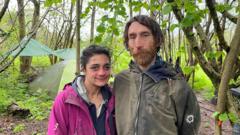
Rain on a nylon tent has a specific, rhythmic ping. For David, it is the sound of autonomy. It is the sound of a dry place that belongs to him, even if the dirt beneath it belongs to the city.
Most people walking past a cluster of tents in a public park see a tragedy, a failure of the system, or a blight on the urban geography. They assume the inhabitants are there because they have no other choice. That is a half-truth. While nobody dreams of sleeping on a thin foam mat as temperatures dip toward freezing, for an increasing number of people, the tent represents a calculated, rational escape from something much worse.
They are choosing the cold over the cage.
The "cage" is the colloquial term often used for the modern homeless hostel or temporary emergency accommodation. On paper, these facilities are the solution. They provide a roof, a bed, and a door that locks. In reality, for someone like David—a hypothetical composite of the dozens of individuals currently navigating the UK housing crisis—the hostel is a site of profound instability.
The Illusion of a Shelter
Step inside a standard emergency hostel and the sensory assault begins immediately. It starts with the smell: a thick, stagnant cocktail of industrial bleach, unwashed bodies, and the sharp, metallic tang of cheap tobacco clinging to clothes. There is no quiet. There is no peace. Walls are thin, and the air is heavy with the vibrations of other people’s trauma.
In a hostel, you do not choose your neighbors. You might be a recovering addict placed in a room next to someone currently using. You might be a victim of domestic violence sharing a hallway with volatile strangers. The "safety" promised by the four walls is frequently undermined by the volatility of the environment.
Violence is a constant, low-frequency hum. It’s in the way someone eyes your boots. It’s in the shouting match echoing through the vents at 3:00 AM. For many, the psychological toll of hyper-vigilance inside a hostel is more exhausting than the physical toll of the elements outside.
Then there are the rules.
Hostels often operate on a logic of infantilization. Curfews are strict. If you are ten minutes late because a bus didn't show or a shift at a low-wage job ran long, you might find yourself locked out for the night, your bed given to the next person on a list miles long. Visitors are forbidden. Privacy is a luxury the system believes you haven't earned.
When you lose your home, you lose your status as an adult in the eyes of the state. The tent, for all its fragility, is the only place where David can decide when to sleep, when to eat, and who to speak to. It is the last remaining vestige of his dignity.
The Economics of Displacement
We often view homelessness as a personal catastrophe, a sequence of bad luck or poor choices. This perspective ignores the cold, hard mathematics of the current housing market.
Consider the "poverty trap" built into the temporary accommodation system. Many hostels are funded through a combination of local authority grants and high service charges. If a resident finds a job—even a part-time, minimum-wage position—the housing benefit that covers their hostel stay is often tapered off or cut entirely. Suddenly, the resident is hit with a weekly bill for "service charges" that can exceed several hundred pounds.
It is a paradox of the cruelest kind. The moment you try to climb out of the hole, the system pulls the ladder up. David found that working twenty hours a week actually made him poorer than staying unemployed. In a tent, his "rent" is zero. He can save his meager earnings. He can buy a better sleeping bag. He can maintain a shred of financial agency that the hostel system systematically dismantles.
The numbers back this up. Across the country, the gap between the Local Housing Allowance (the amount the government provides for rent) and the actual cost of renting a private flat has become a chasm. In some cities, fewer than 5% of available properties are affordable for those on benefits. When the "exit strategy" from a hostel is non-existent, the hostel becomes a warehouse for the discarded rather than a bridge to a better life.
The Invisible Stakes of Sanity
Living outside is brutal. Let us not romanticize the shivering or the damp that seeps into your bones and stays there for weeks. But we must understand the hierarchy of needs. For many, the need for psychological safety precedes the need for physical warmth.
In a tent, David can curate his surroundings. He has a small gas stove. He has a radio. He has a sense of boundary. Psychologically, the "walls" of a tent are thicker than the brick and mortar of a hostel because they are walls he has chosen to erect.
There is also the issue of the "Institutional Circuit." Once you enter the hostel system, you become a data point. You are moved from one temporary placement to another, often with only a few hours' notice. You are shuffled across boroughs, away from your doctors, your support networks, and the streets you know.
This constant displacement creates a state of permanent mourning. You mourn the life you had, and then you mourn the small bits of stability you try to build in the temporary space. Eventually, the soul tires of starting over. The tent stays where you put it. Until the police or the council move you along, you have a fixed address in the universe.
A Failure of Imagination
The tragedy isn't that people would rather live in tents. The tragedy is that we have made our "solutions" so dehumanizing that a nylon sheet in a park feels like a promotion.
We treat homelessness as a plumbing problem—move the liquid (people) from one pipe (the street) to another (the hostel) until it reaches the drain (permanent housing). But people are not liquid. They are complex bundles of memory, fear, and desire.
True "Housing First" models, which have seen success in places like Finland, operate on a different premise. They provide a permanent, self-contained home immediately, without the "readiness" tests or the gauntlet of hostel life. They recognize that you cannot fix a life until the person living it feels safe.
Until that shift happens, the parks will remain dotted with those who have looked at the options provided by a wealthy society and decided that the wind is a kinder companion than the system.
David zips the door shut. The world outside is loud, chaotic, and increasingly expensive. But inside this small, triangular space, the air is his own. He lights a small candle lantern. The orange glow fills the space, turning the thin fabric into a golden shell. For tonight, he is not a client, a claimant, or a problem to be solved. He is a man in his room, listening to the rain.