Every spring, a silent massacre happens on Europe's roads. Millions of amphibians wake up from hibernation and head toward their ancestral breeding ponds. They don't care that a two-lane highway now sits right in the middle of their migration route. They just cross.
Most don't make it. In fact, a busy road can wipe out an entire local population of common toads or great crested newts in just a few seasons.
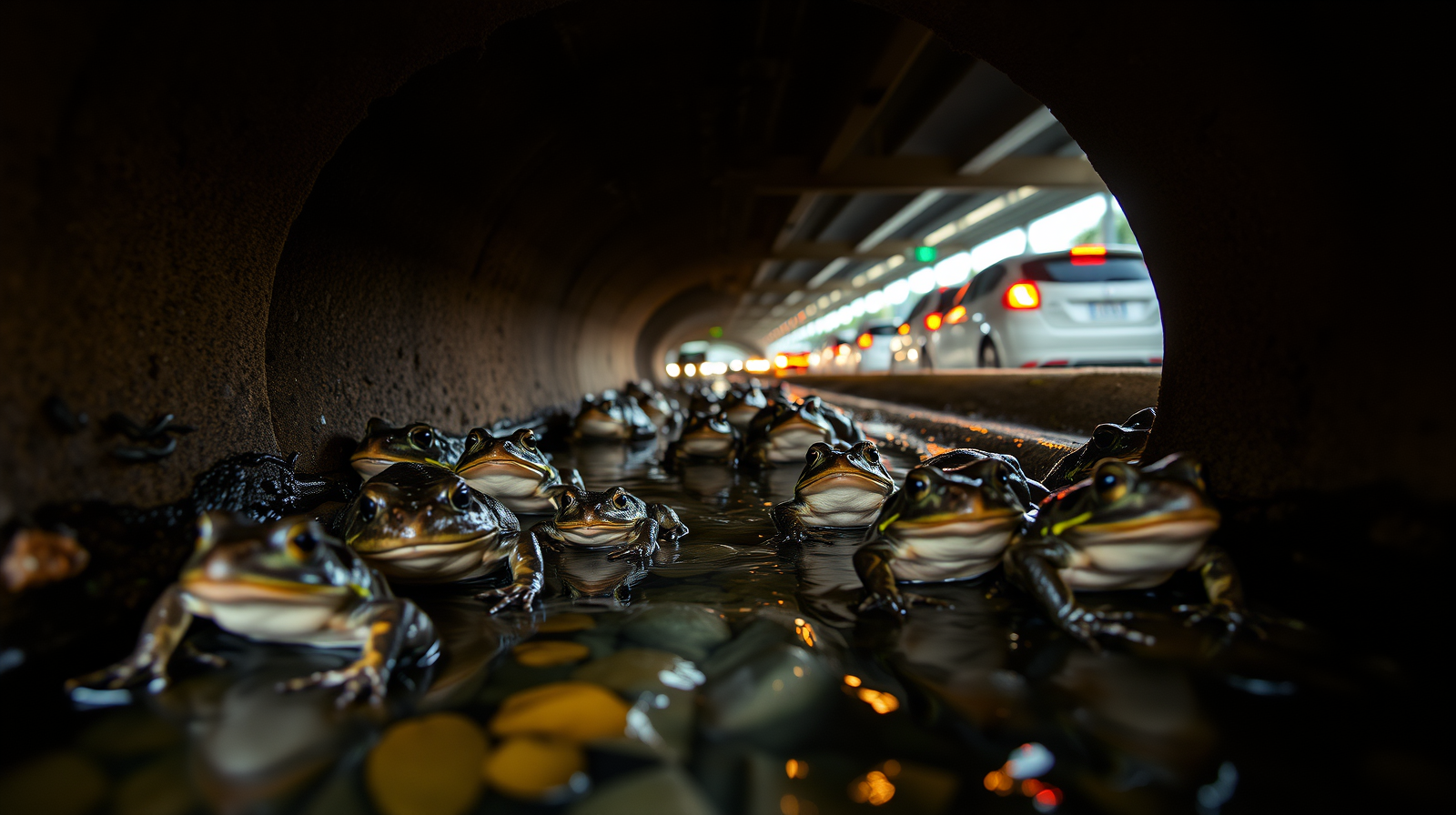
France decided to stop treating this as unavoidable roadkill. Across the country, local governments and conservation groups like the Ligue pour la Protection des Oiseaux (LPO) are spending serious money to build permanent underground tunnels—popularly known as "batrachoducts" or ecoducts—specifically for frogs, toads, and salamanders.
It sounds crazy to spend tax dollars on toad tunnels. It isn't. These small structures are changing how we think about infrastructure and biodiversity conservation.
The Brutal Reality of the Spring Migration
Amphibians are stubborn. They use the exact same migratory paths for generations. When a male common toad (Bufo bufo) wakes up in March, his internal compass tells him to march straight to the wetland where he was born.
If a highway got built there last year, he still tries to cross it.
The math is brutal. Studies by European transport research organizations show that if a road gets more than 2,400 vehicles a day, the mortality rate for crossing amphibians approaches 100%. They are slow. They freeze when headlights hit them. Squish.
It gets worse. Females carrying thousands of eggs move even slower than males. When cars crush them, you aren't just losing one frog. You are losing the next generation. This creates an immediate ecological collapse in the surrounding forest. Frogs eat thousands of insects, keeping pest populations down. Birds and small mammals eat frogs. Remove the amphibians, and the whole local food web unravels.
How a Batrachoduct Actually Works
You can't just dig a pipe under a road and expect a salamander to find it. They don't read signs.
Designing an effective amphibian crossing takes serious engineering. France’s newer setups, like those installed near the Jura mountains and in the biodiversity hotspots of the Isère department, rely on a two-part system.
First, you need the drift fences. These are low, smooth barriers made of plastic or concrete placed along the edge of the road. They stop the frogs from stepping onto the asphalt.
Instead of turning back, the animals walk along the fence looking for a way through. The fence guides them directly into the mouth of the underground tunnel.
Second, the tunnel itself has to feel right. Amphibians are incredibly sensitive to temperature and moisture. If a tunnel is dry, dark, and drafty, they will stop at the entrance and freeze to death.
Modern French ecoducts use slotted concrete tops or polymer materials that allow rainwater and ambient light to filter down from the road surface. This keeps the inside of the tunnel damp and cool, mimicking the natural forest floor. The animals cross without even realizing they have a 30-ton semi-truck rolling over their heads.
Temporary Buckets vs. Permanent Tunnels
For decades, the standard way to handle this was the "toad patrol."
Volunteers would go out in the freezing rain at 9:00 PM with buckets and flashlights. They would erect temporary plastic mesh fences, catch the frogs stuck at the barrier, and carry them across the road by hand.
I’ve talked to volunteers who do this. It’s exhausting, dirty work. While it saves thousands of animals every year, it has massive flaws.
- You need human labor every single night for six to eight weeks.
- Volunteers miss nights when the weather is too miserable.
- It doesn't help the autumn migration when young froglets leave the ponds and head back into the woods.
- People get hit by cars.
Permanent concrete tunnels eliminate the human variable. They operate 24/7, 365 days a year.
The initial cost is high. Retrofitting a road with a series of tunnels can cost anywhere from fifty thousand to several hundred thousand euros depending on the length and road type. But over a 30-year lifespan, it's far more cost-effective than relying on a dwindling number of volunteers.
Proof That the Infrastructure Works
Does it actually work? Yes. The data from French environmental agencies proves it.
In areas like the Brenne Regional Natural Park, monitoring cameras and pitfall traps show that up to 90% of local amphibian populations successfully navigate the tunnels within a few years of installation.
Initially, there's a learning curve. The animals might hesitate at the entrance. But within two seasons, the migration stabilizes.
More importantly, it keeps drivers safe. Swerving to miss a patch of frogs or hitting a slick spot caused by hundreds of crushed bodies causes real accidents. These tunnels protect people just as much as they protect wildlife.
The Global Push for Wildlife Corridors
France isn't alone in this, though they've become masters of the micro-corridor. Germany has been building Amphibienschutzanlagen since the 1980s. The Netherlands has an incredibly dense network of badger pipes and frog tunnels.
The lesson here applies to anyone managing land or local roads. Fragmenting habitats is one of the fastest ways to kill off local wildlife.
If you want to get involved or push for this in your own community, don't wait for the federal government to act. Start small. Contact your local wildlife trust or town council. Map the roadkill hotspots in your town during the next rainy spring night. Hard data on where the animals are dying is the only way to convince local planners to install fencing or pipes during the next scheduled road resurfacing project. Action starts with mapping the problem.