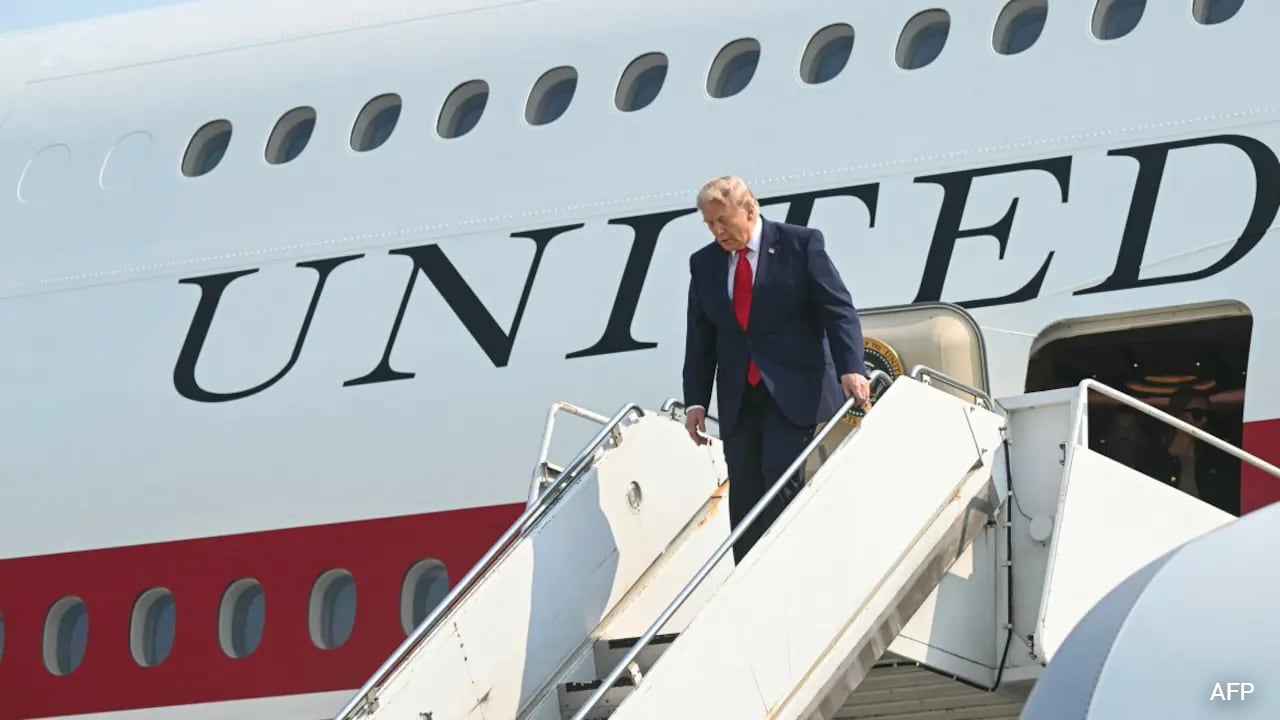
The air at Andrews Air Force Base carries a specific, sharp scent. It is a mix of burnt kerosene, asphalt baking under the sun, and the invisible weight of global authority. On this tarmac, airplanes are not merely vehicles. They are instruments of statecraft. They are sovereignty shaped into aluminum and titanium, designed to broadcast raw national power to whatever corner of the Earth they touch.
But the machine resting on the runway on this crisp morning represents something entirely different.
It is a Boeing 747-8, a mountain of engineered metal stretching longer than a football field. Officially, it represents the latest evolution in VVIP transport. Unofficially, it is a four-hundred-million-dollar token of appreciation from the royal family of Qatar. A gift. To step inside its pressurized cabin on its debut voyage is to step directly into a complex web of Middle Eastern diplomacy, high-stakes finance, and the deeply personal way Donald Trump views the architecture of power.
Power, after all, is rarely quiet. Sometimes, it flies.
The Weight of Gold and Light
The boarding stairs shake slightly underfoot. At the top of the threshold, the familiar world of military efficiency vanishes. In its place stands an environment that feels less like an aircraft and more like a boutique hotel floating thirty thousand feet above the clouds.
Thick, custom-woven carpets swallow the sound of footsteps completely. Silence. It is the kind of quiet that only immense wealth can purchase. The interior lighting does not hum or flicker; it bathes the main cabin in a warm, amber glow that mimics the late afternoon sun over Doha. The bulkheads are wrapped in hand-stitched leather, cool to the touch and flawless.
Consider the sheer scale of what it takes to transform a commercial airliner into a flying estate. This is not the standard military configuration of the traditional blue-and-white VC-25A airframes that the public recognizes from movie screens. This aircraft was originally built to serve the absolute highest echelons of the Qatari state, designed to move emirs and princes across oceans. Every fixture speaks to that heritage. The seat belt buckles are plated in gold. The bathroom sinks are carved from solid blocks of Italian marble, engineered to withstand the vibrations of cross-continental flights without cracking.
In the master suite located toward the nose of the plane, a massive bed sits dead center, flanked by automated nightstands that rise and fall at the touch of a hidden panel. It is easy to look at this opulence and see nothing but vanity. That is a mistake. In the world of international relations, luxury is a language. It is a statement of status, a physical manifestation of alignment between two nations. When a Gulf monarchy hands over the keys to a custom-built super-jumbo jet, they are not just giving away a piece of hardware. They are investing in access.
The Human Gears in the Machine
Behind the polished mahogany doors and the gold-trimmed mirrors, a very different reality exists.
Meet Chief Master Sergeant Miller. That is a hypothetical name for the crew chief supervising the pre-flight checklist, but his real-world counterparts carry a stress that few human beings ever experience. For Miller and his maintenance team, a four-hundred-million-dollar gift is not a luxury. It is a terrifying logistical puzzle.
A standard Air Force transport plane operates on predictable manuals. Every bolt has a part number; every line of code in the avionics suite is logged by the Department of Defense. This Qatari-spec aircraft is a hybrid beast. It pairs American aerospace engineering with highly bespoke, foreign-installed luxury systems. If an entertainment console malfunctions over the Atlantic, you cannot simply pull a replacement part from a supply depot in Illinois.
The mechanics must learn the quirks of a plane built for a different culture. They trace miles of hidden wiring beneath the gold plating, ensuring that the heavy secure-communications equipment installed by American defense contractors integrates perfectly with the luxury infrastructure already in place. The stakes are absolute. A single loose connection could compromise a secure line to the Pentagon during a diplomatic crisis.
Down in the galley, the flight stewards face their own quiet battle. The kitchen is equipped with commercial-grade steam ovens, espresso machines that require precise water pressure calibration, and refrigeration units designed to keep rare ingredients fresh for days. The crew prepares for a flight where the principal passenger expects perfection. The temperature of the Diet Coke must be exact. The steaks must be seared to a specific degree of doneness despite the thinning air pressure of a high-altitude cabin.
We often view these flights through the lens of the person sitting in the executive leather chair. We see the waves from the doorway, the flashbulbs of the press pool, and the slow climb into the sky. We forget the dozens of men and women sweating in the cargo holds, checking the hydraulic fluid lines, and rewriting the safety protocols to accommodate a flying palace that was never supposed to wear the American flag.
The Architecture of a Deal
To understand how this aircraft arrived on an American runway, one must look back at the shifting sands of geopolitical alliances over the last decade. Qatar is a small peninsula with immense natural gas reserves, trapped in a perpetual geographic tightrope walk between powerful neighbors like Saudi Arabia and Iran. Survival for Doha has always depended on making themselves indispensable to Washington.
The gift of this Boeing 747-8 was not a sudden impulse. It was a calculated move in a long game of diplomatic chess.
When the aircraft was transferred, it bypassed the traditional bureaucratic procurement channels that usually govern how the American government acquires its assets. It was a direct transaction, a personal gesture wrapped in the language of state cooperation. For an administration that prizes the art of the deal, the acquisition of a pristine, fully loaded luxury jet for zero taxpayer dollars was seen as a massive victory. A masterstroke.
But critics look at the same shiny fuselage and see a dangerous precedent. They ask a simple, uncomfortable question: What does the giver expect in return?
International diplomacy operates on the principle of reciprocity. Nothing of this scale is ever truly free. The four hundred million dollars represented by this aircraft is a down payment on goodwill. It is a physical reminder, parked at an airbase just miles from the White House, that Qatar is a partner that cannot be ignored. When regional tensions flare, when blockades are threatened, or when energy markets shift, the memory of this flying palace sits silently in the background of every phone call between Washington and Doha.
The plane itself becomes a character in the negotiation. It is a beautiful, heavy, golden anchor anchoring two capitals together.
The Debut Crossing
The four massive General Electric engines roar to life with a deep, bass resonance that vibrates through the floorboards of the main cabin. There is no shuttering, no hesitation. The plane glides down the runway with an eerie smoothness, lifting its massive frame into the cloud layer without apparent effort.
Inside the private office suite, the noise of the engines is reduced to a faint, distant whisper. This room is where the real work happens. A massive desk made of burled walnut dominates the space, equipped with secure satellite phones and encrypted data terminals. From this chair, an American president can command armies, alter global markets with a single statement, or monitor an election halfway across the world.
During this debut flight, the atmosphere is a mix of high-altitude business and quiet observation. Staff members move quietly along the corridors, holding briefing binders and secure tablets. They adjust to the layout, discovering that the path from the conference room to the communications center requires walking past a private lounge lined with silk-upholstered sofas.
It is a strange collision of worlds. The stark, cold realities of global military dominance are housed within an interior designed for the ultimate leisure of Gulf royalty.
As the aircraft reaches its cruising altitude of thirty-eight thousand feet, the sky outside turns a deep, dark blue. Below, the Atlantic Ocean is a vast, grey sheet of glass. Inside, the temperature is a perfect seventy-two degrees. The air smells faintly of expensive leather and fresh coffee. It is an environment designed to insulate its passengers from the friction of the world below. It creates a sense of absolute detachment. When you look down at the earth from a gold-trimmed window, the problems of ordinary people can seem very small, very distant, and very easy to manage.
That detachment is the real danger of such luxury. The danger is not the cost of the marble or the weight of the gold. The danger is the illusion of omnipotence it provides.
The Echoes on the Tarmac
The plane will eventually land. It will descend through the clouds, its massive landing gear reaching out to grip the runway of a foreign capital. The doors will open, the red carpet will be rolled out, and the cameras will capture the moment of arrival.
The public will stare at the images of the interior. They will marvel at the dining room that seats fourteen people, the showers lined with custom tilework, and the private theater room designed to pass the hours during long Pacific crossings. They will debate whether it is appropriate for an American leader to fly in an aircraft gifted by a foreign power, or whether it represents a brilliant cost-saving measure for the public treasury.
But the true story of this aircraft is not found in the luxury features or the price tag.
It is found in the quiet spaces between the lines of the ledger. It is found in the unspoken understandings between leaders, the hidden labor of the mechanics who keep the machine flying, and the undeniable reality that in the modern world, the lines between private wealth and public power have blurred beyond recognition.
The Boeing 747-8 streaks across the sky, a lone silver spark moving toward the horizon. It carries the weight of a nation, the ambitions of a kingdom, and the unpredictable future of global politics inside its golden shell. It leaves behind nothing but a thin white vapor trail, slowly dissolving into the cold, empty air.