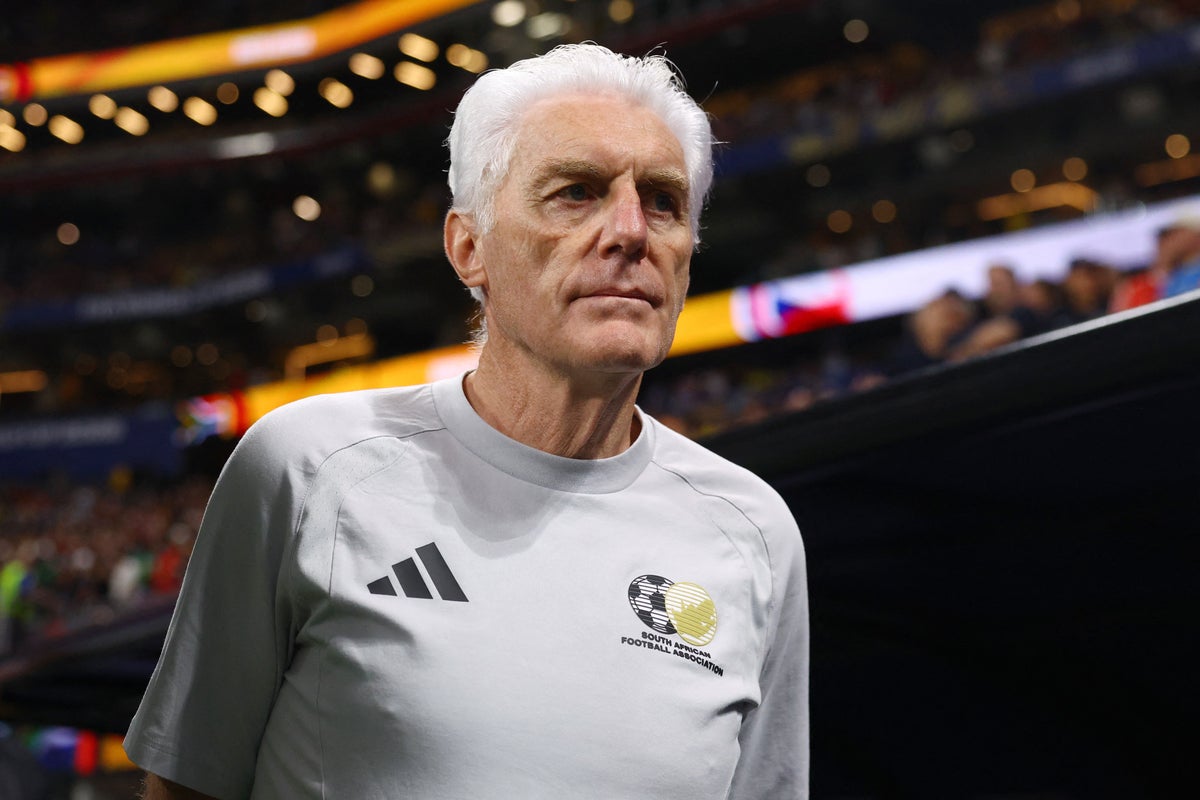
The press conference room in Mexico City smelled of damp carpets and stale air. Under the harsh glare of the television lights, Hugo Broos rubbed his face. His skin looked like weathered leather, lined with forty years of stubborn survival in a game that eats men alive. At seventy-four, with thick silver hair and a brow permanently locked in a frown, the Belgian didn't look like an artifact of modern football. He looked like an old sailor who had walked into a cocktail party, completely indifferent to the dress code.
Someone asked him about a statue. Back home in Johannesburg, following South Africa's qualification for its first World Cup since hosting the tournament in 2010, an ecstatic supporter had suggested his likeness be carved into the history books.
Broos didn't smile. He told the man to make the statue out of wood. That way, it would burn more easily when he lost.
Football is a brutal business of short memories, but the World Cup is something entirely different. It is an amplifier. Every word spoken in its orbit is stretched and twisted until it fits a narrative. For a week in June 2026, Broos found himself at the center of that machine, a man holding a match over his own wooden monument, telling the rest of the world to watch it burn.
The Question That Wasn't Answered
A microphone was passed through the crowd during a midweek briefing. A reporter cleared his throat and directed a question at Broos and his captain, goalkeeper Ronwen Williams. The prompt was a grenade disguised as journalism. It invoked Donald Trump, the American president whose country was co-hosting this massive tournament. Specifically, it asked for their commentary on Trump's public assertions regarding the systematic targeted killing of white farmers in South Africa—a deeply volatile political landmine back home.
Williams shifted slightly in his track jacket. The room grew quiet, the kind of silence that usually precedes an institutional apology or a carefully rehearsed PR pivot.
Broos listened intently through his earpiece. He didn't blink. He leaned forward into the microphone, his gravelly voice cutting through the tension with surgical precision.
"I will answer that question," Broos said, staring straight at the room. Then came the twist. "We will not answer that question."
Seven words. It was an exercise in absolute control. In an era where sports figures are constantly pressured to perform as political commentators or social barometers, Broos understood the invisible stakes. To engage was to lose. To answer was to allow the focus to drift from the pitch to the cable news cycle. He protected his captain, insulated his squad, and shut down a global political debate with a grammatical contradiction that left the press corps silent.
But if Broos was willing to pull down the iron curtain on geopolitical theater, he was more than happy to tear down the hierarchy of football nobility.
The Untouchables
Consider the math of a tournament match. A tackle happens at seventy miles an hour. A boot meets a shin. One man goes down; another stays up. The referee looks at a monitor.
During South Africa's opening match in Mexico City, a 2-0 defeat to Mexico, Bafana Bafana player Themba Zwane was involved in a collision with Mexico's Roberto Alvarado. The Video Assistant Referee intervened. The replay was slowed down to individual frames, stripping the play of its human context until it looked violent enough to warrant a red card. Zwane was sent off. Later, the tournament organizers handed down a crushing three-match suspension.
Broos felt the sting of that judgment. Not because his player was entirely innocent, but because of what he witnessed on another pitch, under the same tournament banner.
Lionel Messi, the undisputed icon of the modern game, had caught Algeria captain Aissa Mandi with a heavy challenge. The whistle blew. The game moved on. The multi-million-dollar VAR apparatus remained dark.
"I think there was not even a VAR with Messi," Broos remarked later, his voice carrying the exhaustion of a man who has seen the rules change depending on the name on the back of the jersey. "I don't want Messi to get a red card because that player has to be on the pitch. But, yeah, what is the difference here?"
It wasn't a cry of conspiracy; it was a cold observation of human nature. The world wants Messi on the field. The broadcasters want him there. The fans who paid thousands of dollars for tickets want him there. Broos wasn't naive enough to think that an aging coach from Belgium representing South Africa could change the gravity of global stardom. He just wanted the room to admit that the gravity existed. He wanted them to acknowledge that the scales are never truly balanced.
The Noise from Home
The hardest critics to face are often the ones who speak your language. After the opening loss to Mexico, the knives came out in the South African press. Former players, columnists, and armchair tacticians filled the airwaves with post-mortems, dissecting Broos’s selections and questioning his methods.
The standard response for a national team manager is diplomacy. You talk about learning from mistakes. You talk about rebuilding focus for the next match.
Broos took a different route. He told them to shut up.
"For those who still don't know it, I do it my way," Broos said, his tone flat, devoid of anger but heavy with defiance. "I never listen to people who sometimes think that they are important enough to criticize the team. So when I'm going to see what they did before, I think it should be better that they shut up."
It was a striking moment of vulnerability disguised as arrogance. Broos has already announced that he will step down at the end of this tournament. He has no contract to renew, no corporate board to please, and no political capital to save. This is his final act. When you have forty years of mud on your boots and your bags are already packed for retirement, the opinions of men sitting in air-conditioned television studios lose their power to hurt.
The Atlanta Turf
On a humid Thursday evening in Georgia, South Africa faced the Czech Republic at Atlanta Stadium. It was a match played on temporary grass laid over an artificial surface, inside a cavernous dome built for American football.
Six minutes in, the plan cracked. A long throw-in—a play Broos had spent days drilling his defense to stop—sliced through the penalty box. Michal Sadilek found the net for the Czechs. A mental error. At this level of competition, you pay the price immediately.
But the team didn't collapse. They fought back, scratching out a 1-1 draw that kept their hopes of surviving the group stage alive. After the whistle, while standard analysis focused on the tactics and the points table, Broos stood on the touchline and looked at the stadium around him.
"If I can be very honest, this is not a football stadium," Broos told the press, gesturing to the environment. "It's a nice stadium, fantastic stadium, everything you want, but only the grass is football. All the rest is not."
It was the perfect summary of his entire week. The massive arenas, the political questions about American presidents, the celebrity protection circles surrounding legends like Messi—all of it was part of the modern entertainment spectacle. It was magnificent, expensive, and loud. But to Hugo Broos, it wasn't football.
Football was the eleven men on the pitch trying to defend a throw-in. Football was the sweat on Ronwen Williams' gloves. The rest was just noise.
Next week, South Africa will face South Korea. A victory will likely see them advance to the second round for the first time in the nation's history. If they lose, the tournament ends, Broos goes home, and the critics back in Johannesburg will get their matches ready.
He will be waiting for them, completely at peace with the smell of smoke.