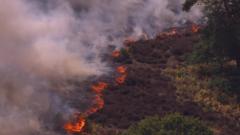
Aerial footage of a Suffolk heathland fire triggers immediate panic. Smoke billows across the screen, news anchors grip their microphones with trembling urgency, and the public demands an aggressive response. Stop the burn. Send in every engine. Drench the earth.
Everyone assumes every flame on a heathland is an ecological catastrophe.
They are wrong.
I have walked these ash-laden tracts hours after the smoke cleared, boot soles crunching on cooling peat, studying the immediate fallout of suppression efforts. The consensus view treats fire as an invader. That perspective ignores how these landscapes evolved. Suffolk heathlands are not fragile victims waiting for a savior with a hose. They are fire-dependent systems. When we wage total war against natural or controlled burns, we do not save the ecosystem. We suffocate it.
The Lazy Consensus of Total Suppression
The standard media narrative relies on a comfortable, lazy heuristic: green equals good, black equals bad. Every plume of smoke equals failure. Every charred acre equals a tragedy.
This binary thinking ignores centuries of ecological reality. Sandlings and Suffolk heathlands depend on periodic fire to clear dense, aging heather, break down accumulated litter, and trigger dormant seeds waiting in the soil. Species like the nightjar and the silver-studded blue butterfly do not just tolerate fire; they require the early-successional habitat that only a burn creates.
When fire suppression is absolute, organic matter builds up unchecked. Dead wood piles high. Old, woody heather dominates, creating a tinderbox of staggering proportions.
Call it the suppression paradox. The harder we try to eliminate small, manageable fires, the more we guarantee catastrophic, high-intensity mega-fires that sterilize the soil and destroy the very biodiversity we claim to protect.
Anatomy of a Heathland
Let us define terms. A lowland heath is a cultural landscape shaped by centuries of grazing, turf-cutting, and yes, fire. It is not an ancient climax forest.
When a fire sweeps through Suffolk heathland, onlookers imagine total annihilation. The reality on the ground is a mosaic. Fire moves unevenly across a terrain shaped by topography, wind, and moisture pockets. Some patches burn hot down to the mineral soil, while others experience only a fast-moving, low-temperature scorch that leaves rootstocks intact.
Below the surface, seeds of the common heather, bell heather, and gorse sit in a natural subterranean bank. Many of these seeds possess hard coats that require the direct heat shock of a fire to germinate. Without that thermal trigger, they remain dormant for decades, locked in a biological vault.
When we rush in with heavy machinery and thousands of gallons of water, we disrupt this natural rhythm. Heavy fire engines compact fragile sandy soils, crushing root systems and destroying micro-habitats for ground-nesting birds. Chemical retardants dropped from the air introduce artificial nutrient loads into nutrient-poor soils, inviting aggressive invasive weeds that choke out native flora.
The Cost of Artificial Preservation
Conservation managers often fall prey to risk aversion. Public pressure forces them into a corner where doing nothing feels negligent, even when doing something destructive is the alternative.
Look at what happens when a heathland goes unburned for thirty or forty years. The canopy closes. Nutrient cycling slows to a crawl. The unique invertebrate fauna that rely on open, sun-baked sand vanish. Common generalist species move in, homogenizing a landscape that should be a patchwork of distinct micro-habitats.
Imagine a scenario where a conservationist refuses to use prescribed burns out of fear of public backlash. Within a decade, the site transitions from open heath to scrub woodland. The rare specialist species disappear. Then, during an exceptional drought, a lightning strike or a discarded cigarette ignites the accumulated fuel load. Because the biomass is massive and continuous, the resulting fire burns hotter and longer than any historical regime. It vaporizes the seed bank, sterilizes the topsoil, and turns a vibrant, resilient ecosystem into a sterile moonscape.
That is the true cost of our obsession with pristine, static nature. Nature is not static. It is a dynamic, churning engine of renewal.
Redefining Management
If the old approach is broken, what replaces it? We need a shift from reactive suppression to active pyrodiversity.
Pyrodiversity means maintaining a mosaic of patches at different stages of post-fire recovery. Instead of suppressing every ignition source, land managers must use controlled, low-intensity burns during the cooler months to break up continuity. This creates natural firebreaks and ensures that no single ignition can sweep across the entire region unchecked.
This approach requires courage. It means taking flak from local residents who see smoke and panic. It means accepting short-term visual disruption for long-term ecological stability.
The heavy hitters in conservation science—from the British Ecological Society to global fire ecology researchers—agree on the core principle: suppression alone is a losing game. The data shows that as suppression budgets rise, wildfire severity often follows suit due to fuel accumulation.
Every time we treat a heathland fire as an absolute emergency rather than an ecological signal, we tilt the scales toward disaster.
The Uncomfortable Downside
Contrarian strategies carry real costs. Prescribed burning is not a silver bullet, and it demands precision.
If a burn goes wrong, it destroys property, releases carbon, and creates immediate air quality hazards. Public trust can evaporate overnight if a managed fire escapes its boundaries. Furthermore, climate volatility makes traditional burn windows narrower and less predictable. A wind shift can turn a textbook low-intensity prescription into a raging hazard.
Admitting this vulnerability is essential. Pyrodiversity is not a risk-free luxury; it is a calculated risk designed to mitigate a catastrophic certainty. The alternative—letting fuel accumulate indefinitely while crossing our fingers—is a guarantee of eventual devastation.
Dismantling the Premise
People often ask: How can we stop fires from starting in Suffolk altogether?
The question is flawed. It assumes stopping fire is desirable or possible. You cannot fireproof a landscape that relies on fire to live.
The correct question is: How do we manage fire so it works for the ecosystem rather than against it?
We stop treating the landscape like a museum exhibit encased in glass. We stop listening to the untrained panic of aerial footage that shows only drama, not context. We accept that a blackened patch of Suffolk soil today is the necessary price for a resilient heathland tomorrow.
Put down the hose. Pick up the drip torch. Let the earth breathe.