Dust settles differently on paper made from bamboo and cotton rag.
I learned this ten years ago inside a cramped, humid archive room in Kolkata, squinting at a nineteenth-century botanical study so fragile that breathing too hard felt like an act of vandalism. The pigment—ground lapis lazuli mixed with gum arabic and perhaps a touch of crushed cochineal—still pulsed with an electric, stubborn life. Yet the signature at the bottom was missing. Not faded. Simply never recorded.
We have a terrible habit of treating museum acquisitions like real estate transactions. A collector signs a deed, a press release goes out, fifty items cross a threshold, and the public nods politely before scrolling past. That is precisely how most people reacted when news broke that British art historian Charles Greig had donated fifty paintings and watercolours from colonial India to the Tate.
Fifty works. A neat, round number.
Look closer, though, and that neat number fractures into a messy, urgent reckoning with who gets to own memory.
The Myth of the Neutral Eye
For decades, the standard story of art in colonial India was told through a very narrow keyhole. You walked into a major London gallery and saw sweeping, sun-drenched oil paintings by British travelers—Thomas and William Daniell, Tilly Kettle, Johann Zoffany. You saw grand ruins, exoticized landscapes, and stately portraits of East India Company officials posing beside docile attendants. The British held the brush. India sat still as the subject.
It was a comfortable illusion. It suggested that visual history during the Raj was something Europeans did to India, rather than something Indian artists actively negotiated, subverted, and mastered from the inside.
Consider what happened when the Mughal Empire began to fracture in the late eighteenth century. As the imperial courts in Delhi and Lucknow lost their financial muscle, thousands of hereditary court painters—men trained in the exacting, jewel-like traditions of Mughal and Rajput miniatures—suddenly found themselves without patrons. Starving for work, they adapted. They knocked on the doors of British merchants, botanists, and military officers in Calcutta, Madras, and Patna.
Picture a hypothetical encounter in a sweltering Calcutta bungalow around 1815. Let us call the artist Karim, a third-generation miniaturist whose grandfather once painted illuminated manuscripts for the Nawab of Awadh. Across the teak table sits a Scottish East India Company surgeon who wants a meticulous watercolour of a local fruit bat for a natural history treatise he is sending back to Edinburgh.
Karim takes the commission. He trades his traditional squirrel-hair brush and burnished gold leaf for English Whatman paper and imported Winsor & Newton cakes. On the surface, he is giving the colonizer exactly what the colonizer wants—an objective, scientific rendering. Yet look at the brushwork along the wing membrane. Look at the rhythm of the line. Karim sneaks the spiritual geometry of the Mughal atelier into a British taxonomic diagram. He hybridizes two worlds on a single sheet of paper, creating what art historians lazily lumped together for a century under a dismissive label: Company School painting.
That term itself is a quiet erasure. Calling these works "Company paintings" credits the British East India Company—the buyer—rather than the Indian masters who actually mixed the pigments and held the brush.
Why Charles Greig Spent Decades Hunting Shadows
Charles Greig did not approach these works as colonial souvenirs. As an art historian who spent years immersed in South Asian visual culture, he recognized early on that these watercolours and paintings were something far more volatile than decorative antiques. They were primary-source testimonies from an era when two civilizations collided at close range.
When you collect art with a scholar's obsession rather than a speculator's greed, your house stops being a home and becomes a rescue shelter.
Over decades, Greig tracked down pieces that had slipped through the cracks of mainstream Western art history. Many of these fifty works had spent generations tucked inside leather-bound albums in English country houses, brought home by colonial administrators as curiosities and forgotten once the empire dissolved. Others surfaced in regional auction houses, misattributed or undervalued because the artists' names had been stripped away by indifference.
I remember the first time I held an unframed Company School architectural study in my own hands—not behind museum glass, just bare paper resting on archival felt. My hands were sweating slightly, and I felt an unexpected wave of vertigo. You could see the pinpricks where the artist had used a compass to lay out the symmetry of a Mughal tomb, right beside pencil notes written in slanted, impatient English cursive. Two hands. Two languages. One fragile sheet surviving two hundred years of monsoons, sea voyages, and attic dampness.
That physical intimacy is what makes Greig’s donation to Tate so consequential.
Tate has long been the flagship of British art—a temple built around Turner, Constable, Gainsborough, and the canon of British visual identity. Yet for most of its existence, Tate’s galleries told a remarkably insular story. You could walk through room after room of nineteenth-century British painting without realizing that Britain’s wealth, aesthetic tastes, and global power were inextricably bound to the Indian subcontinent.
The Architecture of Omission
Why does it matter whether fifty colonial-era Indian paintings hang in a private London townhouse or inside Tate’s public collection?
Because museums do not merely store objects. They manufacture legitimacy.
When an institution like Tate absorbs fifty paintings and watercolours from colonial India into its permanent holdings, it changes the center of gravity of British art history. Suddenly, a watercolour painted by an Indian artist in Murshidabad or Tanjore in 1820 is no longer an ethnographic footnote tucked away in an anthropology museum. It stands on equal aesthetic footing beside J.M.W. Turner.
Let us be candid about the discomfort this stirs up. Repatriation debates dominate the cultural headlines right now, and rightly so. Whenever colonial-era art enters a British national museum, a sharp, valid question hangs in the air: Should these works be in London at all, or do they belong in Delhi, Kolkata, or Mumbai?
It is a thorny, unresolved tension, and pretending otherwise would be dishonest. Unlike looted temple bronzes or the Koh-i-Noor diamond, most Company School watercolours were commissioned and paid for through commercial transactions—albeit transactions shaped by an undeniable colonial power imbalance. Keeping them in Britain means millions of visitors, including the massive British South Asian diaspora, can confront the entangled roots of British history directly on the walls of their national gallery. At the same time, it requires institutions like Tate to abandon the comforting fiction of neutral curation and speak plainly about the empire that funded and shaped these works.
Reading Between the Brushstrokes
Look closely at what actually lives inside a collection like Greig’s. It is rarely grand, blood-soaked battle scenes. The real drama happens in the margins.
You find botanical studies where every vein of a mango leaf is rendered with almost devotional precision, revealing how Indian artists turned British scientific curiosity into a vehicle for quiet visual poetry. You see architectural elevations of the Taj Mahal or Fatehpur Sikri drafted with razor-sharp perspective—works that taught European audiences what India looked like decades before the invention of photography.
And then there are the portraits.
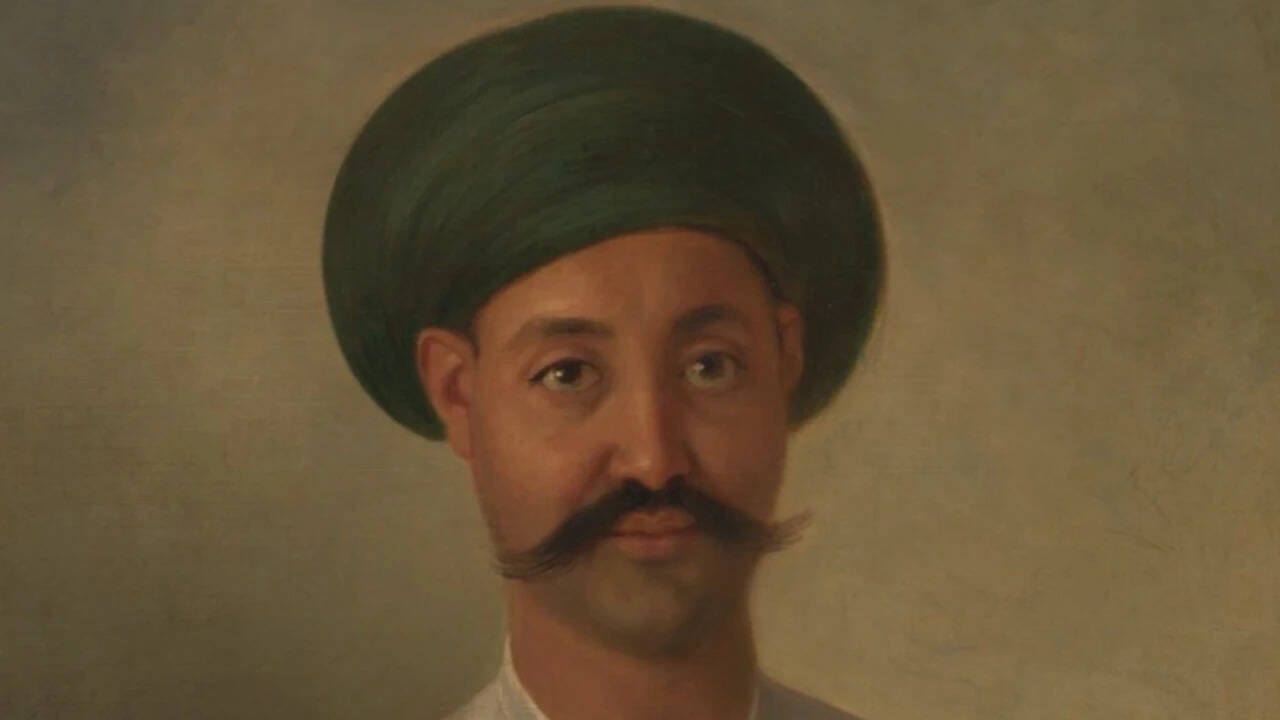
In early nineteenth-century India, wealthy European men frequently married or lived with Indian women—bibis—before Victorian racial anxieties hardened social boundaries. Indian painters captured these domestic worlds with a tenderness that official British histories tried hard to scrub away. You look at a portrait of an Indian woman wearing both Kashmiri shawls and European pearl earrings, gazing straight out at the viewer without a trace of subservience, and the whole cardboard mythology of colonial history collapses. She was not a passive background figure. She was a person who commanded space, wealth, and the gaze of the artist.
Greig’s eye gravitated toward precisely this kind of complexity—works where rigid categories break down.
The Weight of a Gift
Collectors rarely part with fifty pieces at once without feeling a phantom limb ache afterward. When you live with art for thirty or forty years, you memorize the way late afternoon light hits a particular wash of indigo, or how a tiny crack in gouache pigment catches a shadow. Giving a collection to a public institution is an act of deliberate surrender. You trade private intimacy for public permanence.
For Tate, however, accepting these fifty works is not the finish line. It is an obligation.
A museum vault is a terribly quiet place. Thousands of donated artworks enter national collections every year only to disappear into climate-controlled drawers, seen once a decade by a visiting doctoral student wearing white cotton gloves. If Greig’s fifty paintings simply trade a private wall for a dark storage rack in South London, the gesture loses half its soul.
The real test begins when curators bring these watercolours out into the light, hang them directly alongside British Romantic landscapes, and trust the public to handle the friction. Let visitors see how Indian masters absorbed European linear perspective and bent it to their own sensibility. Let them read the names of the artists wherever scholars have managed to recover them from obscurity—names like Shaykh Zain-ud-Din, Bhawani Das, or Mazhar Ali Khan—instead of hiding them behind the anonymous stamp of a colonial trading company.
Next time you step into a quiet gallery room and pause in front of a small, unassuming watercolour from nineteenth-century Bengal, lean in past the frame. Look at the impossibly fine hairs of the brush preserved in the pigment, and remember the hand that mixed the blue from crushed stone two hundred years ago so that someone standing in London today would finally have to look back.