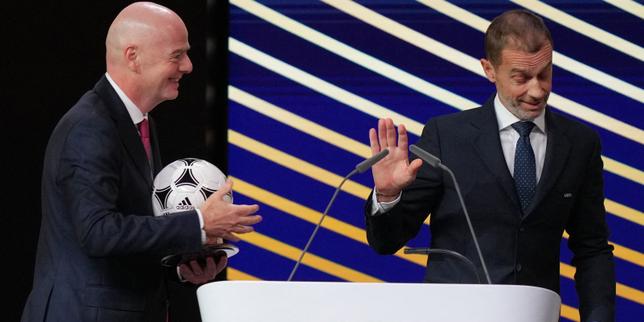
Football governance is broken, but not for the reasons the headlines suggest. When FIFA publicly accuses UEFA of running a calculated smear campaign, the sports media treats it like a seismic institutional fracture. It is nothing of the sort. It is professional wrestling in bespoke suits. Both organizations operate as entrenched cartels carving up global revenue streams, and whenever their financial hegemony faces regulatory pressure, they manufacture a turf war to distract the public.
The lazy consensus in sports journalism frames this feud as a battle of moral authority or ideological purity between Zurich and Nyon. That narrative is absurd. Neither governing body cares about the health of the players, the integrity of domestic leagues, or the fans paying extortionate ticket prices. They care about commercial control. When FIFA expands the Club World Cup or UEFA redesigns the Champions League, they are not innovating; they are executing a land grab for calendar space and broadcasting billions.
Let us look at the structural mechanics of international football politics. I have spent two decades watching sports federations weaponize regulatory frameworks to crush alternative competitions while crying victim whenever a rival cartel steps on their turf. The European Super League debacle exposed the exact same hypocrisy. UEFA screamed about sporting merit while protecting its own closed-shop television revenue models. FIFA does the exact same thing on a global scale.
The Anatomy Of A Manufactured Feud
To understand why FIFA points the finger at UEFA, you have to follow the money and the legal threats. European football generates the vast majority of the sport's global wealth. UEFA acts as the gatekeeper for the most lucrative club competitions on the planet. FIFA, meanwhile, wants a bigger slice of that pie, which explains their desperate push to inflate their own tournament schedules.
When two monopolies collide over calendar congestion, they do not negotiate quietly in a boardroom. They leak, they posture, and they use compliant media channels to paint each other as corrupt. Of course they are both corrupt. That is a redundancy, not a revelation. The real scandal is that fans and commentators fall for the kayfabe every single time.
Imagine a scenario where a corporate conglomerate splits into two separate legal entities that continue to control every single factory, supplier, and retail outlet in an industry. Whenever antitrust regulators get too close, the two entities stage a public feud over supply chain ethics. The regulators get distracted investigating the interpersonal drama, the antitrust probe stalls, and business carries on as usual. That is modern football administration.
Why The Calendar Is The Real Battleground
The conflict between FIFA and UEFA is fundamentally about who gets to exhaust the players first. Modern elite footballers are treated like high-performance racehorses, driven to structural collapse because every governing body wants its own branded tournament to monetize summer windows and international breaks.
The standard defense from Zurich and Nyon is that expanding formats increases global accessibility and rewards sporting excellence. This is economic illiteracy disguised as philanthropy. Adding more matches to an already saturated calendar dilutes the product, destroys player longevity, and prices local match-going fans out of existence in favor of corporate hospitality packages.
When FIFA cries foul about UEFA's administrative dominance, they are complaining that they do not have total veto power over European cash flows. When UEFA retaliates with leaks about governance failures at FIFA, they are protecting their territorial rights. Neither side has clean hands.
The Flawed Premise Of Institutional Reform
People always ask how we can democratize global football governance or install ethical leadership at the top of these federations. This question fundamentally misunderstands the incentives at play. You cannot reform a monopoly by replacing the executives. The structural design of FIFA and UEFA virtually guarantees regulatory capture. They are private associations exercising monopoly power over a global cultural asset with virtually zero external democratic accountability.
Expecting FIFA to fix UEFA or UEFA to police FIFA is like asking two rival drug cartels to audit each other's accounting practices. The only solution that matters is aggressive antitrust intervention by sovereign states and European courts. The European Court of Justice rulings regarding the Super League proved that these sports federations are vulnerable to real legal challenges, which is precisely why they are doubling down on political theater and public relations warfare.
The next time you read a breathless report about institutional infighting between football's governing bodies, remember what is actually happening. They are dividing the spoils, protecting their tax-exempt status, and making sure no outsider disrupts their duopoly. Stop buying the melodrama and start looking at the balance sheets.
The game does not belong to them. It is simply being held hostage by accountants who figured out how to make a sport into a religion and a religion into a cartel.