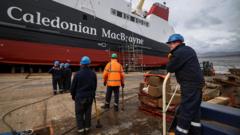
The last commercial shipyard on the River Clyde is shrinking. Ferguson Marine, the state-owned facility at Port Glasgow, confirmed today that it intends to shed nearly one-quarter of its total headcount. Up to 70 staff members are being encouraged to accept voluntary redundancy as the yard enters a precarious limbo between the final completion of the long-delayed MV Glen Rosa and the delayed arrival of promised new government contracts.
This announcement is more than a standard corporate restructuring. It is a symptom of a systemic failure in industrial planning. When a shipyard completes one major project without having the next one physically ready to commence, it does not simply pause operations. It hemorrhages the very expertise that took years to cultivate. By the time the ink dries on new contracts for four vessels—two small ferries and two support ships—the skilled workers who currently understand the unique technical nuances of the Port Glasgow site will likely have moved to other sectors or private firms.
The official line from the shipyard leadership and the Scottish Government emphasizes efficiency. They argue that reducing the workforce is a necessary step to maintain financial stability during this transitional period. Yet, industry observers recognize this pattern with weary familiarity. A shipyard that lacks a continuous pipeline of work effectively chooses to dismantle itself from within.
The Cost of Political Uncertainty
The Scottish Government announced a strategic intent to award four new ship contracts to Ferguson Marine back in March. This was framed as a show of confidence in the yard's future. Months later, those contracts remain unsigned, stuck in the gears of due diligence and regulatory scrutiny. For a business, this gap is fatal.
Consider a hypothetical engineering firm that relies on a single massive client for its entire revenue stream. If that client promises future work but fails to sign a binding commitment while the current contract ends, the firm is forced to cut overhead. It is a simple equation. However, shipbuilding is not a modular office environment. It requires specialized trades—welders, pipefitters, and marine electricians—who are in high demand across the UK. Once these specialists depart for jobs in the naval defense sector or other private maritime interests, they rarely return.
The GMB union has been vocal in its opposition, labeling the move a betrayal of a blameless workforce. Their frustration is rooted in the history of the yard. Ferguson Marine has been the subject of intense scrutiny for a decade, largely due to the disastrous cost overruns and delays associated with the Glen Sannox and Glen Rosa projects. These vessels became symbols of administrative failure. The irony is that the workforce is now being penalized for the very delays that were largely the result of design changes and management failures from years ago.
The Myth of Competitive Efficiency
The argument for being lean is often used in political discourse to mask the reality of managed decline. To suggest that Ferguson Marine can somehow remain a competitive, high-end shipyard while simultaneously firing 25 percent of its staff is a claim that lacks historical backing. Shipbuilding success requires a stable, experienced core. A revolving door of staff does not make a yard more competitive; it increases training costs and drives up the margin for error on future builds.
The reliance on voluntary redundancy as a primary tool for "modernization" is a convenient way to avoid the optics of forced layoffs, but the outcome for the yard's capacity is identical. The institutional knowledge walks out the door. When the government eventually signs the contracts for the four requested vessels, the yard will be tasked with building them under a tighter timeline than ever before, but with a thinner team to execute the work.
Where the Strategy Fails
There is a fundamental disconnect between the Scottish Government's industrial policy and the practical realities of the shipyard floor. Ministers talk about upskilling and future opportunities, yet the current industrial strategy appears to be reactive rather than proactive. By failing to bridge the gap between the end of one project and the start of the next, they have created a self-fulfilling prophecy of instability.
If the goal is to save the Clyde's last commercial shipyard, the priority should be the immediate finalization of contracts. Every day that passes without a firm commitment to the four new ships is a day that the yard’s viability decreases. It is a slow, quiet exit for a facility that once held a global reputation for maritime excellence.
Management asserts that they are taking proactive action to ensure a viable future. But a future requires a foundation. If the foundation is stripped away to satisfy short-term balance sheets, there will be nothing left to build upon when the next order finally arrives. The history of British shipbuilding is littered with the ghosts of yards that thought they could cut their way to prosperity. History rarely favors the diminished.