A massive magnitude 7.8 earthquake ripped through the offshore waters of Sarangani province in the southern Philippines on Monday morning. The tremor killed at least eight people, collapsed commercial infrastructure in General Santos City, and sent thousands fleeing toward high ground under urgent tsunami warnings. While initial media dispatches focused on the immediate chaos of shattered storefronts and panicked coastal evacuations, the disaster exposes a much larger, systemic vulnerability. This event lays bare the severe friction between rapid urban commercial development and the lagging, underfunded reality of local disaster resilience in Mindanao.
The earthquake struck at 7:37 a.m. local time, centered just miles from General Santos City, a major economic and tuna-processing hub home to more than 700,000 people. Within minutes, the Philippine Institute of Volcanology and Seismology (PHIVOLCS) and the Pacific Tsunami Warning Center issued alerts for waves up to three meters high.
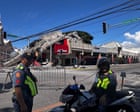
While the worst of the tsunami threat receded after a one-meter surge hit lines of the southern coast, the physical and structural toll tells a deeper story of engineering failures. Videos verified across news networks captured the upper floor of a prominent Jollibee fast-food restaurant slumping into rubble. Concrete walls of a major commercial complex sheared completely off, while an unoccupied high school building in Davao del Sur buckled under the stress.
The Illusion of Structural Compliance
In the immediate aftermath of a major disaster, official statements routinely cite the raw natural force of a 7.8 magnitude event as an unavoidable act of God. This narrative shields systemic human failure. General Santos City has undergone a massive real estate and commercial expansion over the last decade. Concrete multi-story plazas, modern processing plants, and dense residential blocks have filled the skyline.
The structural failure of newly built commercial spaces raises tough questions about building code enforcement. The National Building Code of the Philippines is technically stringent on paper. In practice, local government units bear the responsibility of inspecting structures and issuing occupancy permits. This decentralized system frequently suffers from a lack of qualified structural engineers on municipal payrolls, leading to perfunctory sign-offs.
When commercial properties collapse while older, less complex structures remain standing, it signals a failure in localized oversight rather than an unprecedented seismic anomaly.
The Problem with Short-Memory Urban Planning
- Inadequate Soil Assessment: Much of the recent commercial infrastructure in coastal Mindanao is built on alluvial soils and reclaimed land highly susceptible to liquefaction.
- Corrupted Material Chains: Substandard concrete mixes and low-grade rebar frequently slip into private construction projects to pad profit margins.
- Delayed Modernization: Local zoning maps rarely account for the true velocity of rapid urban migration, placing dense populations directly in high-risk coastal zones.
The Tsunami Warning Paradox
When the ground stopped shaking, the secondary crisis began. President Ferdinand Marcos Jr. went on national airwaves urging immediate evacuation to higher ground.
"Do not wait. Your life is more important than anything left behind."
This directive looks simple from an office in Manila. On the ground in Sarangani and Sultan Kudarat, execution was a chaotic mess.
The National Grid of the Philippines reported immediate, severe damage to transmission lines across Southwestern Mindanao. Power grids collapsed instantly. When electricity fails, the digital warning systems designed to protect the public go dark with it. Cell towers lost battery backup within an hour, rendering mobile emergency alerts useless for thousands of coastal residents.
[7:37 AM: 7.8 Magnitude Quake]
       │
       ▼
[7:39 AM: Grid Collapse / Power Outages]
       │
       ▼
[7:45 AM: Tsunami Warning Issued]
       │
       ▼
[Communication Blackout in High-Risk Zones]
This structural failure highlights a massive gap in disaster planning. The government relies heavily on digital communication and cellular broadcasts. Yet, the physical infrastructure supporting these networks is highly vulnerable to the very disasters it is meant to warn against.
In several coastal barangays, local officials had to rely on manual megaphones and church bells to sound the alarm. This primitive method saved lives, but it is an indictment of modern infrastructure spending. Millions of pesos are directed toward disaster risk reduction frameworks annually, yet the final mile of communication remains fundamentally broken.
A Regional Ring of Fire Reality
The tectonic geography of Mindanao makes these events entirely predictable. The island sits atop a complex web of subduction zones and local faults, including the Cotabato Trench. This system is fully capable of generating both shallow, violent shaking and destructive local tsunamis.
| Measurement Agency | Reported Depth | Assessment of Threat |
|---|---|---|
| PHIVOLCS | 10 kilometers / 33 kilometers | Immediate shallow crustal threat; high localized wave potential |
| USGS | 55 kilometers | Deep subduction faulting; widespread regional shaking |
Discrepancies in depth readings between international and domestic agencies are common in the first hours of a crisis. However, the shallow depth reported by domestic scientists explains the sheer intensity of the surface destruction in South Cotabato and Sarangani. The region was subsequently hammered by a relentless sequence of aftershocks, including a major 6.5 magnitude secondary quake that triggered further structural failures on weakened foundations.
Neighboring nations like Indonesia and Malaysia quickly triggered their own coastal alerts before lifting them hours later. The trans-boundary nature of these alerts shows that seismic risk in the Celebes Sea cannot be managed in isolation.
Moving Past Emergency Response
The immediate focus of the state will naturally remain on search, rescue, and clearing the rubble. But when the dust settles, the real test of governance begins. The national government routinely promises that "Mindanao will not be left behind."
Fulfilling that promise requires moving past the theater of emergency response. True resilience is found in the unglamorous work of auditing concrete, punishing corrupt developers, and building decentralized, solar-powered communication grids that do not die the moment the high-voltage lines snap. Until municipal accountability matches the speed of urban growth, the southern Philippines will remain trapped in a cycle of predictable catastrophes.