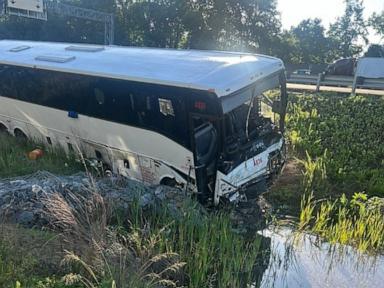
Five people are dead because a commercial motorcoach plowed into slowing traffic at 2:35 a.m. on Interstate 95. The tragedy happened in Stafford County, Virginia. It wiped out an entire family traveling to a South Carolina wedding. Investigators are looking closely at the driver's driving history. Records show this wasn't an isolated moment of bad judgment. Jing Sheng Dong, 48, had a clear track record of excessive speed before he got behind the wheel that night.
The Stafford County Commonwealth's Attorney's Office announced that a grand jury indicted Dong on three additional counts of involuntary manslaughter and one count of reckless driving. He already faced two felony counts of involuntary manslaughter. The new counts bring the total to five felony charges, one for each life lost on that stretch of highway.
A Fatal Pattern on the Highway
Commercial bus drivers carry the ultimate responsibility on our roads. They hold the lives of dozens of passengers in their hands while navigating heavy vehicles that require massive stopping distances. Dong routinely ignored speed limits.
Online court records show Dong faced multiple speeding charges across different states.
- In November 2024, authorities cited him for driving 73 mph in a 55 mph zone in Colonial Heights, Virginia. He paid a $219 fine and court costs.
- In March, Maryland authorities caught him driving a motorcoach at 72 mph in a 50 mph zone in Annapolis. That means he was doing 22 mph over the limit in a commercial vehicle.
Dong also has a pending criminal case for trespassing in Mecklenburg County, Virginia.
The public assumes commercial drivers undergo strict screening. We trust that state traffic convictions trigger real professional consequences. This case proves that assumption wrong. A driver with a habit of speeding in heavy vehicles kept his privileges until it was too late.
The Devastating Cost of 45 Tons of Unchecked Momentum
The crash itself was a violent chain reaction. Traffic on southbound I-95 had slowed down for an active highway work zone. Dong was driving a massive tour bus operated by E&P Travel Inc., a company based out of Kings Mountain, North Carolina. He failed to slow down.
The motorcoach smashed directly into a Chevrolet Suburban. The force pushed the Suburban into an Acura SUV, which ignited. The fire trapped the occupants. Four people inside the Acura died at the scene. They were a family of four from Greenfield, Massachusetts: Dmitri Doncev, 45, his wife Ecterina, 44, their 13-year-old daughter Emily, and their 7-year-old boy Mark.
Dmitri was a dedicated nurse at Holyoke Medical Center. Ecterina was a local hairstylist. They immigrated to the United States from Moldova in 2008 to build a life. That life ended on a Virginia highway. They were traveling with a carload of homemade desserts Ecterina had spent days baking for a family wedding. The fifth victim was 25-year-old Priscilla Mafalda of Worcester, Massachusetts, a passenger in the Suburban.
Beyond the fatalities, the crash injured 44 other people. Three individuals suffered critical injuries. The emergency response flooded local hospitals with victims. Dong survived the crash and remains under arrest in a local hospital. Prosecutor Eric Olsen confirmed that police will move Dong straight to jail as soon as doctors discharge him.
What the Federal Investigation Left Out
The National Transportation Safety Board sent a team to lead a weeklong investigation. NTSB officials stated they are examining speed, fatigue, and language proficiency as key factors. Investigators revealed that Dong is a U.S. citizen from China who does not speak English.
The language barrier is a critical issue. Federal regulations require commercial drivers to read and speak English well enough to converse with the public, understand highway traffic signs, and respond to official inquiries. If a driver cannot understand emergency construction zone warnings posted on overhead signs, the risk of a catastrophic collision skyrockets.
The NTSB is performing a standard 72-hour lookback into Dong’s life leading up to the crash. They want to know exactly how much sleep he got, whether he was distracted, and if drugs or alcohol played a role.
This oversight system operates reactively. The Department of Transportation and the Federal Motor Carrier Safety Administration have massive databases designed to track violations. Yet, low-fare curbside bus operations often slip through the regulatory cracks. They change corporate names or use complex shell companies to keep dangerous drivers on the road.
Driving Real Safety Reform in Commercial Transit
If you regularly travel by interstate bus or share the road with these massive vehicles, you shouldn't rely solely on federal watchdogs to keep you safe. The system is broken. It takes a tragedy like this to expose drivers who rack up major moving violations without losing their commercial licenses.
You can take action to protect yourself and your family.
Before booking any trip on a regional motorcoach, look up the company’s safety rating using the Federal Motor Carrier Safety Administration’s electronic logging system. Look at their historical crash data and vehicle maintenance violations.
If you witness a commercial bus tailgating, speeding, or weaving through traffic, don't ignore it. Pull over safely and dial 911 immediately to report a dangerous driver. Your phone call might save a family from a horrific chain-reaction crash.