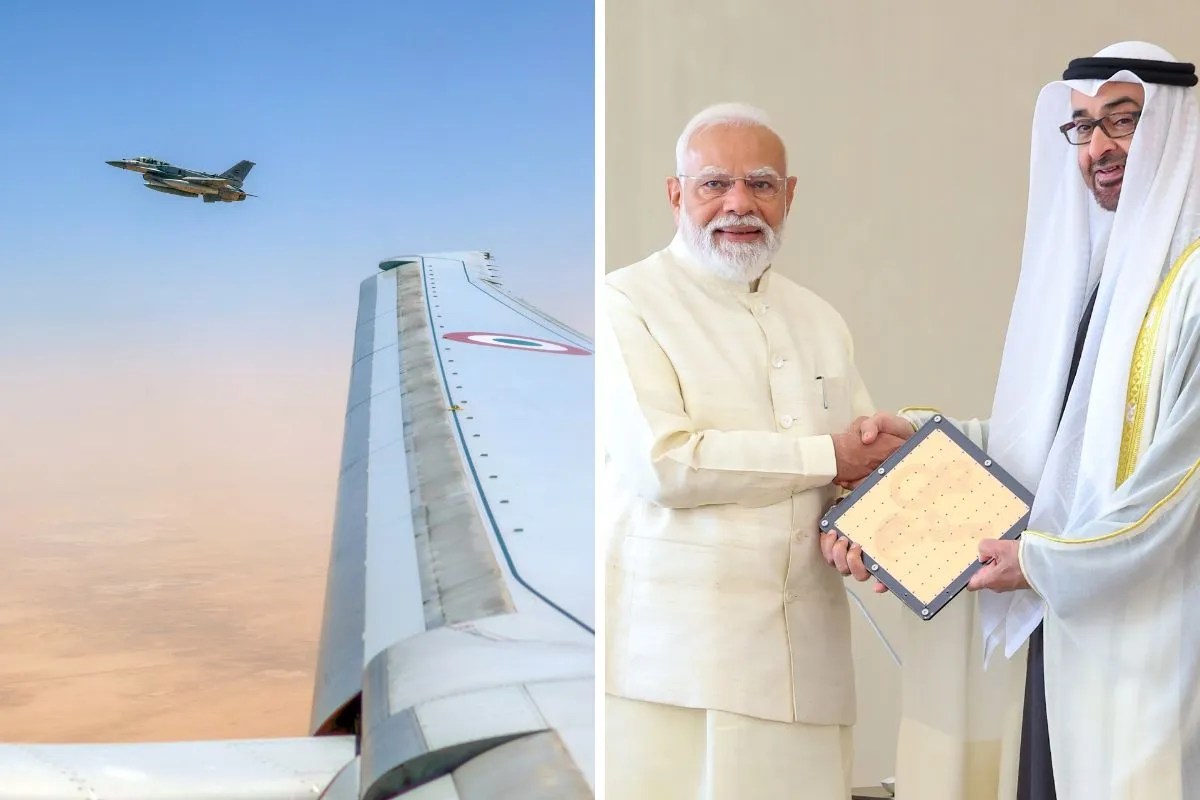
When Air India One pierced the airspace of the United Arab Emirates on May 15, 2026, it didn't just cross a geographical boundary. It flew straight into a geopolitical storm. Two Emirati F-16 Block 60 'Desert Falcon' fighter jets instantly locked into formation, flanking Prime Minister Narendra Modi’s aircraft.
To the casual observer scrolling through social media, it looked like a standard, flashy diplomatic welcome. Beautiful sky, sleek jets, great optics. But look a little closer. This wasn't just a friendly wave from Abu Dhabi. It was a calculated, high-stakes signal sent directly across the Persian Gulf, aimed squarely at Iran.
The Weaponry Behind the Message
The choice of planes wasn't accidental. The UAE didn't just send up any aircraft to greet Modi. They sent the very same F-16s that have been actively intercepting Iranian-fired drones and missiles over the past few weeks. The Middle East is currently entangled in an intense conflict involving Iran, the US, and Israel. Abu Dhabi has found itself on the receiving end of this chaos, enduring over 2,500 drone and missile strikes launched by Iranian-backed forces.
By using these battle-tested fighter jets to shield the Indian Prime Minister, UAE President Mohamed bin Zayed Al Nahyan (MBZ) made a loud statement. He demonstrated that the UAE's airspace is secure, and more importantly, he showed exactly who the Emirates considers its top-tier global allies.
Modi didn't mince words after landing. He explicitly called the attacks on the UAE "unacceptable" and stated that India stands shoulder to shoulder with the Emirates. For a country like India, which traditionally balances its ties between Iran and the Arab world with extreme caution, this is an incredibly direct stance.
Shifting From Balance to Boldness
Historically, Indian diplomacy in the Middle East has been a masterclass in tightrope walking. New Delhi needs Iran for access to Central Asia via the Chabahar port. At the same time, it relies heavily on the Gulf nations for oil and remittances.
But the ongoing closure of the Strait of Hormuz by Iran has changed the math. The Strait is a massive global energy chokepoint. With Iran choking off the supply lines, India has faced a brutal squeeze on oil, LNG, and LPG. When your domestic energy security gets hit, diplomatic neutrality starts to feel like a luxury you can no longer afford.
India imports nearly 85% of its oil. The recent regional instability forced state-run oil companies to hike fuel prices by ₹3 per litre back home, triggering a domino effect of public frustration. India has also been reeling from an acute LPG crunch for about a month.
Modi’s brief two-hour stopover in Abu Dhabi wasn't a casual visit. It was an urgent mission to lock down energy security. The results speak for themselves. Despite the short duration of the meeting, India walked away with massive commitments.
- LPG Supply Guarantees: Immediate agreements to stabilize India’s domestic cooking gas shortage.
- Strategic Reserves: New Memorandums of Understanding (MoUs) specifically targeting strategic petroleum reserves.
- Infrastructure Investment: A massive $5 billion commitment from the UAE into Indian infrastructure.
- Maritime Footprint: A brand new agreement to set up a dedicated ship repair cluster at Vadinar in Gujarat.
The Real Power Play Behind Closed Doors
To understand why the UAE is rolling out the red carpet for India so aggressively right now, you have to look at the cracks forming within the Gulf itself.
The old alliance structures are fracturing. The UAE’s relationship with its neighbor, Saudi Arabia, has turned remarkably tense. Abu Dhabi recently took the drastic step of walking out of OPEC and OPEC+ due to deep policy rifts with Riyadh. Furthermore, the UAE just demanded that Pakistan return a $3.5 billion loan, heavily driven by Islamabad’s shifting alignment toward Saudi Arabia.
Just three months prior, in January, MBZ made a highly unusual, quiet three-hour standalone visit to India. That unannounced trip happened right after Saudi Arabia and Pakistan inked a NATO-style defense pact.
The chess pieces are moving fast. The UAE is actively looking for powerful, reliable democratic allies outside its immediate neighborhood to balance out regional rivalries. India, with its massive economy and its status as the world's largest consumer market, fits that bill perfectly.
Beyond the Dust of the Desert
This F-16 escort is a clear indicator that India's foreign policy is getting significantly more transactional and assertive. New Delhi is showing that it will openly align with Gulf partners against hostile actors if it means securing the energy resources required to keep its economy running.
The five-nation tour began in Abu Dhabi, but the strategic ripples will travel much further. Modi is already heading toward the Netherlands, Sweden, Norway, and Italy. The focus will shift to semiconductors, green hydrogen, and European defense ties. However, the foundational tone of this entire diplomatic push was set in the skies over Abu Dhabi. India is no longer just a passive bystander in the shifting dynamics of Middle Eastern geopolitics.
If you are tracking global trade routes or domestic energy stocks, keep your eyes on the Vadinar ship repair cluster and the upcoming strategic reserve rollouts. These aren't just corporate press releases. They are the structural pillars of a new economic reality. Look closely at how your energy portfolios are positioned as India secures these new alternative supply lines.