The PR Machine Wins Again
Every time a major news outlet splashes a headline about the "first person" receiving a trial vaccine for a deadly pathogen like Ebola, the global health press releases a collective sigh of relief.
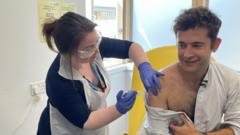
It is a comfortable, high-drama story. It features a brave volunteer rolled into a sterile clinic, a dedicated team of researchers in white coats, and the implicit promise that Western medical innovation is once again galloping to the rescue of vulnerable populations.
It is a comforting story. It is also an intellectual trap.
Focusing on the theatrical milestone of "Patient Zero" in a clinical trial ignores the structural reality of epidemic response. I have spent years watching institutions blow tens of millions of dollars on silver-bullet clinical interventions while the basic mechanics of disease control starve for funding. We celebrate Phase 1 safety trials while basic containment infrastructure, diagnostic supply chains, and community trust remain broken.
Vaccines are essential medical tools. Nobody sane argues against their efficacy when properly developed and deployed. But treating the arrival of an experimental trial jab as a triumph masks a uncomfortable truth: if you are relying on an experimental Phase 1 candidate during an outbreak, your public health strategy has already failed.
Why the "First Patient" Narrative Is Flawed
Let us dissect what actually happens when an experimental vaccine enters its first human testing phase.
Media coverage frames these events as immediate turning points. The subtext suggests that relief has arrived. The technical reality is far more tedious and far less heroic.
Phase 1: Dose-ranging & Safety  --->  Does it harm the host?
Phase 2: Expanded Immunogenicity --->  Does it spark antibodies?
Phase 3: Field Efficacy          --->  Does it actually stop disease in the wild?
A candidate vaccine injected into a single patient in a controlled laboratory environment tells us precisely two things:
- A human survived the initial injection without immediate, severe anaphylaxis.
- Researchers have completed the administrative hurdles to begin human trial protocols.
It tells us nothing about actual field efficacy. It tells us nothing about thermal stability in tropical climates without cold-chain storage. It tells us nothing about whether a rural population facing systemic neglect will trust the foreign health workers administering it.
The media coverage creates an illusion of momentum. Decision-makers check a mental box, believing the crisis is being addressed by laboratories thousands of miles away. Meanwhile, transmission chains continue uninterrupted in the field because contact tracing lacks basic transport fuel and isolate units lack clean running water.
The Cold Logistics Nobody Wants to Fund
Epidemics are not solved by brilliant isolated breakthroughs. They are contained by boring, repetitive, unglamorous logistics.
When Ebola spreads, it exploits specific failure points in regional health networks. The pathogen spreads through direct contact with bodily fluids. Stopping it requires zero technological miracles. It requires rapid diagnostic tests, personal protective equipment, rigorous contact tracing, and culturally respectful, safe burial protocols.
Look at the capital allocation during recent health emergencies:
| Intervention Type | Media Attention | Investment Yield During Active Outbreak |
|---|---|---|
| Experimental Vaccines (Phase 1/2) | High (80%+ of headlines) | Low (Takes months/years to prove safety & scale) |
| Rapid Diagnostics at Point-of-Care | Low | Extremely High (Isolates cases within hours) |
| Local Health Worker Compensation | Virtually Zero | Critical (Prevents facility abandonment & strike) |
| Cold-Chain Logistics Infrastructure | Low | High (Enables deployment of existing tools) |
When you dump funding into headline-ready trial candidates while ignoring point-of-care diagnostics, you are building a Ferrari with no tires. You end up with a sophisticated biological product that cannot be delivered, stored, or trusted by the time it reaches the zone of infection.
I have seen field clinics where workers had access to advanced monitoring equipment but lacked simple gloves and reliable electricity. The institutional incentive structure is entirely upside down. Grants and press coverage favor high-tech biomedical interventions. No foundation director gets a promotion for procuring ten thousand durable body bags or funding reliable diesel supply lines for generators in remote districts.
The Misguided Questions People Keep Asking
The public discussion around experimental treatments is routinely driven by flawed assumptions.
"Why can't we just deploy experimental vaccines immediately under emergency use?"
This question assumes that an untested vaccine is inherently better than no vaccine. It ignores the fundamental principle of medical intervention: first, do no harm.
If an experimental vaccine causes severe side effects or—worse—fails to confer immunity while giving recipients a false sense of security, you do not just lose a trial. You lose the trust of the entire community. In infectious disease control, community trust is an irreplaceable asset. Once a population suspects an intervention is harmful or experimental exploitation, contact tracers get turned away, isolation wards are abandoned, and the virus spreads unchecked.
"Isn't any progress better than no progress?"
Not when resource allocation is zero-sum.
Capital, expert manpower, and logistical bandwidth are strictly finite during an active outbreak. Every dollar and clinical team redirected toward monitoring a handful of early-stage trial subjects in isolated settings is bandwidth stolen from active contact tracing, epidemiological surveillance, and basic supportive care on the ground.
The Reality of Severe Pathogens
To understand why quick-fix thinking fails, look at the biological reality of filoviruses like Ebola.
+-----------------------------------------------------------------+
|                       EBOLA INFECTION CYCLE                     |
|                                                                 |
|  [Infection] --> [Incubation 2-21 Days] --> [Severe Symptoms]  |
|                                                     |           |
|                                                     v           |
|  [Community Transmission] <-- [High Viral Load in Fluids]       |
+-----------------------------------------------------------------+
Ebola is not an airborne respiratory virus that sweeps through populations unnoticed. Its incubation period ranges from 2 to 21 days, and patients become contagious only when they display severe symptoms.
This specific transmission profile means classical public health measures—when executed flawlessly—are extraordinarily effective at stopping an outbreak. You do not need mass population immunity to stop an Ebola outbreak; you need surgical containment.
You isolate the sick immediately, trace every human contact back 21 days, monitor those contacts daily, and ensure safe burials. That is how outbreaks are broken. The rVSV-ZEBOV vaccine, eventually approved after years of rigorous testing, is an extraordinary tool when used in ring vaccination strategies. But its success depended entirely on the precise execution of traditional contact tracing to identify those rings in the first place.
Without the contact tracing network, the vaccine is useless because you do not know whose ring to vaccinate.
The Hard Truths About Outbreak Response
If we are serious about preventing filovirus threats from escalating into regional catastrophes, we must abandon the biomedical hero fantasy and embrace these operational realities:
- Stop treating early clinical trials as public health victories. A Phase 1 trial is an academic safety test, not an outbreak response strategy. Media coverage must reflect this distinction instead of manufacturing premature optimism.
- Prioritize frontline infrastructure over laboratory optics. If local health centers do not have basic infection control materials, running an experimental trial in the vicinity is ethically questionable and operationally backwards.
- Invest in local diagnostic manufacturing. Waiting for samples to fly to high-containment laboratories in Europe or North America for PCR confirmation wastes critical days. Point-of-care testing stops transmission chains faster than an experimental jab ever will.
- Accept the trade-offs of experimental deployment. Emergency use authorizations for investigational products carry massive political and social risks. If an experimental candidate fails publicly in the field, it jeopardizes future acceptance of fully vetted vaccines for decades.
The fetishization of the "first experimental dose" reflects a Western bias toward technological solutions for institutional failures. It is easier to write a check to a biotech firm and hold a press conference than it is to build durable, lasting public health systems in historically neglected regions.
Until we shift our focus from headline-grabbing trial milestones to the messy, unglamorous work of ground-level containment, we are simply repeating an expensive performance every time a new outbreak begins.
Stop applauding the first syringe. Start auditing the containment lines.