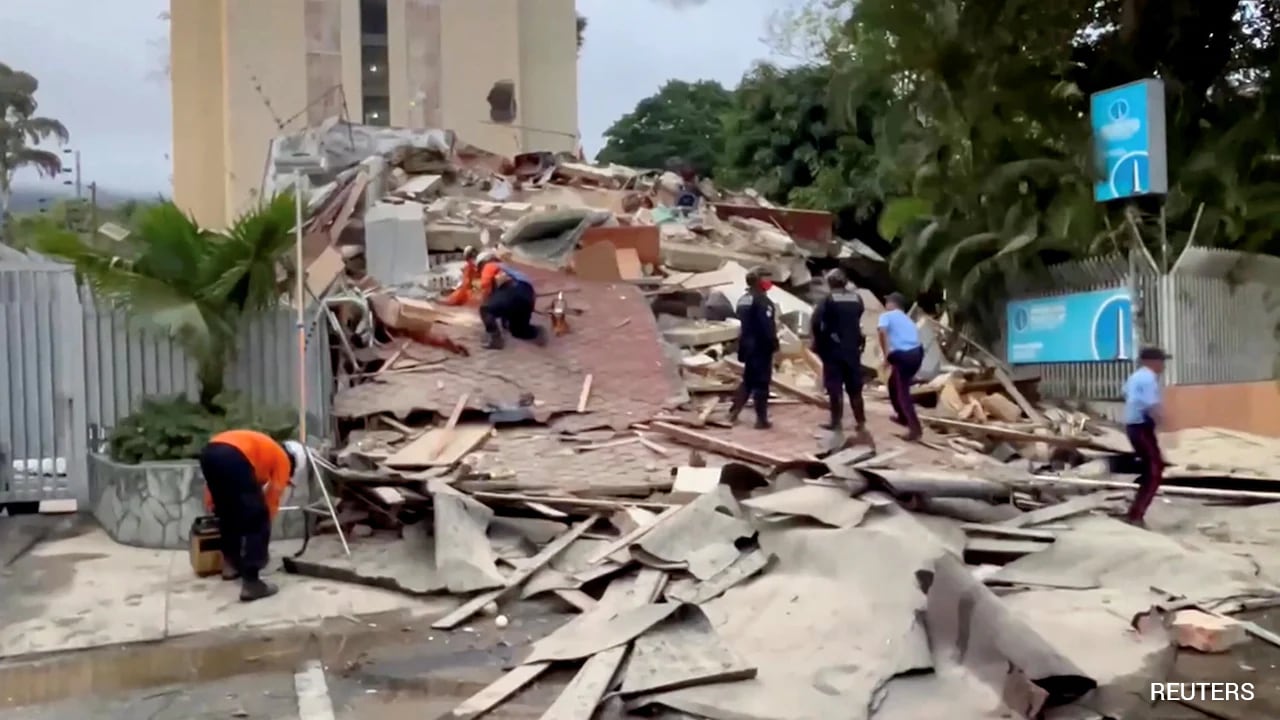
Disaster reporting is broken.
When a seismic event hits a region like Venezuela, the media playbook is entirely predictable. Out come the photo galleries of toppled concrete, shattered brickwork, and trapped citizens. The headlines scream about immediate devastation, and the public collective consciousness nods along, assuming the disaster was an unpredictable act of nature.
They are looking at the wrong map.
The standard media narrative treats an earthquake as a sudden, tragic twist of fate. It focuses exclusively on the kinetic energy of the fault line. But a pile of rubble isn't just the result of a shifting tectonic plate. It is a physical manifestation of regulatory capture, hyperinflation, and corrupted building codes.
If you want to understand why buildings fall, stop looking at the Richter scale. Start looking at the balance sheets of local concrete suppliers and the enforcement history of municipal inspectors.
The Mirage of Natural Disasters
We need to stop calling these events natural disasters. The seismic wave is natural. The disaster is entirely manufactured by human policy.
When a quake rattles a city and structures collapse, the immediate reaction is to blame the severity of the tremors. This is a fundamental misunderstanding of structural engineering. Buildings are entirely capable of withstanding massive lateral forces if they are designed and built to modern engineering standards.
The lazy consensus ignores three structural realities:
- The Reinforcement Deficit: In developing or economically strained regions, concrete is often stretched too thin. Sand and water ratios are increased to save money, creating a porous, brittle material that shears under minimal stress.
- The Non-Ductile Trap: Older concrete structures lack ductile detailing—the specific arrangement of steel rebar that allows a building to bend without breaking. Without it, failure is catastrophic and instantaneous, not gradual.
- The Soft-Story Failure: The ground floors of urban buildings are frequently cleared out to make room for retail spaces or parking garages. This creates a structurally weak base that folds under lateral movement while the upper floors remain entirely intact as they crush the bottom layer.
Media outlets focus on the dramatic dust clouds because it drives immediate clicks. It takes too much time to explain that a building collapsed because a local contractor substituted high-grade rebar with cheap, imported steel mesh to protect their margins.
The Economics of Crumbling Concrete
I have spent years analyzing urban development patterns and structural vulnerability in Latin America. The pattern is always the same. When economic instability hits a nation, the very first thing to erode isn't the political rhetoric; it is the quality of civil engineering.
Hyperinflation destroys infrastructure long before an earthquake ever triggers. When the value of currency plummets, the cost of importing high-quality structural steel skyrockets. Local builders face a brutal choice: stop building entirely, or cut corners hidden deep within the columns where no inspector will look.
They choose the corners.
"A building code is only as strong as the lowest-paid inspector on the municipal payroll."
When regulatory oversight is compromised by systemic economic failure, code compliance becomes a luxury. The official documentation might state a building is rated for a magnitude 7.0 event, but the physical reality on the ground is a structure that will fail at a 5.5.
The images of toppled buildings in Venezuela aren't just news photos. They are architectural autopsies of a failed economic system.
Stop Demanding Better Rescue Teams
Every time a major quake hits, the international community floods the zone with urban search and rescue teams. Millions of dollars are spent shipping specialized equipment and canine units across borders.
This is a reactive, performative exercise that addresses the symptom while ignoring the pathology.
If you are spending millions to pull people out of concrete sandwiches, you have already lost the war. The return on investment for post-disaster rescue operations is abysmally low compared to proactive structural retrofitting.
Consider the mechanics of a typical seismic upgrade. Jacketing existing concrete columns with carbon fiber reinforced polymers or adding steel bracing can increase a building's shear strength exponentially. It is unglamorous work. It doesn't look dramatic on a news broadcast. It doesn't generate viral photo galleries. But it keeps the roof over people's heads when the ground moves.
The downside to this contrarian approach is obvious: retrofitting is incredibly expensive upfront, and it requires displacing occupants in the short term. It requires political will that spans decades, not election cycles. It is far easier for a government to pray the fault line stays quiet during their term and then blame an act of God if it doesn't.
Dismantling the Premise of Disaster Recovery
If you look at public forums or standard news commentary, the questions being asked are fundamentally flawed.
People ask: How can we speed up international aid to rebuild these cities?
This is the wrong question. Rebuilding a city using the exact same corrupt supply chains and unenforced building codes just sets the timer for the next disaster. The focus should not be on rebuilding quickly; it must be on reconstructing restrictively.
If a municipality cannot guarantee the structural integrity of a five-story concrete building due to supply chain corruption, then that municipality should be legally barred from building above two stories. It is a brutal, economically restrictive policy that halts urban density, but it stops the body count.
We must also challenge the notion that newer construction is inherently safer in developing markets. In rapidly expanding urban centers, the pace of construction far outstrips the capacity of regulatory agencies to monitor them. A shiny, new high-rise built during an economic boom can be far more dangerous than a mid-century building constructed when materials were cheap and labor was meticulous.
The Physical Law of Accountability
Gravity has no political bias. It does not care about economic sanctions, ideological stances, or sovereign pride. When a column is subjected to a load it cannot bear, it fails.
The media will continue to show you pictures of the rubble because it evokes a visceral emotional response. They want you to feel helpless in the face of nature’s wrath.
Do not fall for it.
Every single structural failure you see in a modern earthquake zone is a human choice recorded in stone and steel. The collapse happened years before the fault line slipped, the moment someone decided that safety was a variable cost.
Stop looking at the sky or the ground for answers. Look at the blueprints, look at the supply ledger, and follow the money.