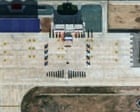
The headlines dropped like clockwork. Commercial satellite imagery surfaced showing attack jets parked at a military installation in Laos, and the global defense commentariat lost its collective mind. Think tanks in Washington and London spun up rapid-response threads about expanding Chinese military footprint, regional hegemony, and the creeping militarization of mainland Southeast Asia.
They are missing the entire point because they are looking at a tactical snapshot through a strategic funhouse mirror.
I have spent two decades looking at how regional logistics actually operate on the ground versus how they look to analysts sitting thousands of miles away in air-conditioned offices parsing pixels. I have seen governments blow millions preparing for the wrong threat vector because they confuse hardware presence with strategic projection.
Those attack jets sitting on a tarmac in Laos do not represent a bold new forward-basing doctrine for Beijing. They represent something far more mundane, far more cost-effective, and entirely misunderstood by the mainstream defense establishment: routine maintenance overflow, joint training economy, and the quiet reality of modern auxiliary basing.
Let us dismantle the lazy consensus piece by piece.
The Pixel Panic Trap
Every time a commercial satellite snaps a high-resolution image of military hardware in a non-traditional location, the default reaction of modern OSINT is immediate escalation. Analysts count wingspans, measure runway lengths, and calculate combat radii as if every parked aircraft is a prelude to an offensive strike package.
This is amateur hour.
A military aircraft on a tarmac is not a permanent geopolitical statement. It is a very expensive, highly delicate piece of machinery that requires constant shelter, specialized ground equipment, and specialized supply chains. Laos shares a border with China and maintains deep military-technical cooperation with its northern neighbor. When you look at those jets, you are not looking at a forward-deployed dagger pointed at the South China Sea or Mekong trade routes. You are looking at a regional logistics node doing what logistics nodes do: sharing space, rotating for maintenance, and engaging in bilateral exercises that have been standard operating procedure for decades.
The lazy narrative treats Southeast Asia as a passive chess board where every square inch is aggressively contested. The reality is far messier. Smaller nations like Laos do not hand over sovereignty to foreign powers for permanent combat staging; they manage multi-lateral relationships for maximum economic and security hedging.
The Logistics Myth
Imagine a scenario where a mid-tier air force needs to conduct extended cross-border training or heavy maintenance rotations away from congested domestic airbases. Do they build billion-dollar infrastructure from scratch? No. They utilize existing friendly bilateral agreements to stage assets where ramp space is available and logistics trails are already established.
The media wants you to believe that every foreign deployment is an ominous projection of hard power. That sells clicks. It feeds the defense budget narrative in Western capitals. But it ignores the brutal arithmetic of aircraft maintenance.
Modern strike aircraft spend dozens of hours in maintenance for every hour in the air. Engines need overhaul, avionics require secure telemetry links, and specialized munitions need climate-controlled storage. None of this appears magically because an airframe was towed onto a concrete apron in Vientiane province. If Beijing were truly establishing a major forward power-projection hub in Laos, you would see massive subterranean fuel storage construction, hardened aircraft shelters, secure electronic intelligence gathering arrays, and dedicated air defense batteries integrated into a unified command network.
We do not see that. We see jets on a ramp.
Confusing a temporary parking spot with a permanent operational base is the kind of analytical laziness that leads to multi-billion-dollar strategic miscalculations.
What the People Also Ask Queries Get Wrong
If you search for recent commentary on this topic, the recurring questions are predictable: Is China building a military base in Laos? Does this threaten neighboring nations? Are regional security balances shifting?
The premise of every single one of those questions is flawed because it assumes static, zero-sum geopolitics.
The question is not whether China has military ties to Laos. Of course it does. They share a land border, railway investments, and extensive defense diplomacy. The real question is why Western observers continue to view every bilateral military exercise or logistics stopover through the lens of Cold War containment.
By framing every regional movement as an existential threat, analysts commit a fundamental error: they discount the agency of the host nation. Laos is not a puppet state or an unsinkable aircraft carrier. It is an independent nation navigating great-power competition by keeping its economic options open with China while balancing regional ties through ASEAN. Letting partner aircraft use facilities for training or maintenance is standard diplomatic currency. It is not an occupation. It is not an invasion preview.
The Uncomfortable Downside of My Argument
I will admit the weakness in my own perspective. Downplaying these satellite sightings risks falling into the trap of complacency. There is a fine line between dismissing sensationalist media and ignoring genuine incremental shifts in regional posture.
China's expanding belt-and-road infrastructure across mainland Southeast Asia—including high-speed railways, dual-use roads, and upgraded airfield facilities—does indeed lower the friction for rapid military mobility if a crisis ever erupts. Just because those jets parked in Laos today are there for routine cooperation does not mean the underlying infrastructure cannot be repurposed tomorrow.
Infrastructure is inherently dual-use. A runway built to boost commercial cargo and regional tourism can also land transport planes and fighters. Pretending that logistics upgrades carry zero strategic weight is just as foolish as panicking over a single satellite photo.
The truth lives in the friction between those two extremes.
Stop Watching the Shadows
If you want to understand where regional security is actually heading, stop staring at commercial satellite imagery of parked fighter jets looking for signs of World War III.
Look at the contracts. Look at the railway freight volumes. Look at the telecommunications standards being adopted across Indochina. Power in the twenty-first century is not projected primarily by where you park an attack jet for a photo op. It is locked in through debt ownership, supply chain dominance, infrastructure control, and diplomatic gravity.
The jets in Laos are a distraction. They are shiny objects designed to capture headlines and keep the defense-industrial complex well-funded.
Ignore the noise. Look at the ledger.