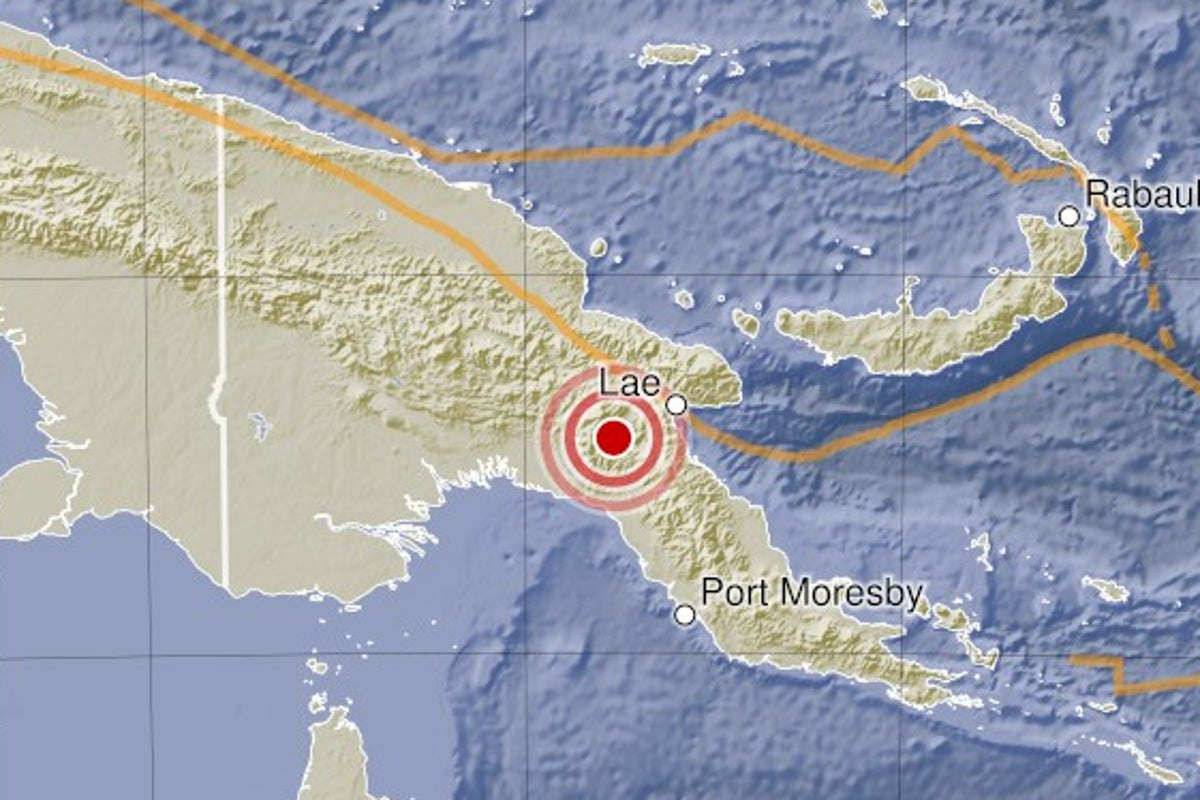
Another tremor rattles the Pacific, and the global media machine spins into its default, lazy panic. Flashing red banners scream about powerful quakes striking Papua New Guinea, treating every tectonic shift as an unprecedented anomaly. Broadcasters rush to push out generic tragedy porn, projecting standard Western disaster tropes onto one of the most geologically volatile zones on the planet.
Stop treating routine plate tectonics like a black swan event.
The lazy consensus in mainstream disaster reporting assumes that every high-magnitude tremor in the region signals an unmitigated humanitarian catastrophe requiring immediate, top-down foreign intervention. This perspective completely misses the structural reality on the ground. Papua New Guinea sits squarely on the Pacific Ring of Fire, straddling the violent collision zone of the Australian and Pacific plates. Seismic activity here is not an interruption of normal conditions; seismic activity is the normal condition.
When a 5.7 or 6.5 magnitude quake hits, headline writers scramble to find damage reports, ignoring the profound adaptive capacity of local communities who have engineered their lives around tectonic instability for millennia. The real story is never the Richter scale reading. The real story is the absolute failure of centralized disaster management models to understand local resilience.
Let us look at the structural mechanics. Geologists at institutions like the USGS do extraordinary work tracking slip rates and hypocenter depths, but cable news outlets strip away the nuance. They report magnitude while ignoring focal depth. A deep-focus quake 100 kilometers underground dissipates immense energy before it ever reaches the surface, yet sensationalist articles lump it in with shallow crustal ruptures that rip apart foundations. This false equivalence drives bad policy, misallocates emergency funding, and feeds a cycle of patronizing foreign coverage that paints indigenous populations as helpless victims waiting for rescue.
I have seen international aid organizations blow millions on emergency logistics plans that completely bypassed local tribal networks, failing because they treated rugged terrain like a suburban grid. Bureaucrats sitting thousands of miles away design relief frameworks based on automated alerts, completely blind to the fact that rural villagers in the Highlands build lightweight, flexible timber-and-thatch structures specifically designed to flex with ground motion or rebuild in hours if a landslide hits.
Imagine a scenario where global media outlets spent half as much time analyzing local infrastructural adaptation as they do broadcasting panicky maps of epicenter coordinates.
The standard questions asked by commentators are fundamentally flawed. They ask: "How severe is the devastation?" and "Will international aid arrive in time?" These questions assume that urban centers are the baseline of civilization and that rural populations are isolated pockets waiting to be saved by centralized state apparatuses.
The correct question is: "How do decentralized indigenous networks absorb tectonic shockwaves better than modern concrete structures?"
Data from the region consistently demonstrates that structural failure is rarely caused by the ground shaking itself. It is caused by secondary triggers—specifically, catastrophic slope failures in deforested or saturated mountainous terrain. Yet, do you see headlines demanding rigorous land-management reform or sustainable hillside retention? No. You see temporary panic followed by collective amnesia until the next plate boundary shifts.
True expertise in disaster preparedness requires abandoning the savior complex. It means recognizing that Papua New Guinea’s communities possess more practical geological literacy than the desk-bound analysts drafting breaking news chyrons.
Stop hyperventilating over routine planetary mechanics. Start paying attention to how resilient systems actually function under pressure.
Powerful 6.5 earthquake strikes Papua New Guinea near Lorengau
This video provides on-the-ground reporting and emergency assessment context regarding seismic activity in Papua New Guinea.