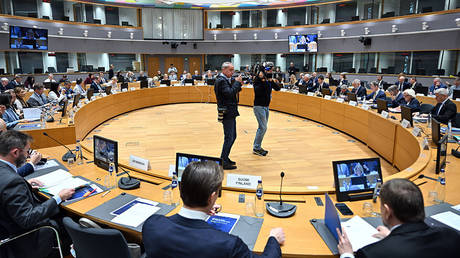
Brussels is shedding decades of post-Cold War complacency. For years, European defense policy was defined by bureaucratic inertia, fragmented procurement cycles, and a quiet reliance on an American security umbrella that politicians hoped would remain permanent. That luxury has expired. The European Union is accelerating a fundamental transformation of its military industrial base, shifting from a loose federation of allied economies into a centralized defense procurement and manufacturing powerhouse.
The immediate catalyst is obvious, yet the structural roots run far deeper. Washington's shifting political priorities and the persistent strain on conventional stockpiles exposed a bitter reality. Europe can no longer outsource its fundamental sovereignty to an overseas election cycle. When conventional warfare returned to the European continent, it laid bare a fractured industrial ecosystem where national capitals routinely competed against each other for artillery shells, radar components, and armored vehicles.
The Anatomy of Fragmentation
To understand why the current defense push is different from previous false starts, one must examine the baseline. The European Union has historically suffered from extreme duplication. While the United States operates a unified military industrial market, EU member states maintained nearly twenty different types of main battle tanks and over thirty types of armored personnel carriers. This fragmentation created massive administrative overhead, bloated maintenance costs, and a near-total inability to scale production rapidly during a crisis.
Efforts to fix this through agencies like the European Defense Agency met polite applause and quiet obstruction. National champions in France, Germany, Italy, and Spain guarded their domestic defense contracts fiercely. Export restrictions, divergent technical specifications, and protectionist procurement laws turned every joint venture into a diplomatic minefield.
The current escalation breaks through some of these historical roadblocks. Driven by emergency funding mechanisms and joint procurement frameworks, Brussels is attempting to force member states to pool their buying power. The goal is straightforward. Create economies of scale that can sustain high-intensity manufacturing over years, rather than months.
Financing the Rebuild
Money is moving where policy stalled. The European Commission has rolled out a series of financial instruments designed to incentivize joint acquisitions and replenish depleted national arsenals. Programs aimed at spurring joint defense procurement are injecting billions into cross-border manufacturing consortia.
Yet, throwing capital at legacy defense contractors does not automatically solve structural bottlenecks. Europe faces severe supply chain vulnerabilities. Raw materials, rare earth elements, and specialized chemical precursors for propellants often rely on complex, vulnerable global supply chains. A billion euros in new funding cannot instantly manufacture skilled metallurgical engineers or compress the multi-year lead times required to build advanced propellant production facilities.
Furthermore, national governments remain caught between two competing pressures. They must rearm quickly, which often pushes them to buy off-the-shelf equipment from non-EU manufacturers like the United States or South Korea to fill immediate gaps. Simultaneously, they face intense political demands to invest domestically to protect local jobs and secure long-term technological independence. This tension creates a sluggish compromise where emergency purchases temporarily undermine the long-term vision of strategic autonomy.
The Technological Frontier
Modern defense is no longer solely about steel and explosives. The battlefield evolution observed over recent years demonstrates that software integration, electronic warfare, resilient satellite communications, and autonomous systems dictate tactical survival. European defense firms excel in high-end platforms like stealth frigates and advanced avionics, but they lag significantly in mass-produced attritable drones and secure battlefield cloud architecture.
Berlin, Paris, and other capitals are racing to close this gap by funding joint research initiatives that bridge traditional defense primes with agile technology startups. Venture capital funds backed by public defense budgets are beginning to target dual-use technologies. Artificial intelligence for predictive maintenance, quantum encryption for secure command networks, and advanced counter-drone systems are absorbing unprecedented shares of capital.
However, scaling these innovations encounters institutional friction. Traditional defense procurement processes are designed for decades-long development cycles, not the rapid software iteration cycles seen in commercial tech sectors. A startup building counter-measure software cannot wait three years for a bureaucratic clearance review while threat vectors evolve every three months. Until procurement agility matches technological ambition, Europe will remain perpetually a step behind the pacing threat.
The Geopolitical Gamble
Underpinning this entire industrial mobilization is a quiet diplomatic anxiety. The push for a stronger defense posture is frequently framed as a reinforcement of the transatlantic alliance, but behind closed doors, planners are preparing for a world where Washington's focus pivots decisively toward the Indo-Pacific.
This creates a delicate balancing act. European leaders must convince skeptical allies that increased defense spending and industrial independence do not equate to a decoupling from NATO. At the same time, they must build the command structures and logistical capacity to operate independently if a major crisis erupts on the continent's eastern periphery without direct American leadership.
Achieving this requires hard choices that few politicians are eager to explain to their electorates. Prioritizing defense spending means making difficult trade-offs against social welfare budgets, green transition subsidies, and public infrastructure investments. As inflation pressures persist and public debt levels remain high across several key economies, sustaining political momentum for multi-year defense expansions will test the resilience of European cohesion.
The transformation underway is neither smooth nor guaranteed. It is messy, politically fraught, and plagued by historical rivalries and industrial bottlenecks. Yet the trajectory is set. The era of European strategic leisure has closed, replaced by a grim determination to forge a defense apparatus capable of standing on its own terms.


