The containment of an Ebola virus disease outbreak depends on a simple mathematical reality: the rate of transmission reduction must exceed the rate of geographic and demographic expansion. When the suspected case count in the Democratic Republic of Congo passes the 900-case threshold, the crisis ceases to be merely a medical emergency. It becomes a systemic logistics and security failure. Standard epidemiological models fail in this environment because they assume a frictionless operational theater. In reality, containment efforts are impeded by an adversarial feedback loop where targeted violence, severe resource scarcity, and deep institutional distrust compound exponentially.
To dismantle and understand this crisis, the situation must be evaluated through three distinct operational vectors: transmission dynamics in volatile zones, the security-delivery bottleneck, and the structural depletion of frontline capital. You might also find this similar coverage useful: The Red Ink on the Map of Beni.
The Triad of Epidemic Acceleration
The escalation of cases past 900 indicates that the basic reproduction number ($R_0$) remains stubbornly above 1. In standard filovirus outbreaks, targeted contact tracing and ring vaccination pull $R_0$ below the critical threshold. In the eastern regions of the DR Congo, this math is disrupted by three structural accelerators.
Hyper-Mobility and High-Density Vectors
The populations in the affected provinces are not static. Decades of economic instability and regional trade create constant informal migration patterns. When a suspected case flees a screening checkpoint or moves across informal border crossings to evade surveillance, the contact network expands geometrically. A single untracked individual interacting with a high-density transit hub resets the incubation clock for dozens of secondary contacts, rendering traditional geographic containment maps obsolete. As extensively documented in latest coverage by World Health Organization, the effects are worth noting.
Nosocomial Amplification Rings
A significant portion of transmission occurs within informal health structures or traditional healing centers. When formal health infrastructure lacks protective gear, these facilities shift from treatment nodes to amplification rings. Patients presenting with early, non-specific febrile symptoms inadvertently expose healthcare workers and adjacent patients. This creates a secondary wave of infection that decimates the localized healthcare workforce before a formal alert is even triggered.
Post-Mortem Transmission Pathways
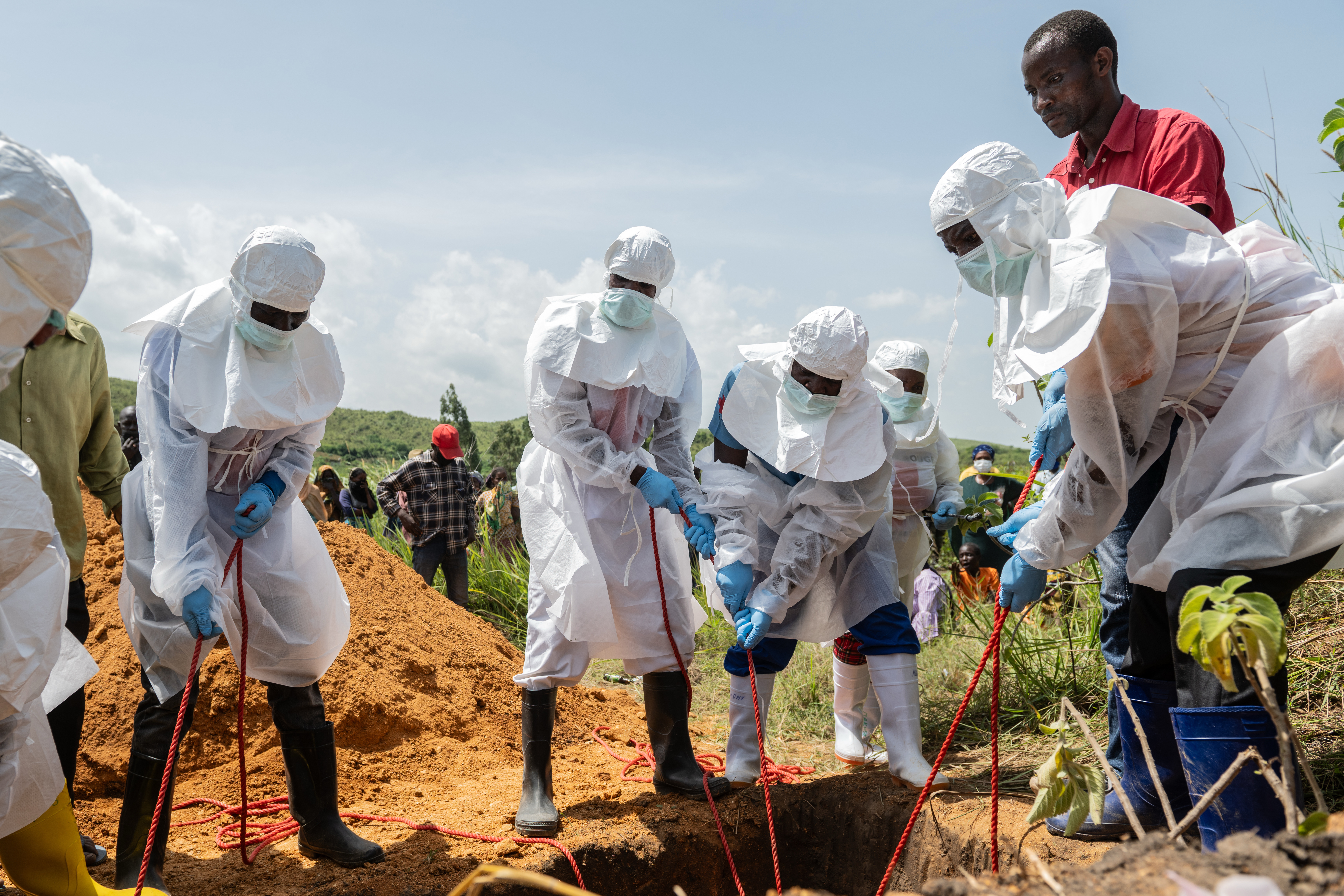
Deeply ingrained community burial practices require physical contact with the deceased. Because the viral load of the Ebola virus peaks immediately after the death of the host, these rituals represent the highest-probability transmission events. Interrupting this pathway requires immediate behavioral modification, yet imposing top-down burial protocols without community integration triggers intense resistance.
http://googleusercontent.com/image_content/202
The Security-Delivery Bottleneck
The defining characteristic of this outbreak is not the virulence of the pathogen, but the hostility of the operating environment. The presence of active armed factions and widespread civil unrest transforms medical logistics into a high-risk paramilitary operation. This reality introduces a severe degradation of intervention capabilities through a predictable causal chain.
[Armed Attack / Civil Unrest]
       │
       ▼
[Suspension of Surveillance & Ring Vaccination]
       │
       ▼
[Blind Spots in Contact Tracing (48–72 Hours)]
       │
       ▼
[Exponential, Untracked Community Spread]
When a health facility or a response team faces a kinetic attack, the immediate operational consequence is a complete suspension of surveillance and ring vaccination activities within that sector. A pause of just 48 to 72 hours generates a profound data blindness. During this window, contacts of confirmed cases exhibit symptoms, enter the community, and generate new transmission chains completely outside the view of epidemiologists.
By the time security is re-established and teams deploy back into the field, the original contact list is useless. The response team is forced to restart the resource-intensive process of mapping an entirely new, larger generation of the disease. Security multi-agents do not just delay operations; they actively multiply the scale of the epidemic.
Furthermore, the introduction of heavily armed escorts for medical personnel creates a psychological paradox. While security forces protect the physical safety of international and national responders, their presence reinforces a narrative of state coercion. The population ceases to see a medical intervention and instead perceives a hostile military occupation. This perception drives symptomatic individuals further underground, completely neutralizing the efficacy of passive surveillance systems.
Frontline Resource Depletion Functions
The narrative of "shortages" in humanitarian crises is frequently treated as a simple scarcity of supply. In an active epidemic zone, supply degradation is a multi-variable equation involving cold-chain logistics, personnel attrition, and capital misallocation.
The Cold-Chain Failure Rate
The highly effective rVSV-ZEBOV vaccine requires an uninterrupted ultra-cold chain, maintaining temperatures between $-60^\circ\text{C}$ and $-80^\circ\text{C}$. In a region characterized by a near-total absence of a centralized electrical grid, this dependency introduces a massive point of failure. Every kilometer the vaccine travels via motorbike over unpaved infrastructure increases the probability of equipment failure.
                       [Central Depot (-70°C)]
                                  │
                          (Logistical Transit)
                                  ▼
                     [Sub-District Hub (-20°C)]
                                  │
                    (Last-Mile Motorbike Transit)
                                  ▼
                  [Field Team Passive Cold Box]
When local supply hubs run out of fuel for generators, or when transit delays exceed the passive cooling lifespan of field containers, the vaccine doses degrade. The bottleneck is rarely the absolute global volume of the vaccine; it is the daily operational yield of viable doses at the point of injection.
Human Capital Attrition Mechanics
The physical and psychological toll on local healthcare workers creates an unsustainable attrition rate. These professionals face a dual threat: the lethal biological hazard of the virus and the kinetic threat of community violence driven by misinformation. The depletion of this workforce follows a distinct pattern:
- Phase 1: Physical Fatigue. Sustained shifts in high-temperature personal protective equipment (PPE) lead to cognitive decline, increasing the probability of accidental self-contamination during the doffing process.
- Phase 2: Social Isolation. Responders are frequently ostracized by their own communities due to fear of contagion or accusations of collaborating with exploitative external entities.
- Phase 3: Operational Exit. Following direct threats or the death of a colleague, local clinicians withdraw from service, stripping the response of its most culturally competent and linguistically capable assets.
Replacing these workers with external personnel is structurally inefficient. External responders require lengthy onboarding, lack established trust networks, and consume a disproportionate amount of the response's logistical and security bandwidth.
Deconstructing the Misinformation Matrix
It is a analytical error to view community resistance as irrational ignorance. In regions defined by systemic neglect, exploitation, and conflict, suspicion of sudden, heavily funded external interventions is a rational survival mechanism.
For decades, basic health infrastructure in the DR Congo has suffered from chronic underfunding. Populations routinely perish from easily preventable diseases like malaria, measles, and cholera due to a lack of nominal resources. When an Ebola outbreak occurs, millions of dollars in international capital suddenly flood a specific corridor. The local population witnesses the arrival of high-end vehicles, specialized isolation units, and highly compensated foreign experts—all dedicated exclusively to a single disease.
This hyper-targeted funding creates a profound systemic distortion. The community asks a logical question: Why does the global apparatus deploy unlimited resources to contain a virus that threatens the international community, while ignoring the daily endemic killers that decimate our children?
This dissonance forms the foundation for weaponized misinformation. The rumor that Ebola is an imported bioweapon or a commercial enterprise designed to generate funding is not born in a vacuum; it is an interpretation of the stark disparity in global health priorities. When political actors exploit these anxieties for localized leverage, resistance hardens from passive non-compliance into active, organized sabotage of treatment centers.
The Strategic Matrix for Epidemic Stabilization
Reversing the trajectory of an outbreak that has breached 900 cases requires shifting from a reactive crisis-response posture to a highly structured operational strategy. The current paradigm of high-visibility, centralized interventions must be replaced by a decentralized, low-signature deployment model designed to neutralize the operational bottlenecks.
┌────────────────────────────────────────────────────────────────────────┐
│                      DECENTRALIZED TRIAGE NETWORK                      │
└─────────────────────────────────────┬──────────────────────────────────┘
                                      │
           ┌──────────────────────────┴──────────────────────────┐
           ▼                                                     ▼
┌─────────────────────────────────────┐               ┌─────────────────────────────────────┐
│    COMMUNITY-LED SURVEILLANCE       │               │     DE-ESCALATED LAST-MILE LOGISTICS│
├─────────────────────────────────────┤               ├─────────────────────────────────────┤
│• Local personnel lead tracing       │               │• Supply distribution via local hubs │
│• High cultural integration         │               │• Passive cooling systems            │
│• Reduced reliance on state security │               │• Low-signature transport profiles   │
└─────────────────────────────────────┘               └─────────────────────────────────────┘
1. Decentralization of Triage and Isolation Architecture
Large, centralized Ebola Treatment Centers (ETCs) act as lightning rods for civil unrest and represent significant transit barriers for symptomatic patients. The response must pivot to a network of micro-triage points integrated directly into existing, trusted community health structures.
- Implementation: Convert localized clinics into decentralized isolation and stabilization units using modular, rapidly deployable containment kits.
- Operational Benefit: Minimizes the distance symptomatic individuals must travel, reduces the visibility of the intervention, and ensures that non-Ebola medical needs are addressed concurrently, mitigating the funding-dissonance effect.
2. Operational Transition to Localized Personnel Profiles
The profile of the frontline responder must be systematically altered to decouple the medical intervention from the geopolitical apparatus.
- Implementation: Imposed mandates must shift 90% of field-facing contact tracing, community engagement, and safe burial operations to local personnel native to the specific health zones. International experts must retreat to secondary support roles, focusing on data analytics, supply chain integrity, and macro-logistics.
- Operational Benefit: Drastically reduces the security target profile of the teams, dismantles the "foreign intervention" narrative, and utilizes existing community trust to identify untracked transmission chains that evade external teams.
3. Asymmetric Security De-escalation
The practice of utilizing armed state military escorts for routine medical movements must be terminated, as its epidemiological cost exceeds its defensive utility.
- Implementation: Establish localized humanitarian corridors through indirect negotiations managed by neutral, non-state mediators. Secure operational areas not through kinetic deterrence, but through community-enforced guarantees of safety predicated on the delivery of broad-spectrum medical aid (e.g., combining Ebola containment with clean water initiatives and basic pediatric care).
- Operational Benefit: Eliminates the militarized aesthetic of the response, neutralizes the primary trigger for community-led attacks, and allows surveillance teams to re-enter previously closed sectors without introducing new political tensions.
4. Dynamic Vaccine Allocation Protocols
To counter the cold-chain degradation bottleneck, the response must deploy alternative delivery methodologies that optimize the preservation of active thermal capital.
- Implementation: Transition from strict ring vaccination (which requires rapid, unpredictable movement over vast distances) to a targeted geographic barrier vaccination strategy. Establish permanent, solar-powered refrigeration hubs at critical trade choke points and transit nodes, immunizing high-mobility populations systematically before they enter uncontained zones.
- Operational Benefit: Reduces the reliance on last-mile mobile cold chains, protects the structural integrity of the vaccine supply, and creates an epidemiological firewall around the most volatile sectors.
If the containment apparatus continues to rely on high-signature, centralized, and security-dependent operational methodologies, the transmission velocity will continue to outpace the response capabilities. The stabilization of the DR Congo outbreak depends entirely on executing this transition from a posture of logistical dominance to one of hyper-local integration and operational agility.