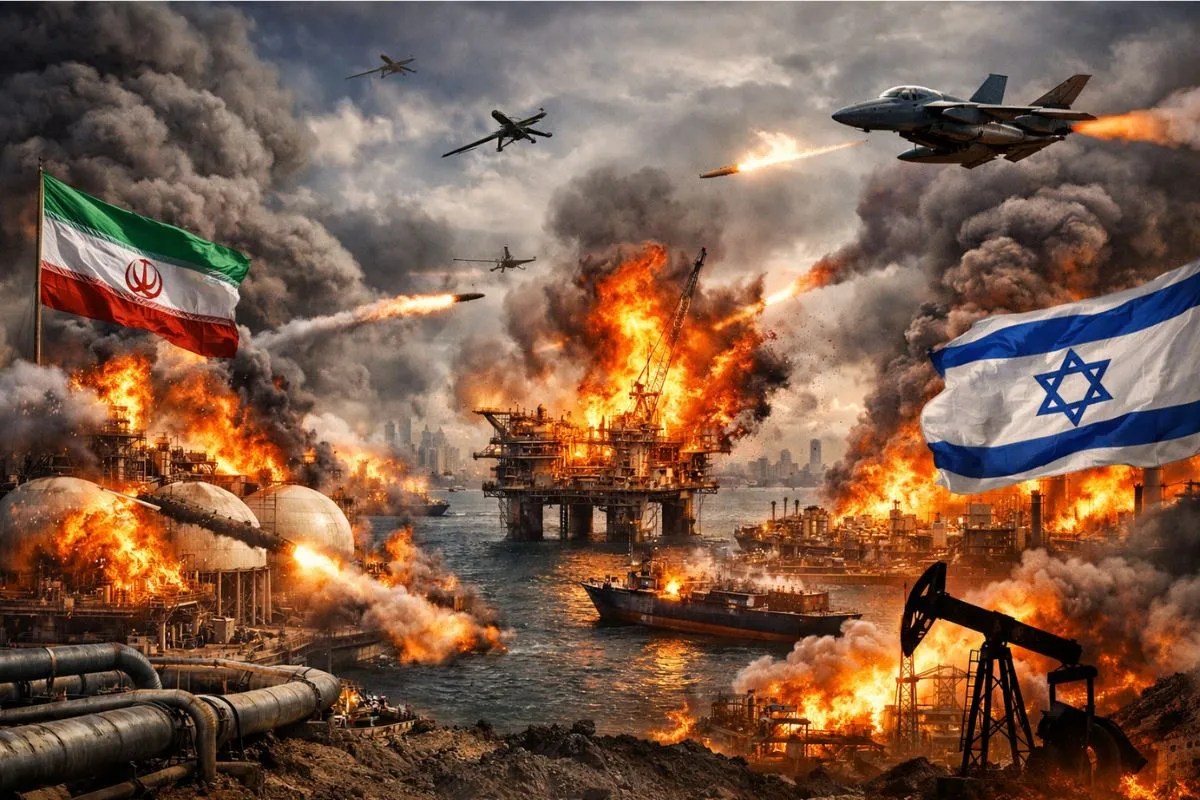
The global economy is currently tethered to a fuse burning in the Middle East. While cable news fixates on the immediate tragedy of missiles and drones, the true structural threat lies in the systematic weaponization of energy infrastructure between Iran and Israel. This is no longer a shadow war. It is a direct assault on the world’s most sensitive economic pressure points. If the Strait of Hormuz closes or the Eastern Mediterranean gas fields go dark, the $100 barrel of oil becomes a memory, replaced by a price floor that could bankrupt emerging markets and stall Western industrial recovery.
We are witnessing a fundamental shift in how kinetic conflict dictates market reality. For decades, the "risk premium" was a theoretical calculation added to Brent Crude prices whenever a regional skirmish broke out. Today, that premium is being baked into the very foundation of global trade. The escalation between Tehran and Tel Aviv has moved past symbolic retaliation and into a phase of targeting the "economic lungs" of the adversary.
The Strait of Hormuz Bottleneck
The mathematics of a global collapse are simple. Approximately 21 million barrels of oil pass through the Strait of Hormuz every single day. That is roughly 21% of global petroleum liquid consumption. Iran knows this is its ultimate leverage. Unlike the localized skirmishes of the past, a full-scale maritime blockade would not just raise gas prices at the local pump; it would halt the global supply chain for everything from plastics to pharmaceuticals.
Skeptics argue that Iran wouldn't dare close the Strait because it would destroy their own economy. This misses the point of a cornered regime. When survival is at stake, economic suicide becomes a viable tactical choice if it ensures the enemy's ruin. The Persian Gulf is the world's most crowded waterway, and it only takes a handful of sunken tankers or sea mines to make the area uninsurable. Once Lloyd’s of London pulls maritime insurance, the flow of oil stops regardless of whether the Strait is physically blocked.
Israel’s Gas Ambitions Under Fire
Israel has spent the last decade transforming itself from an energy importer into a regional gas powerhouse. The Leviathan and Tamar fields are the crown jewels of this strategy. They provide the energy independence Israel craves and a diplomatic tool to build bridges with Jordan and Egypt. However, these offshore platforms are essentially stationary, multi-billion-dollar targets sitting in the Mediterranean.
Hezbollah, Iran’s primary proxy, has already demonstrated its ability to launch sophisticated drones toward these rigs. If these platforms are taken offline, Israel’s domestic grid faces immediate instability. More importantly, the dream of the EastMed pipeline—a project intended to supply Europe with a viable alternative to Russian gas—dies on the vine. Europe, still reeling from the loss of Nord Stream, cannot afford another pillar of its energy security to crumble before it is even built.
The Collapse of the Petrodollar Myth
The instability is forcing a quiet but frantic realignment in the East. China, the largest buyer of Iranian oil, is watching the situation with calculated concern. Beijing has no interest in a global recession, yet it benefits from a Middle East that is no longer an exclusive American playground. We are seeing the accelerated birth of a "shadow fleet"—thousands of tankers operating outside Western oversight, using "dark" ship-to-ship transfers to keep Iranian oil moving despite sanctions.
This shadow market is creating a two-tier global economy. On one side, the West pays a premium for "clean" and insured energy. On the other, the BRICS nations are building an opaque infrastructure that bypasses the dollar entirely. The Iran-Israel conflict is the primary catalyst for this fracture. Every time a new round of sanctions is applied, the incentive to move away from the U.S. financial system grows.
The Hydrogen and Renewables Fallacy
There is a common misconception among policy wonks that a rapid shift to green energy will insulate the world from Middle Eastern volatility. It won't. The transition to renewable energy requires a massive influx of silver, copper, and lithium—materials that require enormous amounts of cheap energy to mine and process. When oil and gas prices spike due to conflict, the cost of building solar panels and wind turbines spikes along with them.
The "Energy Transition" is actually an "Energy Addition." We aren't replacing fossil fuels yet; we are adding renewables on top of a growing demand for traditional power. If the Middle East burns, the green revolution stalls. You cannot build a post-carbon future on $150 oil. The logistical costs alone would bankrupt the very companies tasked with the transition.
Infrastructure as the New Front Line
We have entered an era where the refinery is as important as the airbase. Modern warfare is now defined by "infrastructure decapitation." By targeting power grids, desalination plants, and pipelines, combatants can force a surrender without ever putting boots on the ground. Iran’s cyber capabilities are specifically tuned for this purpose, targeting the SCADA systems that control Western utilities.
On the flip side, Israel’s intelligence apparatus has shown it can sabotage Iranian nuclear and industrial facilities with surgical precision. This back-and-forth isn't just about military ego; it’s a systematic attempt to prove that the other side cannot provide basic services to its citizens. When a country can't keep the lights on or the water running, the social contract dissolves. That is the ultimate goal of this "oil and gas war."
The Inflationary Death Spiral
Central banks are currently fighting a losing battle against inflation. While they tinker with interest rates, the real driver of costs—energy—is being manipulated by geopolitical actors. If the Iran-Israel conflict reaches a point of no return, the "higher for longer" interest rate environment becomes a permanent fixture.
Consider the impact on the shipping industry. To avoid the Red Sea and the Persian Gulf, ships are forced to take the long route around the Cape of Good Hope. This adds 10 to 14 days to a voyage, burning thousands of tons of additional fuel and tying up global container capacity. The result is a hidden tax on every single consumer product on Earth. We are already seeing the beginning of this trend, and there is no "soft landing" in a world where the primary energy arteries are under constant threat.
The Role of Private Military Contractors
A significant but under-reported factor is the privatization of security around energy assets. Major oil companies are no longer relying solely on national navies to protect their interests. We are seeing a surge in the use of private maritime security companies and advanced automated defense systems on oil rigs. This creates a dangerous gray zone. If a private security team fires on an Iranian revolutionary guard vessel, who is responsible? The potential for an accidental escalation that triggers a global war has never been higher.
The technology being deployed is terrifyingly efficient. Autonomous underwater vehicles (AUVs) are now being used to patrol pipelines, while AI-driven sensors monitor for the smallest vibration that might indicate sabotage. But even the most advanced tech cannot stop a sustained barrage of ballistic missiles. The vulnerability of the world’s energy supply is a physical reality that no amount of software can fully solve.
Beyond the Rhetoric
The United States finds itself in an impossible position. It must support its primary ally, Israel, while preventing a total shutdown of global energy markets. This tightrope walk is becoming increasingly frayed. Every time the U.S. releases oil from the Strategic Petroleum Reserve (SPR) to dampen price spikes, it loses another layer of its own national security. The SPR is at its lowest level in decades. We are running out of buffers.
The world is currently operating on "just-in-time" energy delivery. We have eliminated the redundancies that used to protect us from shocks. In our quest for efficiency, we have created a system that is brittle. The Iran-Israel conflict is the hammer, and the global economy is the glass.
Analyze the shipping lanes, the insurance premiums, and the sovereign wealth fund movements. They all point to a single conclusion: the era of cheap, reliable energy is over. We are now in a period of "energy balkanization," where access to fuel is determined by military alliances rather than market demand. The conflict in the Middle East is not a temporary disruption; it is the starting gun for a new world order where the flow of electrons and molecules is the ultimate weapon of statecraft.
Look at the surge in gold and Bitcoin among institutional investors. These are not just speculative plays. They are hedges against the potential collapse of the petrodollar-based financial system. If the energy war escalates, the very concept of "value" will be redefined by who can actually deliver a barrel of oil to a port. Would you like me to analyze the specific impact of a potential Strait of Hormuz closure on the top five Asian economies?