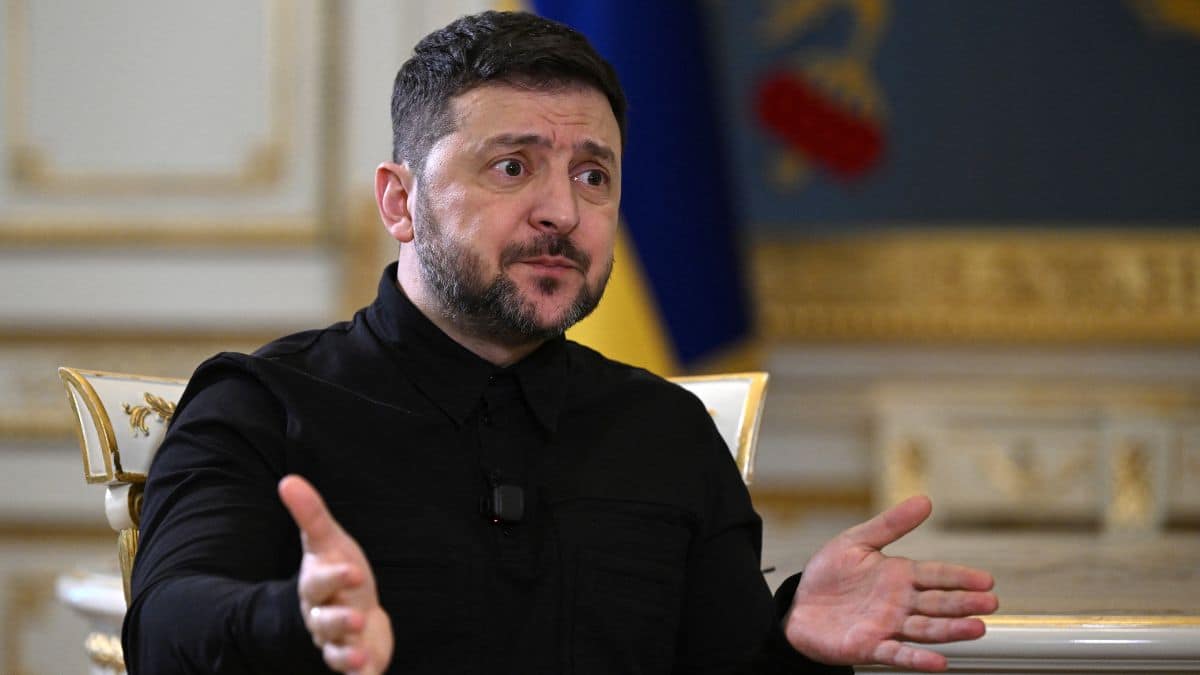
The flow of Russian crude oil through the Druzhba pipeline has long been the most awkward physical reality of the war in Ukraine. Since February 2022, while missiles have struck Ukrainian infrastructure and European capitals have pledged to dismantle Moscow’s war chest, the oil has never stopped moving. It pulses through Ukrainian soil toward refineries in Hungary, Slovakia, and the Czech Republic, providing the Kremlin with billions in revenue and landlocked European nations with their industrial lifeblood. Now, that flow is hitting a wall. President Volodymyr Zelensky’s recent moves to tighten the screws on Lukoil—Russia’s largest private oil producer—have sparked a diplomatic firestorm, with Budapest and Bratislava screaming "blackmail" while Kyiv insists it is merely closing a loophole that should have been sealed years ago.
This is not a simple trade dispute. It is the final collapse of a Cold War energy architecture that was designed to make Europe and Russia codependent. For Ukraine, the logic is brutal. Every barrel of Russian oil that crosses its territory represents a failure of the sanctions regime. For Hungary’s Viktor Orbán and Slovakia’s Robert Fico, the sudden cutoff of Lukoil supplies is an existential threat to their domestic economies and their political standing. The tension has reached a breaking point where energy security, national sovereignty, and the survival of the European Union’s unified front against Russian aggression are all colliding in the same set of pipes.
The Druzhba Paradox
The Druzhba, or "Friendship," pipeline is a relic of the Soviet era. It was built to tether the Eastern Bloc to Moscow’s energy resources, creating a network that remains difficult to replace. While the EU successfully banned seaborne imports of Russian crude in late 2022, these landlocked nations secured exemptions. They argued that their refineries—specifically those owned by the Hungarian group MOL—were technically calibrated to process the heavy, sour Russian Urals grade and could not switch to North Sea or Middle Eastern blends without years of expensive retrofitting.
Kyiv tolerated this for two years. They collected transit fees and maintained the infrastructure even as Russian forces targeted their own electrical grid. But the political climate in Ukraine has shifted. The government no longer sees the utility in facilitating the very commerce that funds the Iskander missiles falling on Odesa. By blacklisting Lukoil, Ukraine has effectively removed a major chunk of the volume flowing through the southern leg of the pipeline.
Budapest and the Politics of Scarcity
Viktor Orbán has built a political identity on low energy prices and a refusal to decouple from Moscow. To him, Ukraine’s actions are a direct assault on Hungarian national interest. The Hungarian government has characterized the move as a violation of the EU-Ukraine Association Agreement, which mandates the free transit of energy. They have even threatened to block European Peace Facility funds—money used to reimburse EU members for weapons sent to Ukraine—unless the oil starts flowing again.
The irony is thick. Hungary is currently the most vocal opponent of further EU integration and often blocks aid to Kyiv, yet it is now appealing to the European Commission to intervene on its behalf against a non-member state. The Commission, however, has been notably cool toward the complaint. From Brussels' perspective, Hungary has had more than two years to find alternative routes, such as the Adria pipeline from Croatia. The fact that Budapest remains 70% dependent on Russian oil is increasingly viewed not as a technical necessity, but as a deliberate political choice.
The Technical Reality of Redirection
Switching a refinery’s diet is not as simple as flipping a switch. The MOL refineries in Százhalombatta and Bratislava were engineered for Russian Urals. Processing "sweet" crude from the global market requires different pressure settings, chemical catalysts, and waste management systems. However, industry experts point out that MOL has already been blending in non-Russian crude for years.
The real bottleneck is the Adria pipeline. While it has the capacity to supply both Hungary and Slovakia, the transit fees charged by Croatia have skyrocketed. This is where the "blackmail" narrative gets complicated. Hungary isn't just fighting for oil; it is fighting for cheap oil. Russian crude through the Druzhba often sells at a significant discount compared to Brent or other global benchmarks. Losing that discount would mean higher prices at the pump and a hit to the profit margins of MOL, a company with deep ties to the Hungarian state.
Slovakia and the Internal Fracture
Slovakia finds itself in a similarly precarious position. Prime Minister Robert Fico, who returned to power on a platform of ending military aid to Ukraine, has described the Lukoil ban as "senseless." Slovakia’s Slovnaft refinery exports a significant portion of its refined products back to Ukraine, including diesel used by the Ukrainian military. Fico’s argument is that by cutting off the crude, Ukraine is inadvertently sabotaging its own fuel supply.
This creates a bizarre feedback loop where Russian oil is refined in Slovakia and then sold back to Ukraine to power tanks fighting the Russians. It is the kind of moral and logistical mess that defines the modern energy landscape. Ukraine’s response has been a shrug. They are betting that the short-term pain of fuel price spikes is a price worth paying to permanently degrade Russia’s ability to use energy as a weapon of influence in Central Europe.
The Geopolitical Gamble
Kyiv’s strategy is high-risk. By squeezing Lukoil, they are testing the limits of European solidarity. They are also calling the bluff of the European Commission. If the EU steps in to force Ukraine to resume the transit of Russian oil, it would be a massive propaganda victory for the Kremlin, signaling that European energy needs still outweigh the commitment to Ukrainian victory.
If the EU stands back, Hungary and Slovakia will be forced to the negotiating table with either Croatia or alternative global suppliers. This would likely result in a sharp increase in energy costs for their citizens. In a region where inflation has already been a volatile political issue, this could lead to civil unrest or a further shift toward pro-Russian populism.
The Lukoil Distinction
It is important to understand why Lukoil was targeted specifically. Unlike Rosneft or Gazprom, Lukoil is technically a private entity, though its leadership is closely aligned with the state. By targeting Lukoil but leaving other smaller Russian shippers alone for now, Ukraine is performing a "salami-slicing" tactic. They are not shutting the entire pipe—which would be a clear breach of various international treaties—but they are making it increasingly difficult for the largest players to operate. It is a targeted economic strike designed to create maximum friction with minimum legal exposure.
The End of the Exemptions
The era of exemptions is closing. For two years, Central Europe has lived in a bubble where the war was something that happened elsewhere, while the cheap Russian energy continued to flow as if it were 2019. Ukraine has just popped that bubble. The messaging from Kyiv is clear: there is no such thing as a "neutral" pipeline.
The European Commission’s refusal to immediately side with Hungary suggests that the broader EU consensus is shifting toward a total break. The "temporary" exemptions granted in 2022 were never meant to be permanent features of the European economy. The current crisis is essentially a forced transition. It is messy, it is litigious, and it will be expensive.
The Leverage Shift
For decades, Russia used the "gas tap" to control Eastern Europe. Now, Ukraine is using the "oil tap" to control the narrative. By holding the transit rights, Kyiv has a level of leverage over EU members that it has never had before. This turns the traditional power dynamic on its head. Hungary and Slovakia, who have used their veto power within the EU to stall aid to Ukraine, now find themselves at the mercy of Ukrainian domestic policy.
This reversal of fortune has left Budapest reeling. The accusations of "blackmail" are a recognition of this power shift. When Russia cuts off gas to Bulgaria or Poland, it is called a "special military operation" in the economic sphere. When Ukraine restricts a Russian company from using its soil to move a product that funds the invasion, it is suddenly a violation of trade law. The double standard is glaring, and Kyiv is no longer interested in playing along.
The Real Price of Independence
The coming months will determine if Central Europe can survive without its Russian umbilical cord. The infrastructure exists to replace the oil, but the political will to pay the higher price is what is lacking. If Hungary and Slovakia are forced to modernize their refineries and pay market rates for crude, the political project of Viktor Orbán—built on the promise of insulated, cheap energy—faces its greatest challenge.
Ukraine has demonstrated that it is willing to risk the ire of its neighbors to tighten the noose on the Russian economy. This is a move from a nation that no longer fears diplomatic fallout as much as it fears a prolonged, well-funded enemy. The Druzhba pipeline, once a symbol of "friendship" and integration, is now a monument to a defunct era. Whether it eventually runs dry or continues to trickle, the trust that once allowed these millions of barrels to move across borders is gone.
Central Europe must now choose between the high cost of energy independence and the even higher cost of remaining tethered to a crumbling status quo. The choice is no longer being offered by Brussels or Moscow, but by a government in Kyiv that has decided that the transit of Russian wealth through its territory is a luxury it can no longer afford.