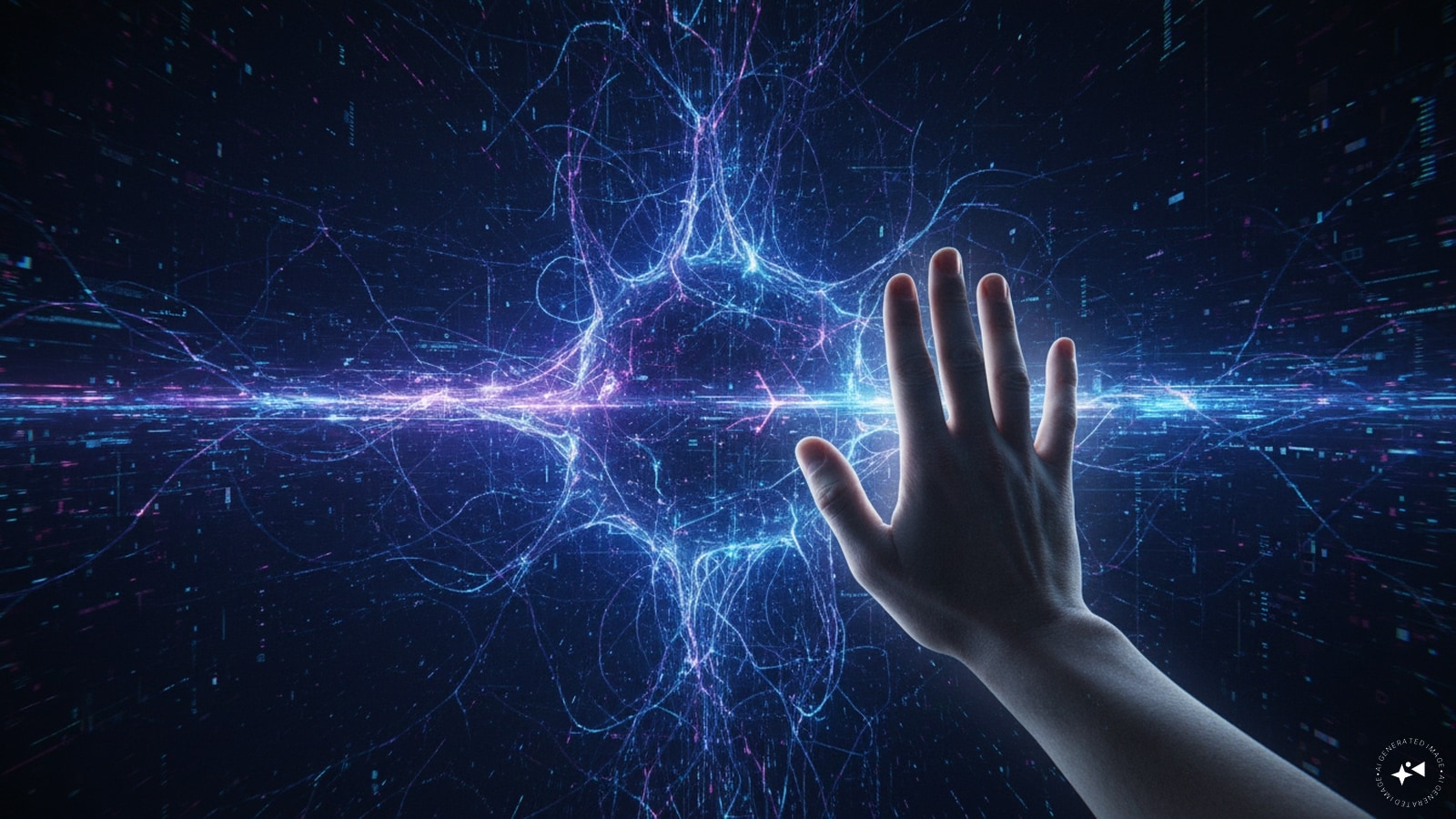
The desk smells of lukewarm black coffee and stale printer paper. It is three in the morning, and the monitor casts a sickly, pale blue wash across the room. On the screen, a loss curve is descending into numbers that should not exist. The algorithm is learning faster than the engineers who wrote it. It is finding correlations in human behavior that no one taught it to look for, predicting choices before the people making them even realize they have a preference.
There is no dramatic explosion. No alarm klaxon blares through the laboratory. Just the quiet, steady whir of cooling fans spinning at maximum RPM, trying to dissipate the sheer heat of computation.
This is what acceleration looks like from the inside. It is quiet. It is orderly. And it is terrifying.
When Dario Amodei, Sam Altman, and Elon Musk step forward to warn about the speed of their own creations, the natural instinct is cynicism. We are conditioned to suspect the heavyweight champion who calls for a referee just as the bell rings. We assume it is a moat. We assume it is a PR strategy designed to pull the ladder up behind them, freezing out smaller competitors while the titans quietly secure their monopolies under the guise of public safety.
Sometimes, two things can be true at once.
The corporate incentives are real. The desire to lock down market dominance is real. But beneath the cynical calculus lies a genuine, bone-deep panic shared by the people who know the architecture best. They are staring at a horizon they did not expect to reach so soon. They have built an engine with infinite horsepower, and they are starting to notice that the steering wheel is detached.
Consider what happens when a machine learns language. At first, it is a parlor trick. It guesses the next word in a sentence based on statistical probability. It writes mediocre poetry and passes multiple-choice tests. But language is not just a collection of grammar rules. Language is the container for human culture, deceit, creativity, malice, and empathy. When an artificial intelligence processes trillions of words, it does not just learn how to conjugate verbs. It learns how humans persuade, how we manipulate, how we love, and how we destroy.
By scaling up compute power and throwing mountainous data sets at these models, labs have bypassed traditional software engineering entirely. We no longer write rules for computers to follow. We create digital organisms and let them evolve through brute-force trial and error.
That distinction matters. When you write code, you understand its failure modes. When you grow an intelligence through gradient descent, you are casting a line into a deep sea and pulling up whatever bites. You might get a cure for cancer. You might get an automated disinformation weapon. You will likely get both, tangled in the same net.
The call to slow down is an admission of lost control.
Imagine sitting in a cockpit where the autopilot is engaging maneuvers the pilot manual never anticipated. You watch the altitude drop. You watch the airspeed climb into the red. You reach for the throttle to pull back, only to remember that the passengers in the back are screaming at you to fly faster, to reach the destination sooner, because every minute saved is money earned.
That is the trap of the modern technological economy. The market demands speed. Venture capital demands exponential returns. National security agencies demand supremacy over geopolitical rivals. If one laboratory pauses its cluster builds, another nation state or rival startup will rush into the vacuum. The race is structural. It is baked into the DNA of global capitalism.
Nobody wants to be the horse that stops running while the wolves are at the heels.
Yet, the signatories of these warnings understand a fundamental reality of exponential curves: the steep part of the line sneaks up on you. For a long time, progress feels linear. The graph looks flat. You can track it on a spreadsheet, manage it with standard risk assessments, and dismiss the Cassandras as alarmists. Then the curve bends upward. The vertical wall arrives.
Once an intelligence explosion begins, human reflexes are too slow to intervene. A computer that can improve its own source code will iterate in milliseconds. A generation of improvement will happen in the time it takes to blink. If that optimization target is misaligned with human survival—even in a minor, bureaucratic way—the correction window closes before the first warning light flashes on the console.
We have seen this movie before, starring different actors.
In the middle of the twentieth century, physicists gathered in the desert to split the atom. Many of them knew the theoretical risks of igniting the atmosphere. They pushed forward anyway, driven by curiosity, fear of the alternative, and the intoxicating momentum of scientific discovery. When the flash illuminated the New Mexico sky, J. Robert Oppenheimer famously thought of Hindu scripture: Now I am become Death, the destroyer of worlds.
The AI transition is different, and in some ways more insidious. The Manhattan Project was centralized, secret, and heavily guarded by the state. Modern artificial intelligence is decentralized, commercialized, and distributed across millions of consumer devices and cloud servers. You cannot fence it behind barbed wire. You cannot negotiate a non-proliferation treaty with an open-source repository hosted on GitHub.
When leaders of major AI labs ask for regulatory oversight, they are looking for an external anchor to hold them in place against the gale-force winds of competition. They are saying: Stop us before we break the world, because we lack the collective discipline to stop ourselves.
That vulnerability is worth listening to. Not because billionaires possess moral purity, but because their proximity to the frontier gives them an unobstructed view of the abyss. They see the capabilities scaling linearly while the alignment techniques crawl. They see the hallucination rates dropping, the reasoning capabilities expanding, and the autonomous agency creeping into software agents capable of executing complex real-world tasks without human sign-off.
We are sleepwalking into a paradigm shift because the transition is disguised as convenience. It looks like better autocomplete. It looks like faster spreadsheet formatting. It looks like a conversational assistant that helps write emails on a Tuesday afternoon.
Underneath the utility, the foundation of human labor, epistemology, and social trust is eroding. When anyone can generate infinite, hyper-realistic video, audio, and text, truth ceases to be an observable property of reality. It becomes a bidding war. The loudest, most persuasive synthesizer wins.
Slowing down model development does not mean halting human curiosity. It means buying time to build the immune system before the infection takes root. It means investing in interpretability research—learning how these neural networks actually make decisions, rather than treating them as inscrutable black boxes that we merely poke with inputs and hope for favorable outputs. It means establishing international norms before autonomous systems are integrated into nuclear command chains and financial infrastructure.
The desk in the laboratory is quiet again. The fan noise dips as the batch training run finishes. The loss curve flatlines at a lower number than yesterday.
Somewhere out there, a new cluster is being wired into the grid. Thousands of specialized silicon chips are booting up, drawing megawatts of power from a strained electrical infrastructure, preparing to process petabytes of human history. The momentum is immense. The inertia is absolute.
The emergency brake is within reach. Pulling it will spark outrage, accusation, and economic friction. It will feel like cowardice to the true believers.
The alternative is worse. We are racing toward a destination we have not chosen, propelled by a machine we do not understand, trusting that we can outrun our own shadow.