The sea does not care about your ideology. It does not pause to check a passport, nor does it ask whether you marched beneath a banner of hate or stood on a shore with an open hand. Saltwater fills lungs with an equal, terrifying indifference. Yet, human malice has a way of finding its way onto the open water, carrying the petty grievances and violent crusades of dry land into the absolute vulnerability of the deep.
Consider the fragile rubber of a dinghy bobbing in the gray swells of the English Channel. To look at it from the deck of a passing ship is to see a desperate equation of survival. Every inch of fabric is stretched to its absolute limit. Inside, human beings—mothers, children, fathers whose hands are worn raw from holding onto hope—sit shoulder-to-shoulder, suspended over an abyss.
Then comes the blade.
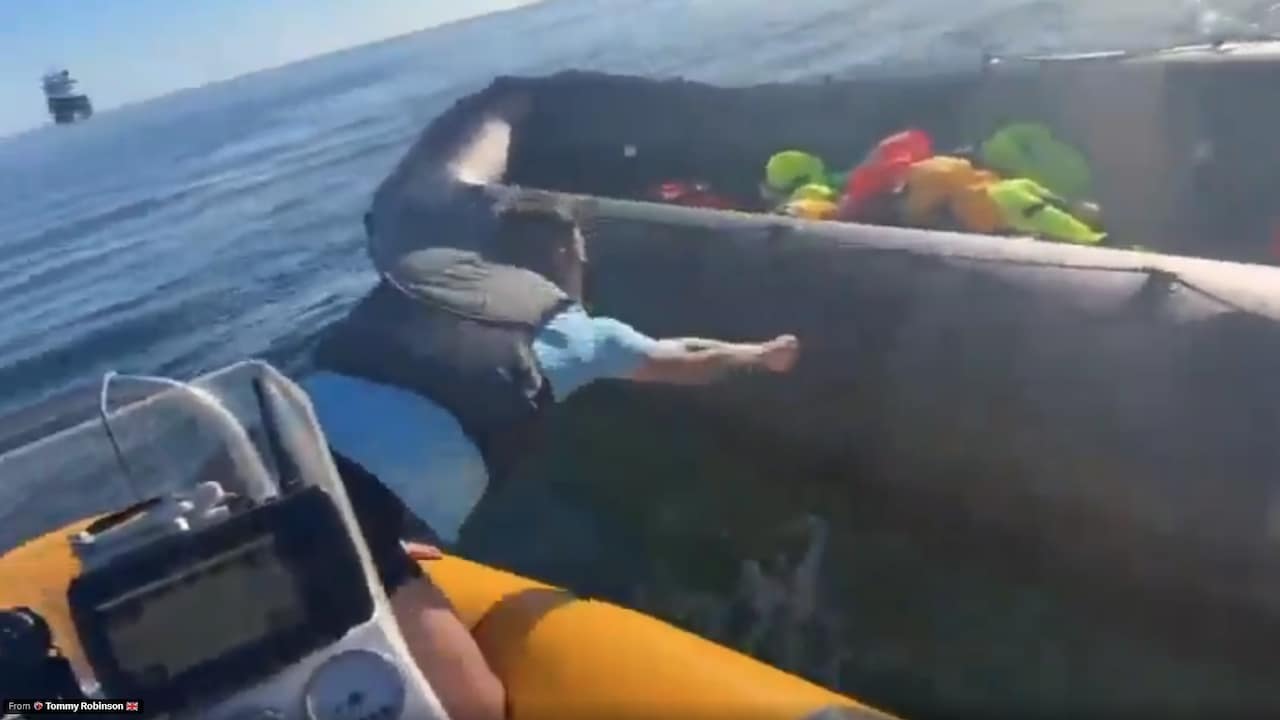
Not a metaphor. A literal, steel knife, brandished by someone who had supposedly come to save lives, turning instead to puncture the very vessel keeping dozens of terrified souls from drowning.
The Anatomy of a Calculated Cruelty
We live in an age where online radicalization wears a suit of digital armor, but every so often, the ideology spills out into the physical world in a way that defies comprehension. The reports from the Channel tell a chilling story of a man associated with far-right movements, someone who had embedded himself in maritime rescue spaces under the guise of humanitarian aid, allegedly drawing a blade to slash at a migrant dinghy.
Think about the physical reality of that moment. The rubber hiss of air escaping. The sudden, collective intake of breath from people who have already survived bomb-cratered cities, brutal desert crossings, and armed extortionists, only to find themselves betrayed on the open sea by someone holding a knife.
It is a specialized kind of cruelty. It relies on the absolute asymmetry of the situation. Out on the water, thousands of yards from shore, a punctured tube is not a political statement. It is a death sentence.
To understand how a person reaches that point, we have to look past the individual headlines and examine the architecture of modern extremism. It is built on a foundation of dehumanization. When you spend enough time behind a screen consuming manufactured panic about invasions and threats, the breathing, bleeding human being in front of you ceases to exist. They become an abstraction. They become a symbol to be eradicated.
And so, a rescue mission becomes a sabotage mission. The life jacket becomes a prop. The knife comes out.
The Sound of Escaping Air
Water has a voice if you listen closely enough. Against the hull of a rescue vessel, it laps with a rhythmic, hypnotic indifference. But add the sound of a punctured inflatable, and the acoustic signature changes instantly. It is a sharp, hissing sigh—the sound of safety bleeding out into the dark.
I remember standing on a rocky coast years ago, watching the horizon blur into the evening mist. The wind carried a biting chill that went straight through wool and cotton alike. Now multiply that chill by the terror of being miles from land in a vessel engineered to fail under the slightest provocation.
When the activist allegedly slashed that dinghy, he wasn't just cutting rubber. He was cutting through the thin, frayed thread of international empathy that keeps modern society from descending into total barbarism.
We often talk about the refugee crisis as a political debate. We argue over numbers, quotas, legal definitions, and border controls. We treat human lives as data points on a bureaucratic spreadsheet. But every statistic has a pulse. Every data point is a person who packed a single plastic bag with whatever memories they could salvage before fleeing the wreckage of their homeland.
When policy fails to address human suffering with dignity, it creates a vacuum. Into that vacuum step the extremists, armed with rhetoric online and, occasionally, with knives on the water. They feed on the fear of ordinary citizens, twisting legitimate anxieties about resources and security into a murderous crusade against the most vulnerable people on earth.
The Mirage of Neutrality
For years, volunteer rescue organizations have operated in the gray spaces between official state apathy and total humanitarian collapse. Civilians take to the water because governments look away. They buy boats, stock medical supplies, and launch into the freezing surf at dawn, driven by a simple, unyielding conviction: drowning is not an acceptable punishment for seeking a better life.
Yet, that same openness makes these spaces vulnerable. How do you vet a volunteer when the baseline requirement is simply a willingness to help? Extremism thrives in decentralized networks, and the far-right has increasingly recognized the tactical value of infiltrating rescue operations—not to save lives, but to sabotage the architecture of compassion from within.
It is a profound betrayal. It turns the symbol of the lifeboat into a Trojan horse.
When the truth emerged about what happened on that vessel, it sent shockwaves through the maritime community. It forced organizations to confront an uncomfortable reality: the hatred dividing our societies on land is no longer contained by the shoreline. It has boarded the ships. It is wearing the same uniforms. It is smiling while it sharpens the blade.
The Choice Before Us
We stand at a peculiar crossroads in human history. On one side lies the growing temptation of fortress mentalities—the belief that we can wall off our societies, ignore the suffering of the rest of the world, and maintain our prosperity behind razor wire and armed patrols. On the other side is the much harder, much messier path of radical empathy.
The man with the knife chose the fortress. He chose to align himself with the forces of entropy and cruelty, acting out a dark fantasy of dominance in the middle of a cold sea.
But what about the rest of us?
We cannot afford the luxury of looking away, comforting ourselves with the thought that this is an isolated incident involving a fringe extremist. Extremism does not happen in a vacuum. It is fertilized by political rhetoric that paints refugees as invaders, by media coverage that dehumanizes the displaced, and by our own collective exhaustion with a world in perpetual crisis.
Every time we scroll past a headline about a sinking boat and feel nothing, a little bit of that rubber is already hissing. Every time we accept the premise that human life is negotiable based on geography or paperwork, the knife draws closer to the fabric.
The water continues to rise. The boats continue to launch into the dark. And somewhere out on the horizon, the choice remains stark, uncompromising, and entirely ours to make: whether we pick up the tools to pull each other ashore, or stand idly by while someone reaches for a blade.