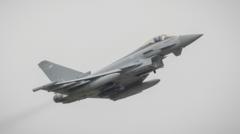
The operational reality of modern air defense is fundamentally defined by an economic contradiction: utilizing a £200,000 legacy surface-to-air or air-to-air missile to neutralize a £30,000 loitering munition represents an unsustainable cost-exchange ratio. In attrition warfare, this asymmetry guarantees strategic exhaustion for high-tier militaries. The Royal Air Force's deployment of the Advanced Precision Kill Weapon System (APKWS) onto Eurofighter Typhoon jets operating within the Middle East theater is a direct, structural correction to this economic vulnerability.
By converting standard 70mm unguided rockets into laser-guided precision munitions, the architecture shifts the financial math of counter-Unmanned Aerial Systems (C-UAS) operations. This adaptation alters the unit-level cost function of aerial interception and reshapes the operational endurance of forward-deployed air assets facing persistent, low-altitude asymmetric threats.
The Cost-Exchange Asymmetry Framework
To understand the strategic necessity of this deployment, the problem must be modeled as an asset-depletion equation. Hostile state and non-state actors utilize low-cost, long-range loitering munitions—specifically the Iranian-designed Shahed-136 series—to force a structural imbalance.
[Hostile Salvo Cost: N * $30,000] <-------> [Legacy Defense Cost: N * $250,000+]
                                  |
                   Result: Financial Exhaustion
The underlying economic variables dictate the failure of traditional air defense frameworks under high-velocity drone salvos:
- The Attacker's Cost Basis: A Shahed-136 platform features a production cost varying between $20,000 and $50,000. It relies on commercial-grade GPS components, a low-signature MD-550 piston engine, and a wooden or composite delta-wing structure.
- The Defender's Legacy Cost Basis: Intercepting these platforms previously required high-end, active radar-homing or imaging infrared (IIR) missiles. A single short-to-medium-range air-to-air missile represents a capital allocation of hundreds of thousands of pounds.
- The Attrition Multiplier: When a defensive salvo requires two interceptors per target to ensure a 95% Probability of Kill ($P_k$), the economic exchange ratio deteriorates to nearly 20:1 in favor of the attacker.
The introduction of the APKWS addresses this friction point. At approximately $30,000 (£22,400) per unit, the interceptor matches the cost basis of the incoming threat. This achieves an economic parity of roughly 1:1, excluding aircraft flight-hour costs. This integration modifies the total cost function of defensive sorties, enabling long-term operational sustainability in contested airspaces.
Technical Architecture of the 70mm Precision Intercept
The APKWS does not require the procurement of an entirely new missile family. Instead, it utilizes a modular, mid-body guidance section that transforms existing inventories of Hydra 70 unguided rockets into precision-guided munitions.
The Mid-Body Guidance Unit (WGU-59/B)
Unlike traditional forward-guided missiles where the seeker is positioned at the extreme tip, the APKWS integrates its distributed Aperture Semi-Active Laser Seeking (DASALS) technology into the mid-body. This allows the system to utilize standard, point-detonating warheads and existing rocket motors without redesigning the nose cone or aerodynamic profiles.
Aerodynamic Stabilization and Homing
Upon launch, four folding wings deploy from the mid-body section. Each wing contains a single, forward-facing laser seeker aperture. Together, these four apertures provide a combined field of view that detects the specific Pulse Repetition Frequency (PRF) of a laser spot designated by either the launching aircraft’s targeting pod or a ground-based asset.
Flight Profile and Dynamics
The integration onto the Eurofighter Typhoon creates a highly dynamic intercept envelope. When fired from an airborne fighter jet, the rocket inherits the aircraft’s initial velocity vector and altitude, expanding its kinetic range far beyond the standard 5-to-5-kilometer boundary observed in surface-launched variants. The missile operates via a laser beam-riding and proportional navigation matrix, continuously adjusting its control surfaces to match the flight path of low-altitude, slow-moving targets.
Sensor Adaptation and Radar Cross-Section Conundrums
Deploying a low-cost kinetic interceptor solves only half of the C-UAS challenge. The primary operational bottleneck remains the detection, classification, and tracking of low-Radar Cross-Section (RCS) targets within complex clutter profiles.
Shahed-class loitering munitions present an RCS frequently below 0.1 square meters. They fly at low altitudes to exploit the radar horizon and terrain-masking limits of ground-based air defense networks. Legacy early-warning radars configured to detect high-speed ballistic arcs or fast-moving manned aircraft often filter out these slow, low-altitude returns as ground clutter or avian anomalies.
The Typhoon compensates for this detection gap via its airborne sensor suite. The integration relies on the Captor-M mechanically scanned radar (or the newer Captor-E active electronically scanned array) combined with the Pirate Infrared Search and Track (IRST) system. The IRST provides a passive, jam-resistant tracking mechanism that detects the thermal signature of the drone's internal combustion engine against the cold atmospheric background.
Once tracked, the aircraft’s Litening III or Centurion targeting pod designates the target with a coded laser line, enabling the APKWS to lock on and guide to intercept. This multi-spectral verification loop prevents the wasting of ordnance on decoys or environmental noise.
Layered Integration: Complementing the Martlet System
The airborne deployment of APKWS does not occur in a vacuum; it functions as the top layer of a broader, theater-wide C-UAS architecture deployed by the UK Ministry of Defence across the Middle East. This framework features a clear division of operational responsibilities based on altitude, platform velocity, and range.
Airborne Tier (High Mobility, Wide Area)
The Typhoon equipped with APKWS operates as a flexible, high-altitude intercept layer. It can rapidly transit hundreds of miles across regional airspaces to counter incoming drone waves before they reach sovereign airspace or critical infrastructure zones.
Maritime and Rotary Tier (Point Defense, Littoral)
Operating concurrently, the Royal Navy's AW159 Wildcat helicopters utilize the Thales-manufactured Martlet Lightweight Multirole Missile (LMM). The Martlet uses a laser beam-riding guidance system that is highly resistant to electronic countermeasures. Carrying up to 20 missiles per helicopter, this platform provides a high-volume, close-in defense envelope against both aerial swarms and fast-attack surface craft.
Ground-Based Tier (Terminal Hardening)
On the surface, Royal Marine commandos and Royal Artillery units utilize ground-based variants of the Martlet and the Starstreak High Velocity Missile (HVM) via Stormer armored vehicles and lightweight multiple launchers. This provides terminal point-defense for strategic nodes, such as RAF Akrotiri in Cyprus or coalition installations in Iraq.
| Intercept Platform | Weapon System | Guidance Mechanism | Primary Operational Role | Approximate Unit Cost |
|---|---|---|---|---|
| Eurofighter Typhoon | APKWS (70mm) | Distributed Semi-Active Laser | Wide-area theater interception of low-RCS targets | ~$30,000 |
| AW159 Wildcat / Ground | Martlet (LMM) | Laser Beam-Riding | Multi-role point defense and littoral swarm suppression | High-tens of thousands |
| Surface/Land Vehicles | Starstreak (HVM) | Laser Beam-Riding | High-speed, low-altitude interception of kinetic threats | >£100,000 |
Operational Limitations and Vulnerabilities
While the conversion of unguided rockets into precision assets provides an immediate tactical solution, a rigorous strategic assessment highlights several system vulnerabilities that prevent it from being an absolute remedy.
First, meteorological attenuation poses a significant threat to laser-guided systems. Semi-Active Laser (SAL) seekers require a clear line of sight between the designator, the target, and the missile. High humidity, heavy dust storms, low cloud ceilings, or deliberate aerosol countermeasures deployed by an adversary scatter laser energy, degrading the tracker’s ability to decode the PRF signal. This introduces a risk of guidance failure in poor weather conditions.
Second, the platform introduces a targeting channel bottleneck. Because the current iteration of the APKWS requires continuous laser designation until the point of impact, the launching aircraft or designating asset can generally engage only one target per laser channel at any given moment. Against highly coordinated, simultaneous saturation swarms, this single-channel architecture can be overwhelmed, regardless of how many missiles the aircraft carries on its hardpoints.
Third, range limitations restrict its use to specific scenarios. The kinetic energy of a 70mm rocket limits its maximum effective range compared to dedicated medium-range air-to-air missiles. Firing platforms must operate closer to the target zone, potentially exposing the launch aircraft to forward-deployed short-range air defense (SHORAD) systems or radar-guided surface-to-air threats if operating near contested airspace borders.
Strategic Outlook and Force Structure Recommendations
The rapid transition of the APKWS from testing to active deployment in under two months signals an operational pivot toward agile procurement cycles. This shift responds directly to long-standing structural criticism of western defense procurement timelines. To maximize the value of this architecture in future conflicts, three tactical plays must be executed:
- Decouple Designation from the Launch Vehicle: To bypass the targeting channel bottleneck, operational doctrines must prioritize hand-off targeting. Typhoons should launch the APKWS based on initial radar coordinates, leaving the continuous laser designation to loitering uncrewed aerial vehicles (UAVs) or forward ground observers. This frees the fighter jet to execute immediate evasive maneuvers or engage secondary targets.
- Standardize Open-Architecture Digital Busses: Future procurement must mandate that missile rail interfaces utilize software-defined architectures. This allows rapid changes between SAL seekers and low-cost imaging infrared or millimeter-wave radar seekers without requiring multi-year hardware overhauls of the aircraft's core mission computers.
- Scale Digital Inventory and Localized Assembly: Because asymmetric threats depend on volume, stockpiles must be structured around modular components rather than complete, round-built assemblies. Maintaining deep inventories of standard unguided rocket motors and warheads, alongside separate kits of bolt-on guidance units, provides logistics networks with the flexibility to scale up either unguided surface-strike or precision C-UAS options based on immediate theater demands.