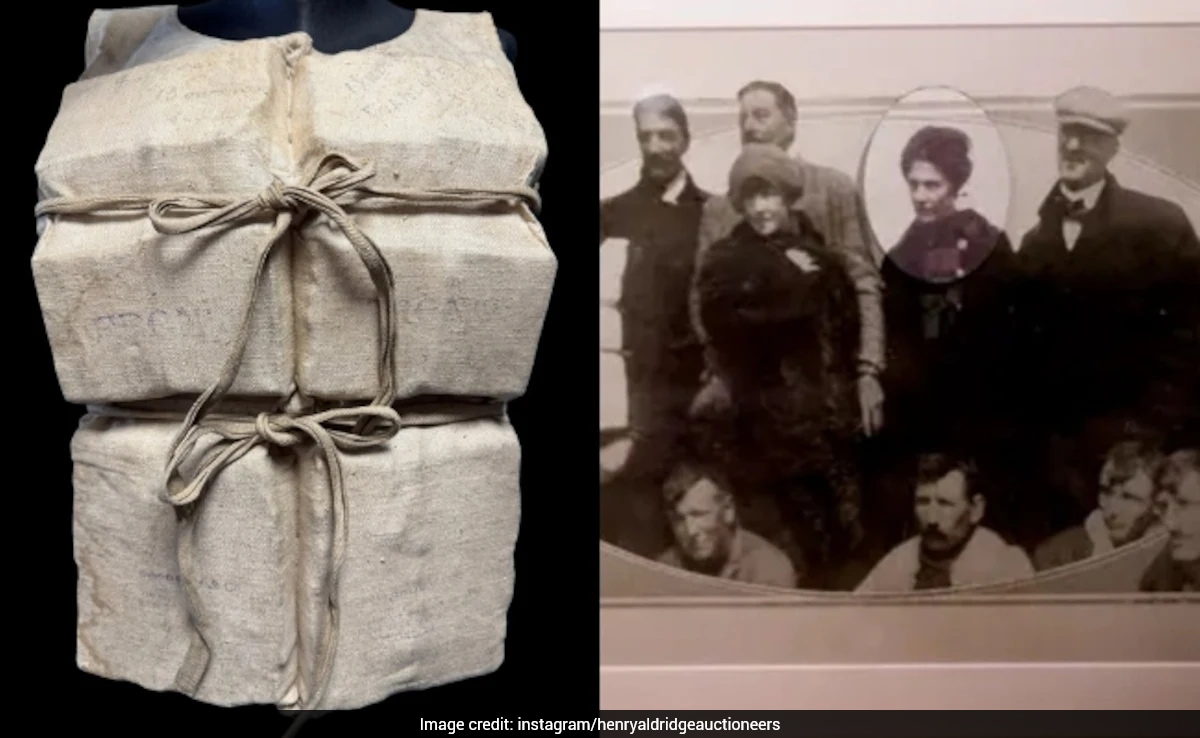
The sale of a Titanic life jacket for ₹9 crore ($1.08 million) represents more than a transaction of historical curiosity; it is a manifestation of the Extreme Scarcity Premium within the alternative asset market. While most maritime salvage is valued based on material recovery or broad historical context, Titanic artifacts operate within a closed economic loop where supply is fixed by international treaty and demand is driven by the convergence of tragedy, global cinematic recognition, and the physics of deep-sea decay. To understand why a canvas-and-cork safety device commands the price of a luxury estate, one must analyze the specific variables of provenance, material degradation, and the shifting profile of the ultra-high-net-worth (UHNW) collector.
The Triad of Value Attribution
The valuation of Titanic artifacts follows a rigid hierarchy. Most auction items fail to reach the million-dollar threshold because they lack one of three critical pillars. Meanwhile, you can find other stories here: HMRC Declares War on Corporate Balance Sheets as VAT Probes Skyrocket.
- Survivor Attachment (Direct Provenance): The specific life jacket in question was worn by a survivor. In the logic of high-end collecting, an object that physically touched a human being who escaped the sinking carries a "relic" status that unattached wreckage lacks. The survival of the passenger converts the object from a piece of debris into a witness to a specific human outcome.
- Material Integrity: The 1912 life jackets were constructed from coarse linen and blocks of cork. These materials are highly susceptible to dry rot, mold, and salt-air degradation. The number of extant jackets in displayable condition is estimated to be in the low single digits. Price discovery in this instance is driven by the physical impossibility of finding a substitute.
- Narrative Scaling: Titanic remains the only maritime disaster with universal brand recognition. This creates a global pool of bidders, ensuring that the auction is not localized to a specific region but involves competing capital from North America, Europe, and Asia.
The Physics of Scarcity and the 2025-2030 Decay Window
The market for these artifacts is currently entering a high-volatility phase due to the biological reality of the wreck site. Halomonas titanicae, the iron-eating bacteria consuming the hull, ensures that no new significant recovery of heavy artifacts is likely to occur without massive structural risk. Furthermore, the 2001 UNESCO Convention on the Protection of the Underwater Cultural Heritage creates a legal moat around the site.
The legal and biological closure of the source means that the "primary market" (recovery) is dead. We are now in a "secondary-only" market. When the supply of an asset class is fundamentally capped by both law and nature, the price ceiling becomes untethered from traditional appraisal metrics and moves into the realm of Psychological Arbitrage. Investors are not buying the linen; they are buying a hedge against the eventual total disappearance of the physical wreck. To explore the full picture, check out the detailed analysis by CNBC.
Structural Comparison of High-Value Titanic Assets
To quantify the ₹9 crore valuation, it is necessary to compare the life jacket against other high-performance assets from the same provenance.
- The Wallace Hartley Violin: Sold for approximately $1.7 million in 2013. Like the life jacket, it was a "hero" object—essential to the central narrative of the sinking.
- The Life Jacket: At $1.08 million, it occupies the second tier of valuation. Its utility was functional rather than symbolic (unlike the violin), but its rarity is comparable.
- Stationery and Menus: These items generally trade between $50,000 and $150,000. They are mass-produced and were not "on the person" during the final moments of the sinking, which limits their emotional resonance.
The delta between a menu and a life jacket is the Criticality Factor. The life jacket was the literal barrier between life and death. In the collector's mind, the closer an object is to the central conflict of the event, the higher the capital allocation required to secure it.
Risk Factors in Maritime Alternative Assets
Investing in hundred-year-old textiles involves significant operational risk that standard art collections do not face. The buyer of the ₹9 crore jacket must account for several cost functions:
1. The Conservation Tax
Maintaining the structural integrity of 114-year-old cork requires specialized climate control. Fluctuations in humidity cause the linen fibers to expand and contract, eventually leading to fiber shearing. The long-term ownership cost includes a permanent nitrogen-enriched or UV-filtered environment, which adds an estimated 2-4% annual "maintenance tax" on the asset's value.
2. The Verification Burden
As prices rise, the incentive for sophisticated forgery increases. Authentic Titanic life jackets have a specific stitch count and canvas weave density unique to the manufacturers commissioned by the White Star Line. Without a continuous chain of custody (provenance), the asset's value can collapse to near zero. The ₹9 crore price reflects not just the object, but the "clean" history attached to it.
3. Liquidity Bottlenecks
While the asset is high-value, it is low-liquidity. Selling such an item requires a specialized auction house and a marketing cycle of 6-12 months. An owner cannot "exit" this position quickly without accepting a significant haircut on the price.
The Institutional Shift in Ownership
Historically, Titanic artifacts were held by survivors' families or niche maritime museums. We are now seeing a transition where these objects are moving into the hands of private equity individuals and sovereign wealth funds. This shift changes the valuation logic. For a billionaire collector, a $1 million life jacket is not a speculative play; it is a "legacy asset" that serves as a centerpiece for a private collection, often used to anchor the prestige of a family office or a private gallery.
This institutionalization creates a price floor. Once an object enters a permanent private collection, it is likely removed from the market for 30 to 50 years. This further constricts the available supply, ensuring that the next life jacket to appear at auction will almost certainly exceed the ₹9 crore mark, regardless of the broader economic climate.
Strategic Allocation of Capital in Historical Artifacts
For those looking to enter the maritime artifact market, the current sale provides a blueprint for asset selection. The highest returns are not found in "bulk" debris (coal, rusted rivets, or hull fragments) which were recovered in large quantities during the 1980s and 90s. These have seen price stagnation due to oversupply.
The growth is concentrated in Singular Functional Objects. These are items that had a specific, documented purpose during the sinking. A life jacket, a telegraph key, or a deck chair carries a structural narrative that a piece of coal does not.
Investors should focus on the following criteria for future acquisitions:
- Personalization: Items tied to a specific name on the passenger manifest.
- Survival Status: Objects that were on a lifeboat have a 400% premium over objects recovered from the debris field on the ocean floor.
- Condition Stability: Metal and ceramic objects offer lower maintenance risks than textiles, though textiles command higher emotional premiums.
The ₹9 crore sale is a signal that the market has moved beyond the "souvenir" phase and into the "sovereign asset" phase. As the physical wreck on the ocean floor continues its inevitable collapse into a rust mound, the value of the few surviving "hero" objects will decouple entirely from traditional historical valuation and align with the pricing models of fine art masterpieces. Owners of such assets should move toward long-term holding patterns, as the total disappearance of the wreck—projected within the next few decades—will trigger the final and most aggressive appreciation cycle in the history of maritime collecting.