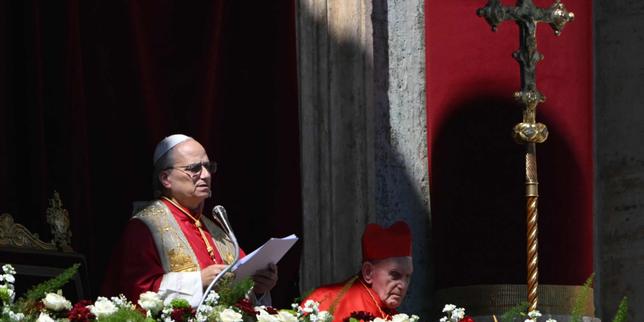
The media cycle loves a weeping Pope. Every Easter, the cameras pivot to St. Peter’s Square to capture a frail man in white begging for peace in the Middle East. The headlines write themselves: "Pope Pleads for End to Conflict," or "Easter Joy Marred by War." It is a comfortable, predictable ritual. It is also entirely useless.
The consensus view—that the Vatican serves as a moral North Star capable of shaming combatants into a ceasefire—is a nostalgic relic of the Cold War. We are watching the sunset of the Papacy as a geopolitical force. While the "competitor" outlets focus on the optics of a rainy Urbi et Orbi address, they miss the brutal reality: The Vatican’s soft power has been hollowed out by a world that no longer speaks the language of universal moral authority. Read more on a similar topic: this related article.
The Myth of the Moral Superpower
For decades, the Vatican was the "Third Pole" of diplomacy. From John Paul II’s role in dismantling the Iron Curtain to Francis’s early successes with the Cuba-U.S. thaw, the Holy See operated on a specific currency: Sacred Neutrality. That currency is currently worthless. In the context of the Gaza-Israel conflict or the grinding war in Ukraine, "neutrality" is increasingly viewed by both sides as "complicity." When the Pope calls for a "general exchange of all prisoners," he isn't being a peacemaker; he’s being a bystander.
Diplomacy requires leverage. What leverage does the modern Vatican hold? Additional reporting by Associated Press explores related views on this issue.
- Economic? None.
- Military? The Swiss Guard aren't crossing the Rubicon anytime soon.
- Demographic? While the Catholic population grows in the Global South, its influence in the halls of power in Washington, Moscow, and Tehran is at an all-time low.
I’ve spent years analyzing institutional decline. When an organization loses its ability to enforce its will, it resorts to "awareness" and "prayer." In the corporate world, we call this "vaporware." In the geopolitical world, we call it a press release from the Holy See.
Why "Peace" is the Wrong Word
The standard reporting treats "Peace" as a binary switch that the Pope is trying to flip. This is a fundamental misunderstanding of 21st-century warfare.
In the Middle East, we aren't dealing with a border dispute between two rational Westphalian states. We are dealing with an existential clash of narratives where the "sacred" is used as a weapon. By attempting to secularize the conflict into a "humanitarian crisis," the Pope inadvertently strips the situation of its primary driver.
You cannot solve a theological war with a humanitarian band-aid.
The "lazy consensus" dictates that we must all agree that "war is a defeat." It’s a nice sentiment for a greeting card. But for a commander on the ground, war is an instrument of policy. By refusing to engage with the utility of conflict, the Vatican ensures its voice is filtered out by the very people who need to hear it.
The Geographic Shift Nobody is Talking About
The media focuses on Rome because the architecture is better for B-roll. But the real story is the Vatican’s pivot toward the East—a pivot that has cost it its moral standing in the West.
Francis has spent his Papacy trying to court Beijing and maintain a line to Moscow. This is the "Realpolitik" of a shrinking firm trying to enter new markets. But look at the cost:
- In Ukraine, his "white flag" comments were seen as a betrayal of the victim.
- In the Middle East, his attempt to balance the scales has left both the Israeli government and the Palestinian leadership feeling ignored.
When you try to be everything to everyone, you end up being nothing to anyone. The Vatican has traded its clarity for a seat at a table that doesn't exist anymore.
The Efficiency of Empty Rituals
Let’s talk about the "Easter Cloud." The competitor article frames the Mideast war as a literal shadow over the holiday. This is a classic narrative trope that prioritizes aesthetics over outcomes.
Imagine a CEO who, every quarter, stood in front of shareholders and simply said, "I wish we weren't losing money," without changing the business model or firing the underperforming management. That CEO would be ousted. Yet, we afford the Papacy a pass because we've confused "ceremony" with "governance."
The Easter message has become a bureaucratic requirement. It’s an "Annual Report" of grievances that changes nothing on the ground. To truly disrupt this cycle, the Vatican would need to do something radical: Take a side.
But it won't. Taking a side creates risk. It risks the tax-exempt status of churches in hostile territories. It risks the safety of clergy. So instead, we get the "middle path"—a path that leads straight to irrelevance.
Dismantling the "People Also Ask" Nonsense
People often ask: Can the Pope broker a ceasefire?
The answer is a hard No. Ceasefires are brokered by those who can offer security guarantees or threaten economic ruin. The Pope can offer neither. He offers "closeness," a theological term that has zero value in a bunker in Gaza or a situation room in Tel Aviv.
Another common query: Is the Vatican still relevant in 2026?
It depends on how you define relevance. If relevance is defined by the ability to move a crowd in a square, then yes. If relevance is the ability to shift a single millimeter of the front line, then the answer is a resounding no.
The Unconventional Truth
The tragedy of the "first Easter under the cloud of war" isn't the war itself. It’s the realization that the world’s oldest diplomatic service has no clothes.
We cling to the image of the Pope as a global mediator because the alternative is terrifying: the realization that there is no adult in the room. There is no one with the moral weight to stop the gears of history from grinding.
The competitor article wants you to feel a sense of melancholy. I want you to feel a sense of urgency. Stop waiting for the guy in the white robe to save the world. He’s just as stuck in the cycle as we are.
The Vatican’s insistence on "dialogue" in the face of absolute ideological warfare is like bringing a philosophy textbook to a drone fight. It’s brave, it’s noble, and it’s profoundly stupid.
The era of the Papal Peace is over. It didn't die because of a "cloud" over Easter. It died because the Vatican chose to be a spectator in a world that only respects participants.
Stop watching the balcony. The real decisions are being made by people who don't care about the Urbi et Orbi. They are made by people who understand that in 2026, a prayer is just a noise you make while you’re reloading.