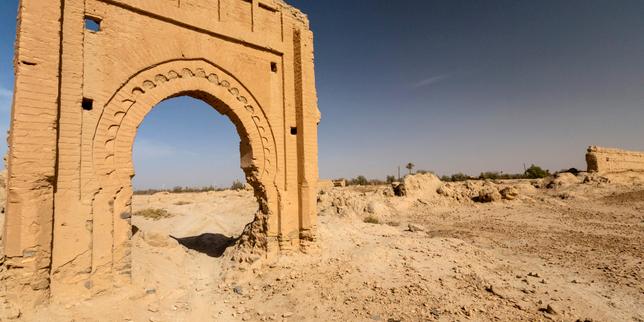
The wind off the Sahara does not care about dynasties. It blows through the Tafilalet oasis in eastern Morocco, carrying a fine, amber grit that stings the eyes and buries everything left unguarded. If you stand just outside the modern town of Rissani, the desert seems to stretch infinitely, a quiet expanse of sun-baked mud and scrub. But look closer at the earth. The ground is uneven, broken by ridges of melted clay and fragments of glazed pottery that catch the brutal afternoon sun.
This is Sijilmassa. Or rather, this is what is left of it.
A millennium ago, this silent field was a roaring metropolis. It was the golden gate of Africa, a sprawling trade hub where caravans of thousands of camels arrived after grueling months crossing the Saharan dunes. They brought gold, ivory, and salt. They brought scholars, poets, and armies. Most importantly, it is the cradle of the Alaouite dynasty, the lineage that has ruled Morocco for nearly four hundred years.
Today, it is the center of a bitter, quiet war over memory. On one side are the bulldozers of development; on the other, the desperate scramble to save a nation’s foundational ghost before it vanishes into the sand forever.
The Ghost in the Oasis
Imagine a merchant named Yusuf. He is a fictional composite, but his reality is baked into every layer of the soil beneath Rissani. In the year 950, Yusuf would have approached Sijilmassa from the south, his eyes strained from days of white desert glare. He would have smelled the city before he saw it—the sharp scent of mint, the smoke of cooking fires, the damp, rich earthy smell of irrigated date palms.
Sijilmassa was a mirage made real. It possessed a sophisticated system of underground water channels that turned a barren wasteland into a lush, fortified paradise. It minted its own gold coins, which circulated as far away as Europe and the Middle East. It was a kingdom unto itself, wealthy enough to defy empires.
But cities, like empires, are mortal.
By the late 14th century, the trade routes shifted. Tribal wars tore at the city’s walls. The grand palaces crumbled, and the mud-brick architecture—beautiful but fragile—began its slow dissolve back into the earth. When the Alaouite dynasty rose to power in the 17th century, originating from this very region, Sijilmassa was already becoming a sacred ruin, a symbol of ancestral roots rather than a living city.
Walk across the site today, and the silence is heavy. There are no grand marble columns like those in Rome or Athens. Mud-brick archaeology is a subtle, agonizingly delicate thing. To the untrained eye, a 1,000-year-old wall looks exactly like a mound of dirt.
And that is exactly where the tragedy begins.
The Clash of Concrete and Clay
The controversy currently brewing around Sijilmassa is not unique to Morocco, but the stakes here feel intensely personal. As the modern town of Rissani grows, it needs roads, houses, and infrastructure. For decades, the boundaries of the ancient archaeological site remained vaguely defined, marked more by local tradition than rigid government protection.
The tension broke into the open when heavy machinery began moving earth near the protected zones. Local activists, historians, and international archaeologists watched in horror as modern construction crept closer to the unexcavated heart of the medieval city.
Consider the dilemma of a local family. You live in a cramped, outdated home. You want a better life for your children, electricity, a paved road that doesn't turn into a swamp when the rare desert rains fall. To you, the empty field next door is just empty dirt. The fact that an ancient king might have slept there ten centuries ago does not fix a leaking roof today.
But historians see something else entirely. They see an unread library.
Only a tiny fraction of Sijilmassa has ever been systematically excavated. Every time a bulldozer digs a trench for a water pipe without archaeological oversight, a chapter of African history is shredded. We are not just talking about old pots. We are talking about the missing links in how global trade networks formed, how Islam spread across the Sahara, and how the environmental landscape of North Africa transformed over a thousand years.
The local outrage is fueled by a sense of historical betrayal. Activists argue that protecting Sijilmassa is not an academic luxury; it is a duty to the national identity. How do you allow the cradle of your ruling dynasty to be chipped away by urban sprawl?
The Problem With Invisible Heritage
The real crisis lies in a fundamental misunderstanding of what archaeology is. People expect ruins to look like the Pyramids or Petra. They want something monumental that can be easily photographed and turned into a postcard.
Sijilmassa refuses to cooperate with modern tourism's need for a quick spectacle.
When you look at the remains of the grand mosque or the ancient city walls, you see stumps of earth. The architecture was organic. It was built from the very soil it stood upon, bound together with straw and water. Without constant maintenance, it melts. When modern development collides with this kind of heritage, the heritage loses instantly. A excavator track can destroy a centuries-old stratigraphic layer in three seconds.
The Moroccan Ministry of Culture has faced mounting pressure to intervene, to draw hard lines in the sand, and to enforce strict zoning laws. But enforcement in a remote oasis region is notoriously difficult. There is a disconnect between the high-minded decrees issued in the capital of Rabat and the daily realities of the Tafilalet.
There is also a deeper, more unsettling question that the polemic raises. Who does history belong to? Does it belong to the academics who fly in with brushes and carbon-dating kits, or does it belong to the people who have lived among these ruins for generations, using the ancient stones to build their goat pens and using the old paths to walk to market?
The Price of Forgetting
To lose Sijilmassa is to accept a collective amnesia.
The battle over the site is a warning sign of a global sickness—the belief that anything that cannot be monetized immediately is worthless. If Sijilmassa is paved over, Rissani might get a few more concrete blocks, a few wider streets. But it will lose its soul. It will become just another dusty town on the edge of the desert, disconnected from the grand narrative that once shaped the world.
The solution cannot be to freeze the region in amber. The people of the Tafilalet cannot be expected to live in a museum to satisfy the nostalgia of outsiders. A bridge must be built between the past and the present. The ancient mud-brick structures could be restored using traditional techniques, creating jobs and drawing a sustainable type of tourism that respects the fragility of the environment. The site could become a living classroom.
Instead, it remains a battleground of bureaucracy and bulldozer tracks.
As evening falls over the oasis, the heat finally breaks. The sky turns a deep, bruised violet, and the shadows of the date palms lengthen across the ridges of Sijilmassa. If you stand perfectly still, the wind sounds like the distant murmur of a crowd—the shouts of traders, the braying of camels, the call to prayer echoing from a mosque that no longer exists.
The dirt underfoot is full of secrets. For now, they remain buried. But with every passing day, the modern world chips away at the crust of the earth, and the ancient city moves one step closer to becoming nothing more than dust carried away by the desert wind.