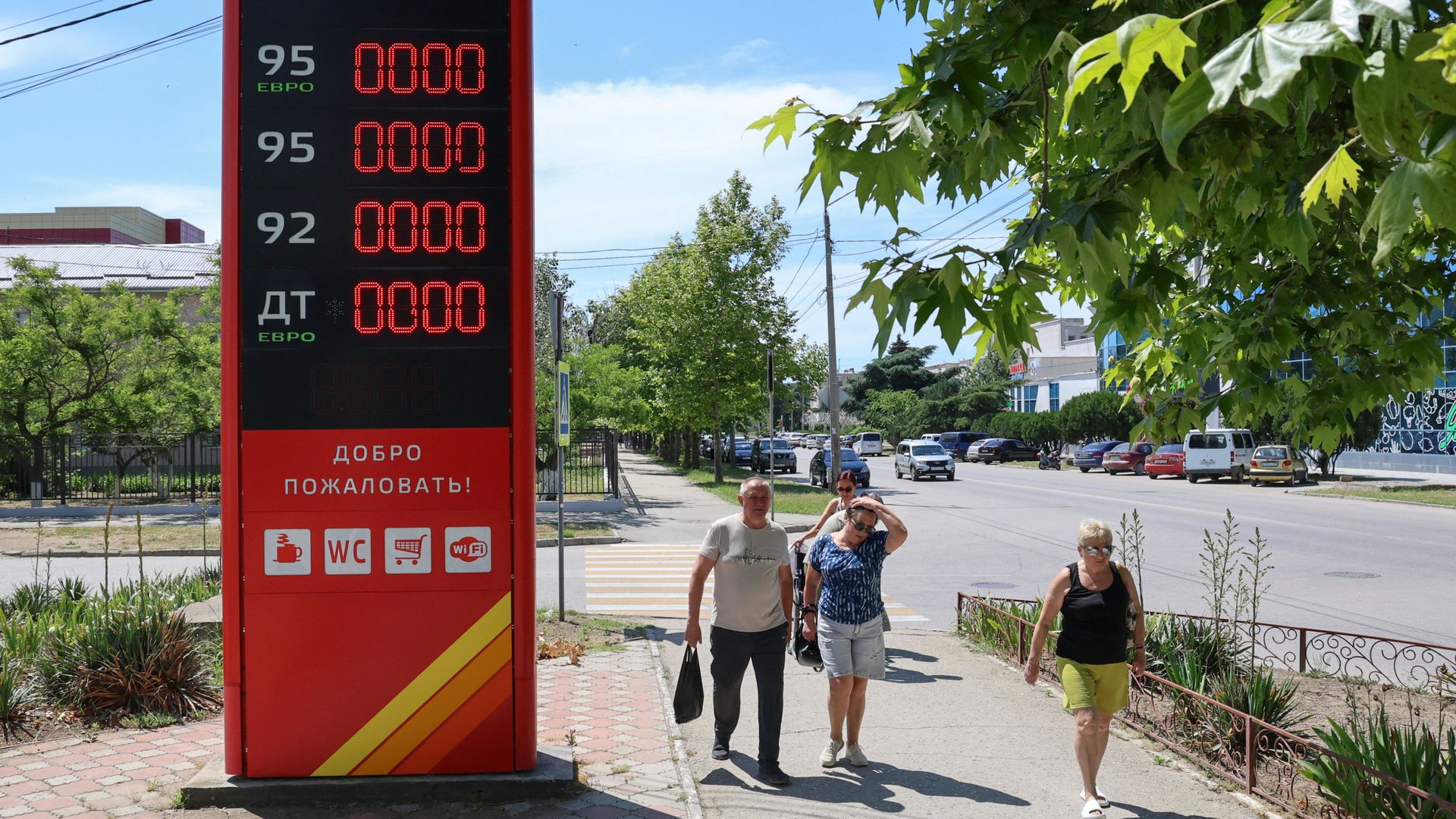
The needle on the dashboard of an old Lada does not move smoothly. It drops in jerky, micro-movements, sticky with age. But for Mikhail, watching that little red sliver drift toward the empty line on the left side of the dial was the only thing that mattered on a humid Tuesday morning. He was idling in a line of sixty vehicles that snaked away from a boarded-up Rosneft station on the outskirts of Simferopol.
Nothing moved. The air smelled of hot asphalt, melting rubber, and the collective anxiety of dozens of drivers stranded under a blinding Crimean sun.
Mikhail is a hypothetical composite of the people currently trapped in a logistical chokehold, but his panic is entirely real. He drives a small delivery van, hauling fresh dairy from rural farms to the coastal markets of Sevastopol. If the refrigerated back of his van loses power because he runs out of diesel, three tons of milk and cheese turn into a toxic liability within hours. For him, fuel is not a line item in a budget. It is the blood in the veins of his livelihood.
What Mikhail was experiencing on that roadside is the direct, human fallout of a calculated, high-stakes military campaign. Over the preceding weeks, Ukrainian drone strikes systematically targeted the very infrastructure that keeps the Crimean peninsula alive. Refineries burned. Pipelines buckled. The region plunged into its most severe fuel crisis since the annexation in 2014.
To read the official press releases is to encounter a wall of clinical terminology. Outages. Logistical recalculations. Temporary supply chain disruptions.
But a supply chain is not a chain at all. It is a rope. And when you fray it enough, it snaps, dropping everyone who depends on it into an abyss of uncertainty.
The Anatomy of a Chokehold
To understand how a few drone impacts can paralyze an entire territory, you have to look at how Crimea breathes. The peninsula is an island in everything but name. It hangs off the bottom of Ukraine, connected to the mainland by narrow strips of land that are heavily militarized and largely impassable for civilian trade.
Its primary lifeline is the Kerch Strait Bridge, alongside a network of maritime shipping routes and underground pipelines designed during the Soviet era and heavily upgraded over the last decade. It is a closed system.
When Ukrainian forces launched a series of coordinated long-range drone strikes against oil depots, processing plants, and distribution junctions, they were not just trying to destroy fuel. They were trying to destroy time.
Think of an oil refinery like a human heart. It does not just store blood; it pumps it, under pressure, through an intricate network of arteries. If you puncture the heart, the extremities go cold first.
In Crimea, those extremities are the local gas stations, the agricultural tractors, the public buses, and the delivery vans. When the Krasnodar refineries across the strait—which supply a massive portion of the peninsula's refined products—suffered critical damage, the pressure in the system vanished.
Suddenly, the Russian administration faced a brutal mathematical equation. A single mechanized military division requires tens of thousands of gallons of fuel per day just to remain operational. If the supply shrinks by forty percent, who gets the remaining sixty? Do you fill the tanks of the armored personnel carriers heading toward the northern front, or do you fill the delivery trucks bringing bread to the grocery stores of Yalta?
The answer is always the same. The military eats first. The civilian population gets the crumbs.
The Ripples Across the Asphalt
By midday, the line at the Simferopol station had not advanced by a single car length. A rumor traveled down the row of baked vehicles: the station had run out of ninety-five octane completely, and only premium diesel remained, rationed at twenty liters per customer.
Drivers got out of their cars, slamming doors with a sharp, metallic ring that punctuated the heavy air. They gathered in small clusters in the shade of a dusty acacia tree.
This is where the true weight of a geopolitical conflict hits the ground. It is found in the conversation of tired men and women who have no say in the grand strategies of generals but bear the immediate cost of their decisions.
"My daughter needs to get to the hospital in Kerch for her treatments on Thursday," a woman named Elena said, wiping sweat from her forehead with a damp tissue. "I have half a tank. That gets me there, but it does not get me back. What am I supposed to do? Leave her there?"
An older man, his hands stained with the black grease of a lifetime spent repairing tractors, spat into the dust. "The government says the tankers are coming by sea. They say the rail lines are clear. But I went to three stations yesterday in Bakhchysarai. Nothing. Just plastic bags wrapped around the pump nozzles."
The psychological toll of scarcity is cumulative. It begins with irritation. It moves quickly to hoarding. Then, it hardens into a quiet, pervasive despair.
When fuel vanishes, society shrinks. People stop traveling to see aging relatives. Small businesses refuse orders from villages more than ten miles away. The local economy, already battered by years of sanctions and isolation, begins to calcify.
The Illusion of Abundance
For years after 2014, the narrative surrounding Crimea was one of transformation. Massive investment poured into the peninsula. New highways were cut through the limestone hills. Shiny, modern gas stations were erected along the main routes, lit up like beacons of prosperity in the night.
But that modern veneer hid a fundamental vulnerability. The new infrastructure was entirely dependent on a fragile, external supply line.
It is easy to forget how much energy it takes to maintain the illusion of normalcy. Every light bulb, every refrigerated grocery case, every running water pump relies on a massive, invisible network of diesel generators and fuel-burning power stations that back up the erratic electrical grid.
When the drones struck the Feodosia marine oil terminal, they did not just set giant tanks of petroleum on fire. They burned the mask off the peninsula's stability. The black smoke that billowed into the Crimean sky for days was visible for miles, a towering monument to a stark reality: the fortress was vulnerable.
Consider what happens next when a region loses its energy security. The black market emerges almost instantly. By the second week of the crisis, shadowed operations began appearing in the online forums and messaging apps used by locals.
Canisters of fuel, stored precariously in backyard sheds and residential garages, were being sold at three times the official regulated price. For those with money, the crisis was an expensive inconvenience. For the working class, it was a hard stop.
The Weight of Winter Longing
The sun began its long downward arc, casting stretched shadows across the line of stationary cars. Mikhail sat on the bumper of his van, holding a lukewarm bottle of water. He had called the dairy cooperative an hour ago. They told him to turn back if he couldn't get fuel within the next sixty minutes. The milk would have to be dumped into the waste pits. A week's worth of labor from a dozen farmers, gone.
He looked at his hands. They were steady, but his chest felt tight.
The most terrifying aspect of this crisis for the people living through it is not the current empty tank. It is the realization that this is the new baseline. The strikes have proven that the distance between normal life and total paralysis is only a few successful drone trajectories wide.
The infrastructure cannot be rebuilt overnight. Repairing a sophisticated refinery cracking tower or a ruptured deep-water pipeline requires specialized parts and technical expertise that are increasingly difficult to procure under global trade restrictions. The damage being done now is structural, long-term, and cumulative.
As twilight began to soften the harsh edges of the landscape, a lone gas station attendant walked out to the entrance of the station. He carried a heavy metal sign. With a dull clang, he hooked it onto the chain-link fence across the driveway.
No Fuel.
The crowd did not riot. There were no shouts of anger, no honking horns. There was only the low, collective sigh of dozens of engines being turned off at once, followed by the clicking sound of cooling metal.
Mikhail got back into his cabin. He did not turn the key. He just sat in the dimming light, looking at the sticky red needle, wondering how a war fought in the sky could feel so heavy on the ground.