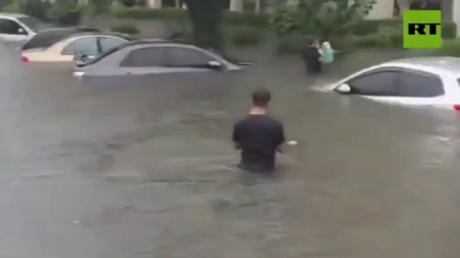
Headline tickers flash brief numbers across international screens. Two dead. A dozen injured. Flights delayed at major hubs while tourists wade through waist-deep water carrying luggage overhead. The footage loops endlessly on social media platforms, capturing momentary panic before the news cycle shifts toward the next global catastrophe. That superficial snapshot completely misses the structural violence unfolding across Southeast Asia. Thailand does not suffer from random acts of meteorological cruelty. It suffers from decades of systematic developmental blindness, municipal hubris, and a political apparatus that treats predictable environmental collapse as an annual inconvenience rather than an existential emergency.
The Architecture of Disaster
Water obeys physics, not political election cycles. The Chao Phraya River basin acts as a giant natural funnel, historically designed to flood during the monsoon months. Floodplains once absorbed millions of cubic meters of overflow, buffering the central plains and protecting coastal settlements. Decades of unbridled real estate speculation and industrial park expansion transformed those natural sponges into concrete fortresses. Developers paved over wetlands, filled vital retention ponds, and built luxury housing estates directly across historical water pathways. When the sky opens up, the water demands its ancient territory back. Concrete offers no resistance to hydrostatic pressure. It merely redirects the catastrophe into working-class neighborhoods and rural farming communities that lack the drainage infrastructure of affluent commercial districts. Learn more on a connected subject: this related article.
Historically, the central plains of Thailand functioned as a massive inland delta where seasonal inundations were not merely tolerated, but integrated into agricultural cycles. Rice paddies thrived on the annual replenishment of nutrient-rich silt carried down from northern watersheds. Modern urban planning discarded this ecological wisdom in favor of Western-style dry-land expansion. Embankments were thrown up, wetlands were drained for condominium construction, and natural water retention basins were converted into industrial estates. When the inevitable monsoon downpours arrive, the water finds its historic escape routes blocked by thousands of tons of steel and asphalt. The resulting floods are not acts of God. They are the mathematical certainty of hydraulic displacement.
Concrete Over Canals
Bangkok remains the prime exhibit of this engineering hubris. Built on a swampy delta barely elevated above sea level, the capital city is simultaneously sinking under the weight of excessive groundwater extraction and rising sea levels driven by global climate shifts. Massive drainage tunnels and high-capacity pumps were heralded as permanent solutions following catastrophic inundations more than a decade ago. Those systems fail under extreme downpours because urban density outpaced municipal capacity long ago. When three hundred millimeters of rain dump onto asphalt within seventy-two hours, the drainage channels simply back up. Canals clogged with construction debris and domestic waste turn into stagnant pools of contamination. Water rises not because humanity lacked warning, but because municipal planners prioritized short-term property valuation over hydrological survival. More analysis by The Guardian explores related perspectives on this issue.
The urban fabric of the capital functions as an intricate maze of blocked arterial waterways. Canals, historically known locally as khlongs, once served as functional drainage arteries and transportation routes. Over generations, municipal authorities allowed these waterways to be narrowed, bridged, and choked by informal settlements and high-rise developments alike. Concrete walls were erected right up to the water's edge to maximize rentable square footage, robbing rivers of their natural banks. Without lateral space to expand, any sudden surge in volume instantly spills over curbs and invades subterranean transit stations, parking garages, and ground-floor commercial spaces.
Furthermore, municipal authorities rely heavily on mechanical pumping stations to push stormwater out to sea against the opposing tide of the Gulf of Thailand. When high astronomical tides coincide with torrential monsoon rains, gravity-fed drainage becomes mathematically impossible. The pumps struggle against an insurmountable hydraulic head, causing water to back up through municipal sewer grates and flood street level from below even before rain finishes falling from above. This dual-threat mechanism renders conventional urban drainage engineering obsolete in low-lying delta cities.
The Rural Blind Spot
Move beyond the glittering skyscrapers of the capital, and the crisis deepens into agrarian devastation. Southern provinces face dual threats from torrential downpours and sudden flash floods cascading down deforested hillsides. Rubber plantations and shrimp farms, vital pillars of the regional export economy, absorb billions in losses when torrential rains sweep through rural districts. Floodwaters destroy crops weeks before harvest, driving debt spirals among smallholder farmers who have no financial safety net. Compounding the physical destruction is a silent public health crisis. Stagnant floodwaters mix with agricultural runoff and sewage, creating ideal breeding grounds for disease-bearing mosquitoes. Outbreaks of dengue fever spike relentlessly in waterlogged districts, while leptospirosis claims lives among those forced to wade through contaminated filth to salvage their belongings. The human cost extends far beyond immediate drowning statistics. It lingers in chronic illnesses, ruined livelihoods, and generational poverty triggered by a single monsoon season.
Agricultural vulnerability exposes the deep disconnect between national economic planning and environmental reality. Thailand positions itself as a major global food exporter, yet rural drainage systems receive a fraction of the capital poured into urban flood defenses. When heavy rains sweep across southern rubber-producing provinces, smallholders watch their tapping panels submerge and their trees rot in waterlogged soil. Insurance penetration among rural farmers remains abysmally low, leaving victims entirely dependent on state compensation schemes that take months to disburse and rarely cover replacement costs for damaged equipment or lost income. Smallholders caught in these recurring cycles find themselves trapped in predatory loans with local agricultural cooperatives or informal lenders, selling off land parcels just to survive the immediate aftermath of a flood.
Bureaucratic Paralysis at the Sluice Gates
Fixing this systemic failure requires an ideological overhaul that successive administrations consistently refuse to undertake. Bureaucratic silos paralyze emergency response and infrastructure upgrades. The Department of Disaster Prevention and Mitigation issues urgent alerts, while municipal authorities argue over budget allocations for dredging canals and upgrading regional pumping stations. Emergency relief packages arrive as temporary handouts rather than structural investments. Politicians prefer distributing food packets and plastic basins in front of television cameras because visible charity yields immediate electoral dividends. Constructing underground retention basins, restoring natural floodways, and enforcing strict zoning laws on wetland development do not win votes before the next parliamentary cycle.
Institutional fragmentation exacerbates every crisis. Responsibility for water management is fractured across multiple ministries, departments, and local administrative organizations, creating a bureaucratic labyrinth where accountability disappears. The Royal Irrigation Department manages major rivers, Bangkok Metropolitan Administration controls municipal canals, and the Ministry of Interior oversees provincial disaster response. During peak flood emergencies, these entities frequently issue contradictory directives regarding when to open or close specific sluice gates. Water channeled away from one municipality to protect commercial real estate frequently floods an adjoining agricultural district, sparking fierce inter-provincial disputes and midnight raids by desperate villagers dismantling government dikes to save their own homes.
State responses often rely on reactive militarized logistics rather than preventive engineering. When floodwaters breach dykes, the government mobilizes military trucks and engineering battalions to distribute bottled water and set up temporary shelters. While essential for immediate life preservation, this emergency theater distracts from the institutional refusal to address root causes. Billions of baht flow into short-term dredging contracts awarded to politically connected contractors without requiring measurable long-term hydrological improvements.
The Cost of Inaction
Land use policy remains the battleground where environmental science loses to commercial interests. Industrial estates enjoy preferential drainage protection, diverting floodwaters away from factories and into surrounding residential villages. This discriminatory water management exposes deep socioeconomic divides in Thai society. Wealthy residents retreat behind gated communities equipped with private flood barriers and industrial pumps, while poorer communities bear the brunt of the displaced volume. When public infrastructure protects private corporate assets at the expense of human safety, the disaster ceases to be natural. It becomes entirely man-made.
Climate projections indicate that extreme weather events will only intensify in frequency and volume over the coming decades. Sea-level rise threatens coastal regions and low-lying delta cities with permanent inundation unless radical adaptation measures are implemented immediately. Merely installing temporary pumps and waiting for the water to recede is no longer a viable governance strategy. The country requires a total reassessment of urban planning principles, treating water not as an enemy to be blocked by concrete walls, but as a dynamic urban design partner that must be accommodated within spatial frameworks. Until policymakers muster the political courage to confront developers, dismantle bureaucratic corruption, and prioritize ecological restoration over endless concrete expansion, the annual ritual of drowning will continue unabated. The cameras will eventually pack up and leave. The floodwaters will remain.
Visual documentation of these events underscores the immediate disruption, such as in this footage showing how flash floods disrupt local communities and force emergency relocations. This video is relevant because it captures the visceral impact and rapid escalation of floodwaters during recent monsoon surges in Thailand.


