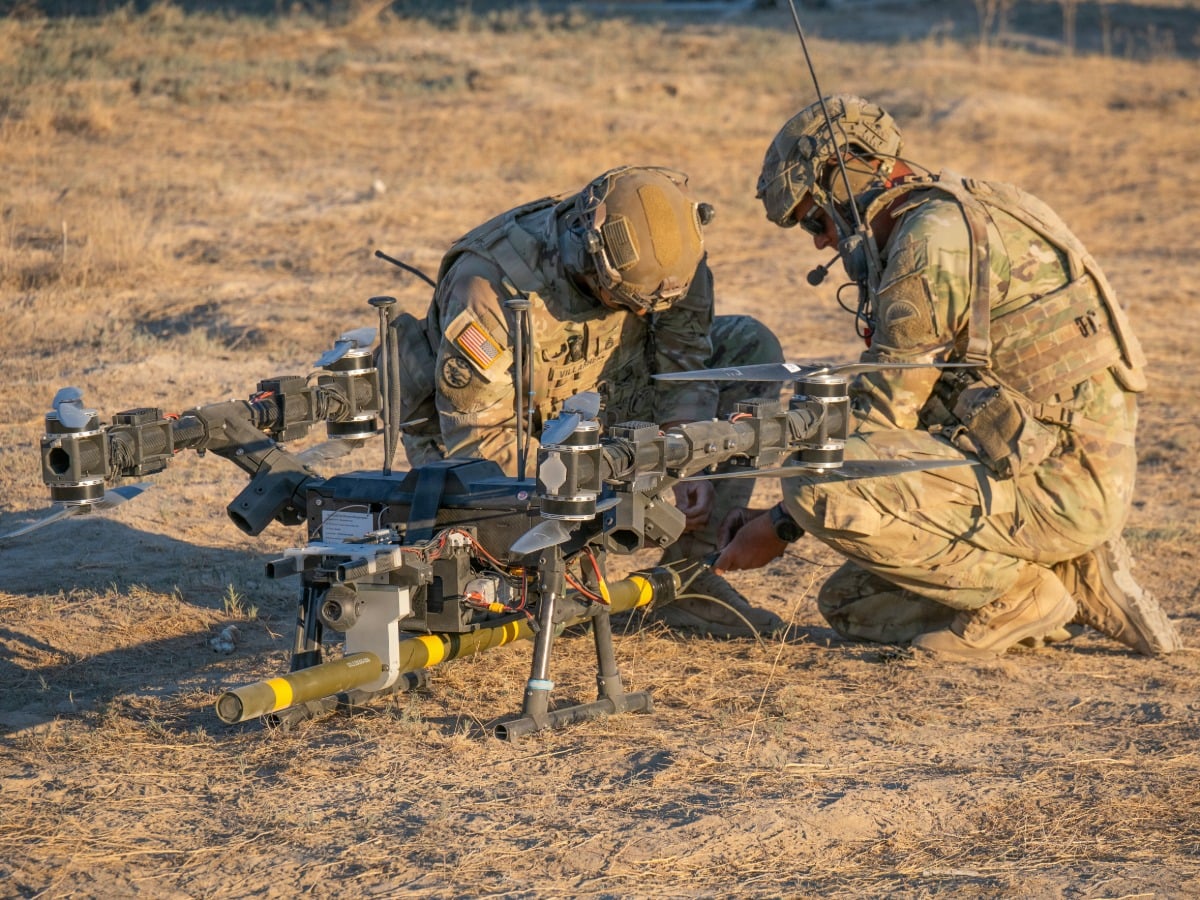
The defense tech community is swooning over a new press release detailing how U.S. Army engineers are testing specialized drones to breach razor wire obstacles. The narrative is comforting, clean, and entirely detached from the realities of mechanized breaching.
The promise is alluring. A soldier sits behind a screen safely defilade, flips a switch, and a quadcopter flies out to drop a tiny explosive charge or a mechanical cutter onto a coil of Triple-Strand Concertina Wire. The obstacle disappears. The infantry advances. No blood spilled.
It is a fantasy.
In reality, using quadcopters to breach wire obstacles on a modern battlefield is a fundamentally flawed concept that misunderstands both the physics of razor wire and the geometry of a combined-arms breakthrough. Having evaluated battlefield obstacle clearance systems for over a decade, I can tell you exactly how this plays out in a high-intensity conflict: the drone gets jammed, shot down by passive electronic warfare, or its tiny explosive charge snaps two strands of wire while leaving the remaining five thousand strands completely intact.
We are throwing millions of dollars at an engineering gimmick because the military procurement apparatus would rather buy an expensive, fragile toy than face the brutal, low-tech reality of the modern breach.
The Flawed Premise of the "Precision Breach"
The conventional wisdom driving these drone tests rests on a lazy assumption: that a wire obstacle is a discrete target you can cut with a scalpel.
It is not. Concertina wire is an apex predator of military engineering precisely because it is cheap, heavy, and structurally redundant. It does not exist in isolation. It is laid out in vast, overlapping belts—often three tiers deep, staked firmly into the ground, and deliberately woven into local terrain features like ditches, tree lines, and anti-tank trenches.
To clear a path wide enough for an M2 Bradley or an M1A2 Abrams main battle tank to pass through, you need a lane at least 4 to 4.5 meters wide. To clear that space with a drone, you would need to execute dozens of pinpoint, consecutive cutting operations while under active artillery and direct machine-gun fire.
Let us look at the raw mechanics of concertina wire. It is constructed from high-tensile spring steel core wire wrapped in razor-sharp barbs. When you clip one strand, the high-tensile nature of the coil does not cause the entire obstacle to unravel like a knitted sweater. It snaps back slightly but retains its overall mass and entanglement profile. If a drone drops a specialized explosive strip or a mechanical cutter, it severs a micro-section. The physical bulk of the wire obstacle remains an impassable tangle for tracks, wheels, and combat boots.
The Math of the Obstacle Belt
To understand why this approach fails, you have to look at how engineers actually build an engagement area. A standard tactical wire obstacle is not a single fence. It is a system designed to channelize forces into pre-registered kill zones.
Imagine a standard operational scenario: an assault element encounters a standard Triple-Strand Concertina obstacle.
- Top Coil: 1 roll of 36-inch diameter wire.
- Base Coils: 2 rolls of 36-inch diameter wire anchored by pickets spaced every 3 meters.
- Total Depth: Approximately 2 to 3 meters of interlocking metal teeth.
To clear a 4.5-meter gap through just one short 10-meter section of this belt using a precision drone requires removing hundreds of pounds of steel. A quadcopter carrying a two-pound explosive payload or a mechanical snip cannot displace that physical mass. It lacks the kinetic energy.
When combat engineers use traditional methods—like the M1A1 Bangalore Torpedo or an Explosive Obstacle Breaching System—they do not use scalpel cuts. They detonate a continuous line of high explosives (composition B or C4) directly inside the wire. The intense blast overpressure literally vaporizes sections of the wire and physically throws the remaining fragments outward, completely scouring the ground.
A drone cannot carry the weight required to generate that level of displacement. You are bringing a laser pointer to a chainsaw fight.
Electronic Warfare Makes Small Drones Inoperable at the Berm
The biggest blind spot in the drone-breaching narrative is the assumption that the airspace above the obstacle is clear.
If the wars in Eastern Europe over the last few years have taught us anything, it is that the immediate proximity of a defensive line is completely saturated with electronic warfare (EW). The moment a mechanized column approaches a wire obstacle, it enters a localized GPS-denied environment. Radio frequencies are actively jammed by directional counter-UAS systems mounted on armored vehicles or hidden in trenches.
A breaching drone relying on a human pilot's video feed or commercial-grade autonomous optical tracking will lose signal long before it hovers over the wire picket. Even if the drone features expensive, military-grade inertial navigation systems, its sensors are highly vulnerable to the dust, smoke, debris, and obscurant obscuration that naturally occurs during an active breach.
If your breaching plan depends on a 2.4 GHz or 5.8 GHz signal surviving at the absolute tip of the spear during a combined-arms assault, your plan is broken before the first engine starts.
The Brutal Truth of the Combined-Arms Breach
The U.S. Army’s own doctrine (ATP 3-34.22, Engineer Operations) states clearly that breaching must be executed with speed and overwhelming violence. A breach is the most dangerous phase of a deliberate attack. The defending force is watching the obstacle; they have their artillery dialed into the exact coordinates of that wire.
Every second your forces spend stalled in front of that obstacle drastically increases the probability of catastrophic mission failure.
Look at the operational timeline of a drone breach versus a traditional mechanical breach:
| Metric | The Drone Fantasy | The Mechanical Reality (MICLIC / Blade) |
|---|---|---|
| Deployment Time | 5 to 12 minutes (Unpacking, calibration, launch, flight, positioning) | 30 to 60 seconds (Line charge firing or plow deployment) |
| Clearing Width | Inches per deployment | 8 meters wide, 100 meters deep instantly |
| Vulnerability | High (Vulnerable to EW, small arms fire, wind drift) | Low (Executed from behind armored hulls) |
| Mass Displacement | None (Wire remains on ground, severed but tangled) | Complete (Wire is blown apart or physically plowed away) |
A drone breach requires an assault element to sit in their vehicles, exposed, while a remote operator maneuvers a fragile aircraft into position. It is an invitation for enemy forward observers to rain 152mm or 155mm artillery shells directly onto your head.
In contrast, an M1150 Assault Breaching Vehicle (ABV) rolls up at 30 miles per hour, fires an M58 MICLIC (Mine Clearing Line Charge) rocket packing 1,750 pounds of C4, detonates it across the entire depth of the minefield and wire belt, and drops a massive combat plow to push the debris aside. The entire operation takes less than two minutes, and the crew never exposes a single limb to small arms fire.
Why We Keep Funding the Wrong Solutions
If the flaws are this glaring, why are military research labs and defense contractors spending millions to develop breaching drones?
Because it scales well in a slide deck. It satisfies the current institutional obsession with automation and artificial intelligence. It looks impressive in a sterile testing environment at a home station where there are no jamming pods, no smoke screens, no shrapnel tearing through composite rotors, and no artillery craters.
It is far easier to secure funding for an "autonomous robotic breaching platform" than it is to buy more heavy, fuel-guzzling, maintenance-intensive armored vehicles like the ABV. But when the shooting starts, you cannot replace steel and high explosives with software code and carbon fiber.
The drone has revolutionized modern warfare in terms of reconnaissance, artillery spotting, and long-range precision loitering munitions. But it cannot bypass the immutable laws of physics. Clearing heavy physical obstacles requires heavy physical power.
Stop trying to turn small drones into construction equipment. If you want to breach concertina wire under fire, build more heavily armored engineer vehicles, stock up on linear demolition charges, and train crews to execute mechanical clearance with ruthless, violent speed. Anything less is just a high-tech death sentence for the infantrymen expected to follow a drone into the gap.