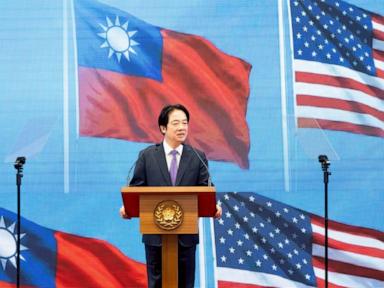
Donald Trump just wrapped up a high-stakes trip to Beijing, and he didn't waste any time shaking up the delicate geopolitical balance. In a Fox News interview with Bret Baier right after his meetings with Chinese President Xi Jinping, Trump openly admitted he's holding back a massive $14 billion arms package for Taiwan. Why? Because he thinks it's a fantastic negotiating tool with China.
"It's a very good negotiating chip for us, frankly," Trump said.
That single phrase sent shockwaves through Taipei. It turns a democratic ally of the US into a mere transaction. Taiwan President Lai Ching-te had to respond quickly to calm his public and assert his country's dignity. On Sunday, Lai released a firm statement reminding everyone that buying weapons from America isn't a game or a favor. It's a legal obligation and the most critical deterrent keeping a massive war from breaking out in East Asia.
Lai did what Taiwanese leaders always have to do when Trump speaks. He smiled, thanked Trump for past weapons approvals—like the $11 billion package signed in December—and then gently corrected the American president on how the law actually works.
The Reality of US Taiwan Policy and Why it Isn't Just up to Trump
Trump likes to view foreign policy through the lens of a real estate deal. You squeeze your opponent, hold back the asset, and get the best price. But you can't treat a self-governing island of 23 million people like a commercial property in Manhattan.
The relationship between Washington and Taipei isn't based on whim. It's based on the Taiwan Relations Act of 1979. This law legally obligates the US government to provide Taiwan with defensive weapons. It's not a personal gift from the White House.
When Trump suggests that a approved or pending $14 billion hardware package "depends on China," he plays into Taipei's absolute worst nightmare. Geopolitical analysts call it the "on the menu" scenario. Instead of sitting at the negotiating table, Taiwan fears it'll be served up as the main course to satisfy Beijing.
China claims Taiwan as its own territory and has never ruled out taking it by force. Xi Jinping allegedly told Trump during their recent talks that Taiwan remains the absolute "first red line" that cannot be crossed. Xi even warned of direct clashes if the US mishandles the situation. By dangling weapons sales as a trade chip, Trump inadvertently signals to Beijing that American security commitments have a price tag.
What's Packed into the Frozen Military Deals
The money isn't just a abstract figure. We're talking about heavy, modern hardware that Taiwan desperately needs to keep China's People's Liberation Army at bay.
The record-breaking $11 billion deal Trump signed off on in December included drones, mobile artillery, advanced missile systems, and critical battlefield software. The newer $14 billion package currently sitting in limbo is aimed at further upgrading Taiwan's asymmetric warfare capabilities. Think mobile anti-ship missiles, sea mines, and smart tech meant to make an invasion far too costly for Xi Jinping to attempt.
Every month these systems are delayed is a month Taiwan loses in its race to modernize its defense forces.
Why Treating Microchips and Missiles as Trade Bait is Dangerous
Trump also used his interview to repeat an old grievance. He complained that Taiwan "stole" the semiconductor industry from the US decades ago. He openly stated he wants Taiwanese chipmakers to pack up and move all production to the US mainland.
This line of thinking misses a massive economic reality. Taiwan didn't steal anything. Companies like TSMC built a hyper-efficient ecosystem over forty years through sheer engineering brilliance and massive capital investment. Today, Taiwan manufactures over 90% of the world's advanced microchips. These chips power everything from the smartphone in your pocket to military fighter jets and artificial intelligence systems.
If the US pauses arms sales to pressure Taiwan or trade with China, it directly endangers the global supply chain. A conflict in the Taiwan Strait would instantly halt global tech manufacturing. It would trigger an economic depression that would make the 2020 supply shocks look like a minor inconvenience.
US Trade Representative Jamieson Greer tried to smooth things over on Sunday. He told reporters that American security needs always come first when a president makes these calls. But treating Taiwan's defense as a transactional item actually weakens American security by creating deep instability in the Pacific.
Congress Backs Taipei While the White House Hesitates
The good news for Taiwan is that the American system has checks and balances. Trump might hold the pen on foreign policy execution, but Congress controls the purse strings and sets the legal framework.
U.S. House Speaker Mike Johnson quickly jumped in to defend Lai Ching-te's response, calling the Taiwanese president's defense of the arms purchases entirely reasonable. Johnson made it clear that Congress intends to stand resolute. "China cannot just go take over land," Johnson stated, signaling that any attempt by the White House to permanently ditch Taiwan for a trade deal with Xi would face intense bipartisan pushback on Capitol Hill.
Lai's stance is clear. Taiwan will not provoke a war, but it will also not surrender its democratic way of life under pressure from Beijing or shifting rhetoric from Washington.
If you want to track how this geopolitical chess match unfolds, you need to look past the loud television interviews and watch the actual delivery schedules. Keep a close eye on whether Congress pushes to bypass White House delays on the $14 billion package. Watch how TSMC handles pressure to build more factories in the US state of Arizona. The true health of the US-Taiwan alliance will be measured in concrete shipments of defense hardware and silicon wafers, not the shifting language of a presidential art of the deal.