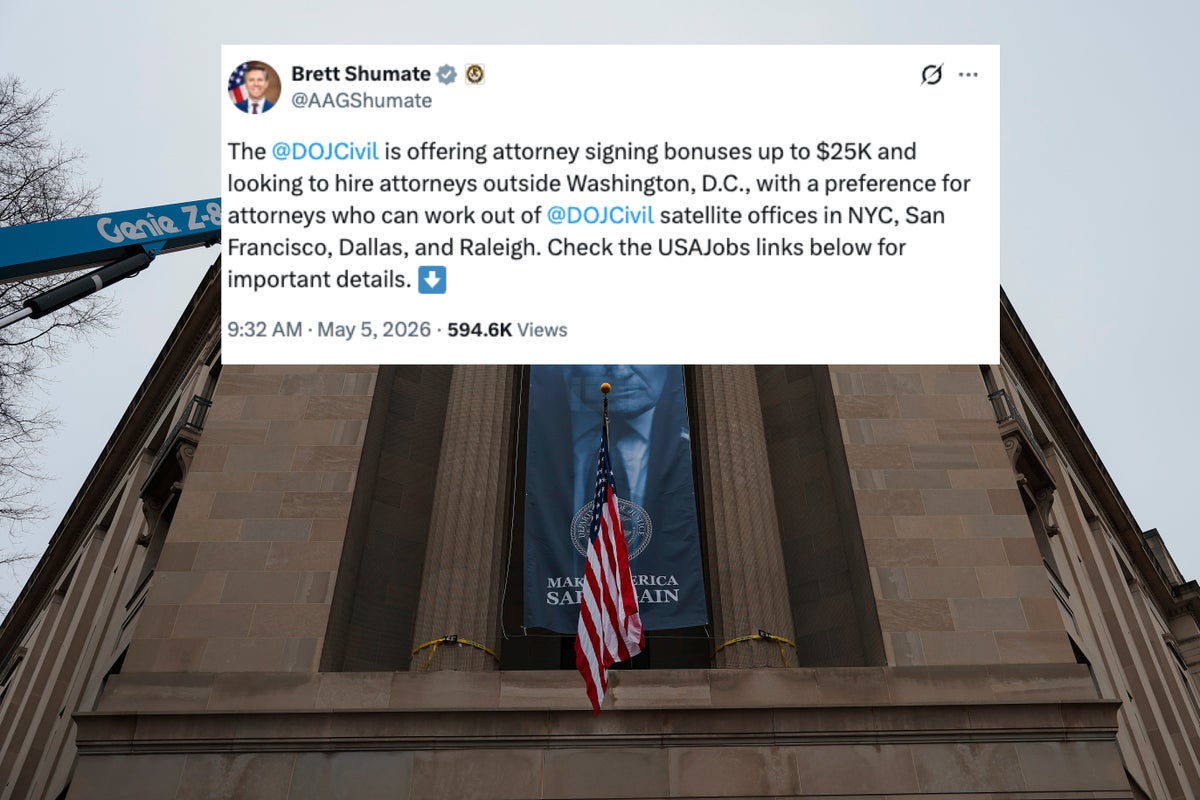
The Department of Justice (DOJ) faces a structural labor shortage that cannot be mitigated by traditional government recruitment cycles. When a federal agency is forced to implement aggressive signing bonuses to attract mid-level and senior legal talent, it signals a breakdown in the non-monetary value proposition that typically sustains public sector excellence. In the legal labor market, attorney movement is dictated by a specific risk-reward calculus: the prestige of government service weighed against the opportunity cost of private practice and the potential for "revolving door" career impairment. The current reliance on financial incentives reveals a critical deficit in "reputation equity," creating a high-friction environment for the administration's legal agenda.
The Tri-Partite Friction Model of Federal Recruitment
The inability to fill career and political slots within the DOJ stems from three distinct categories of resistance. Understanding these mechanics explains why a simple cash infusion via signing bonuses often fails to secure the highest-tier talent.
1. The Exit Value Discount
Attorneys generally view a stint at the DOJ as a value-add for their long-term career trajectory. Under normal market conditions, the lower salary of a government lawyer is subsidized by the "exit value"—the ability to command a massive salary at a white-shoe law firm after leaving government. If the legal community perceives an administration’s legal theories as fringe or likely to be overturned, the exit value drops. Firms may view prospective hires not as seasoned litigators, but as liabilities who could alienate corporate clients or bring unwanted scrutiny. When the exit value is discounted, the DOJ must bridge that financial gap in real-time through bonuses.
2. Operational Risk and Personal Liability
Legal professionals are risk-averse by training. The prospect of working on high-stakes, politically charged litigation introduces a layer of professional risk that standard government roles do not carry. This includes the potential for bar complaints, congressional investigations, or being forced to sign off on briefs that conflict with established precedent. This "liability premium" drives up the cost of labor. Attorneys who are willing to accept these risks are often those with the least to lose, creating a selection bias toward less-experienced or more ideologically extreme candidates, which further degrades the agency’s technical output.
3. The Specialized Talent Bottleneck
The DOJ does not just need "lawyers"; it needs specialists in antitrust, civil rights, and constitutional law. These specialists have high mobility in the private sector. Unlike generalists, their skills are in constant demand regardless of the economic cycle. To lure an expert in a niche field away from a $500,000-a-year partner track, a $50,000 signing bonus is mathematically insufficient. The use of these bonuses suggests the agency is targeting the lower-to-mid-tier associate pool rather than the senior-level architects required to lead complex divisions.
The Cost Function of Political Polarization in Civil Service
The introduction of signing bonuses alters the internal compensation structure of the federal government, creating a "two-tier" system that can erode morale among long-tenured career staff. The financial cost of recruitment is merely the surface metric; the deeper cost is found in the inefficiency of the resulting work product.
Skill-Gap Inefficiencies
When an agency cannot attract top-tier talent, it experiences a higher rate of procedural errors. In the context of federal litigation, a single missed filing deadline or a poorly researched brief can result in a case being dismissed with prejudice. The administration’s "win rate" in federal court serves as the ultimate KPI for its legal recruitment strategy. If the recruitment pool is shallow, the DOJ is forced to rely on "acting" officials or overextended political appointees, leading to a bottleneck where decisions are delayed and legal strategies are uncoordinated.
The Recruitment-Retention Feedback Loop
Signing bonuses are a front-loaded expense that does nothing to solve the problem of retention. If the underlying work environment is hostile or the legal mission is viewed as unstable, the turnover rate will remain high. This creates a continuous cycle of recruitment costs. Each time a senior attorney leaves, they take institutional knowledge with them. Replacing that knowledge takes months, if not years, meaning the agency is constantly operating at 60-70% efficiency while paying 110% of the standard labor cost.
Quantifying the Market Misalignment
To understand why the DOJ is struggling, one must look at the "Big Law" salary scale as the primary competitor. Starting salaries at top firms in 2024 and 2025 have pushed toward $225,000 for first-year associates, with bonuses reaching $100,000+ for senior associates.
The federal General Schedule (GS) pay scale, even with locality pay in Washington D.C., caps out far below this. Historically, the DOJ bridged this gap using the "Prestige Premium."
The Erosion of the Prestige Premium
The Prestige Premium is a function of the agency's perceived independence and the gravity of the cases it handles. When the DOJ is perceived as an extension of a specific political campaign rather than an independent arbiter of law, the premium evaporates.
- Neutrality Risk: Non-partisan career attorneys may avoid the agency to protect their reputation for objectivity.
- Litigation Quality: Top-tier law clerks from elite universities—the traditional feeder for the DOJ—may self-select into the private sector or the judiciary to avoid political volatility.
This leaves the DOJ in a "Market Trap" where it is paying more for lower-quality labor. The signing bonus is a desperate attempt to use a private-sector tool in a public-sector environment where the financial incentives will never truly be competitive.
Structural Constraints on Bonus Efficacy
The federal government operates under strict budgetary and statutory constraints that prevent it from being truly agile in the labor market.
- Cap on Total Compensation: Federal law limits the total amount an employee can receive in a calendar year. High signing bonuses may inadvertently push an employee to their pay cap, effectively meaning they are working for "free" in the final months of the year, which triggers early departures.
- Oversight and Auditing: Every bonus paid by the DOJ is subject to OPM (Office of Personnel Management) guidelines and potentially GAO (Government Accountability Office) audits. The administrative burden of justifying these bonuses adds another layer of cost and delay to the hiring process.
- The "Mercenary" Problem: Heavy reliance on financial incentives attracts candidates motivated by short-term gain rather than long-term mission alignment. This creates a workforce that is less resilient to the pressures of high-stakes government work.
The Litigation Bottleneck: A Forecasting Model
The impact of a depleted DOJ talent pool is most visible in the failure of complex regulatory and enforcement actions. If the agency cannot staff its specialized divisions, the following outcomes become predictable:
- Reduced Enforcement Velocity: Fewer investigations are launched because there are not enough attorneys to review evidence and draft complaints.
- Settlement Pressure: The government may be forced to settle cases on unfavorable terms because it lacks the bench strength to go to trial against well-funded corporate defendants.
- Judicial Pushback: Federal judges are increasingly sensitive to the quality of the arguments presented before them. If DOJ briefs are consistently poor, the courts are more likely to issue nationwide injunctions against administration policies.
The reliance on signing bonuses is a lagging indicator of a systemic failure in the government’s ability to sell its mission to the legal elite. It suggests that the "intrinsic rewards" of the job have become negative, requiring a cash offset just to reach a baseline of staffing.
The strategic play for any administration facing this crisis is not to increase the bonus pool, but to de-risk the roles. This requires a visible commitment to procedural norms and the insulation of career staff from political fallout. Without restoring the "Prestige Premium," the DOJ will continue to overpay for a workforce that is fundamentally unequipped to handle the complexities of federal law in a polarized era. The agency is effectively trying to buy stability in a market that currently values its brand at a steep discount.