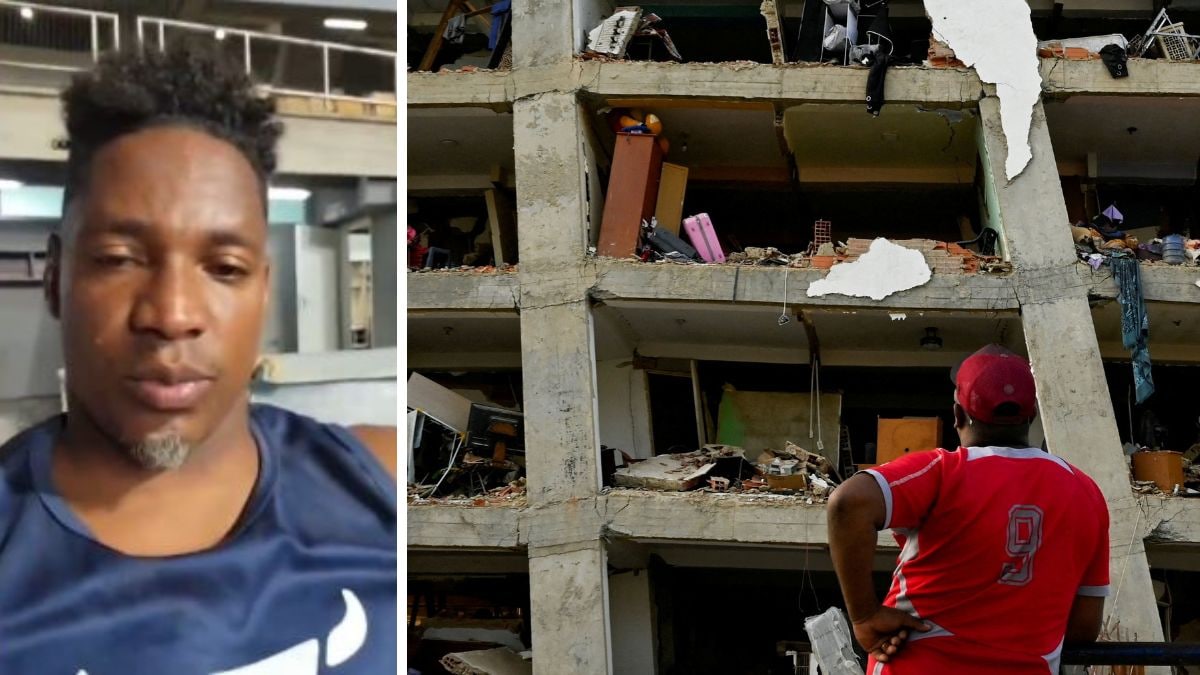
When the earth ripped open in Venezuela, the global media did exactly what it always does: it ignored the architectural autopsy and looked for a saint.
They found one in former New York Mets reliever Jenrry Mejia. The narrative was instantly minted for maximum clicks. Mejia, currently pitching in the Venezuelan summer league, was returning to his hotel room in La Guaira after a gym session. He stepped into the elevator, pressed the button for the sixth floor, but a mechanical glitch overrode his command. The elevator dropped him in the lobby instead. Forty seconds later, the building pancaked into a mountain of concrete dust.
Mejia called it "divine intervention". The media called it a miracle.
I call it a terrifying indictment of how we completely misunderstand risk, infrastructure, and human survival.
Every major outlet ran the same lazy, sensationalist script. They fixated on the 40-second window, the rogue elevator car, and the providential malfunction. But by transforming a catastrophic engineering failure into a theological lucky streak, we are completely missing the point. Surviving an earthquake shouldn’t require a software bug in an elevator. Celebrating a "miracle" inside a collapsed building is just a convenient way to avoid asking why the building collapsed in the first place.
The Structural Amnesia of Sports Journalism
Sports reporting suffers from a chronic case of main-character syndrome. When a 7.2 magnitude earthquake hits a nation, the immediate instinct of western media is to find a guy who used to wear a big-league uniform and filter a national tragedy through his personal survival arc.
Imagine a scenario where we analyzed plane crashes this way. If a commercial airliner falls out of the sky due to systematic maintenance neglect, we do not spend three days interviewing the one passenger who missed the flight because they overslept. We investigate the airline, the regulators, and the fuselage.
Yet, when it comes to infrastructure collapses in developing sports landscapes, the world shrugs and chalks it up to fate.
The real story isn't that Mejia’s elevator went down instead of up. The real story is that a major hotel housing professional athletes and their families was built like a house of cards. La Guaira is a high-risk seismic zone. The back-to-back quakes that hit northwest Venezuela were massive, yes, but seismic engineering exists precisely so that a 7.5 magnitude tremor doesn’t automatically equate to a death sentence.
I have seen leagues and sports franchises pour millions into player payrolls while housing those same multi-million-dollar assets in structural death traps. We obsess over modern training facilities, sports science, and high-tech recovery pods, but the literal foundation under the players' feet is treated as an afterthought.
The Survival Math We Get Backwards
Let's dismantle the basic physics of the "miracle elevator ride." In standard seismic safety protocols—the kind codified by institutions like the American Society of Civil Engineers (ASCE) or the International Code Council—an elevator during an earthquake is a steel coffin.
The conventional wisdom dictates that when seismic waves hit, you do not get into an elevator. Cables snap. Counterweights break free from their guide rails and transform into vertical wrecking balls. The fact that Mejia survived by riding a malfunctioning lift to the basement is an anomaly of the highest order.
| Factor | Popular Narrative | Structural Reality |
|---|---|---|
| The Elevator | A divine vehicle of salvation | A catastrophic mechanical hazard during seismic activity |
| The Building Collapse | An act of God or unpredictable nature | A failure of building code enforcement and structural integrity |
| The Survival Strategy | Relying on luck, intuition, or a glitch | Rigorous compliance with seismic engineering standards |
By framing this as a supernatural intervention, the media establishes a dangerous precedent. It tells the public that survival is a lottery ticket distributed by the cosmos, rather than a measurable outcome of strict building codes, ductile concrete detailing, and proper foundation engineering.
When you look at the destruction in La Guaira, you aren't looking at the wrath of nature. You are looking at the direct consequence of economic strain, lax enforcement, and political isolation that has starved Venezuelan infrastructure of modern engineering upgrades for a generation. A building should be designed to deform, bend, and absorb seismic energy without shedding its vertical load-bearing capacity. When it collapses into flat layers within forty seconds, it is a crime of construction, not a spiritual event.
Redefining the Real Threat to Athletes Abroad
For years, the discourse around Western athletes playing in winter and summer leagues across Latin America has focused almost exclusively on personal security—kidnappings, street crime, and political unrest. The standard advice from sports agencies to players heading to countries like Venezuela or the Dominican Republic is usually: hire security, stay in designated areas, don't flash money.
That advice is completely blind to the actual statistical risks.
The biggest threat to a ballplayer working abroad isn't a guy with a gun in the street; it is the concrete slab above his head while he sleeps. We are sending elite athletes into regions where infrastructure development has bypassed basic safety compliance. The professional sports apparatus—agents, team owners, and league executives—needs to stop looking at hotel accommodations through the lens of luxury and start looking at them through the lens of structural forensics.
If a league cannot guarantee that its host hotels can withstand a standard regional tremor, then the league shouldn't be operating there. It is that simple. The downsides to this approach are obvious: it limits economic opportunities for local leagues, it reduces the footprint of international sports development, and it forces hard conversations about regional poverty and development. But the alternative is waiting for the next hotel to collapse and hoping another player gets a lucky elevator ride.
Stop praising the miracle. Start auditing the concrete.